
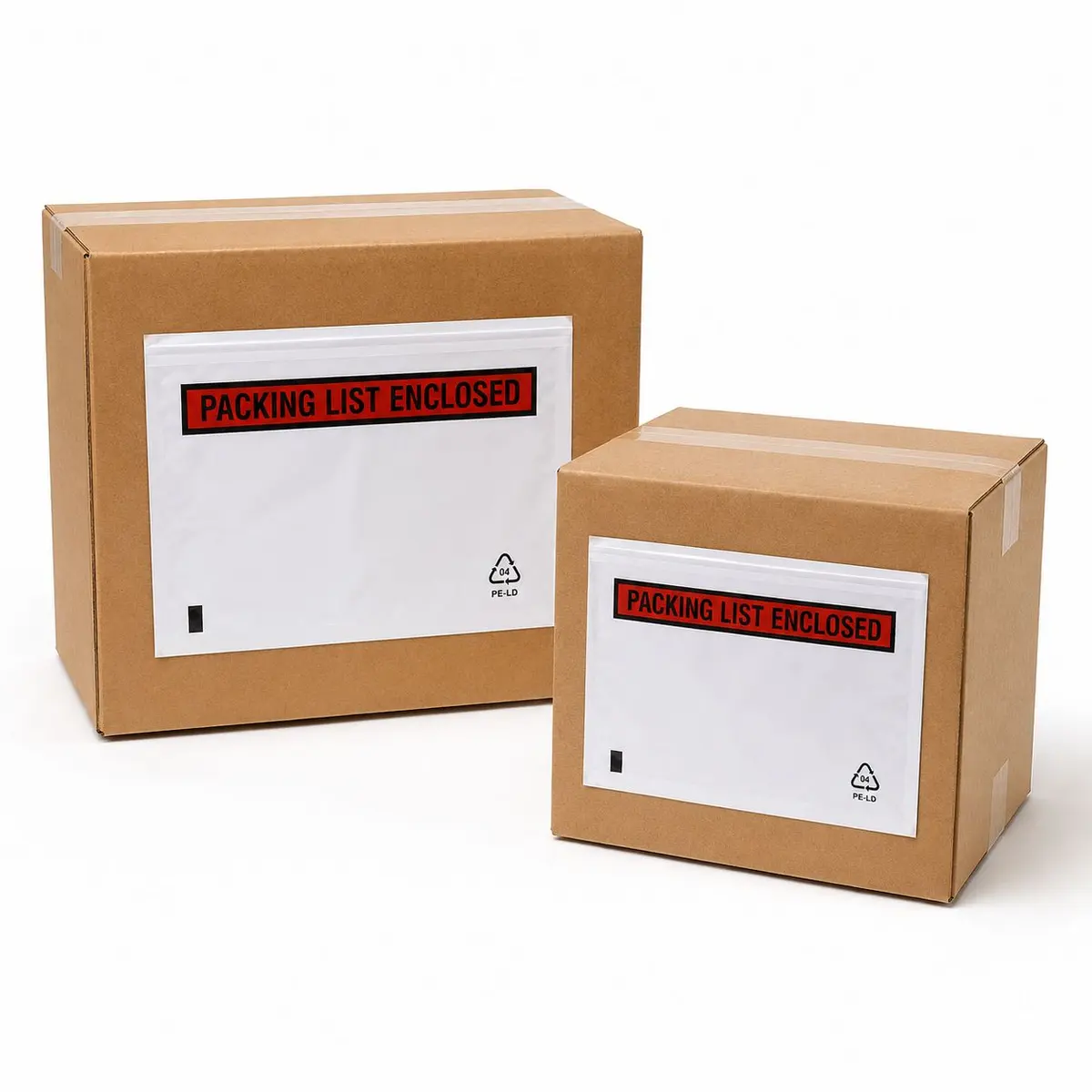
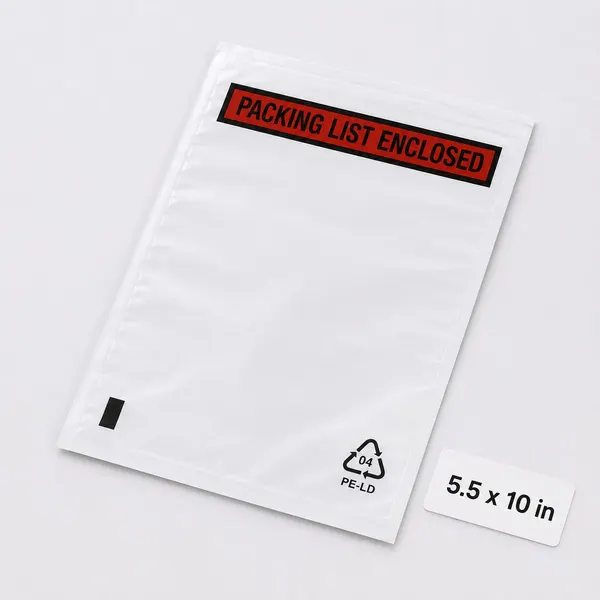
5.5 x 10 Packing List Envelopes: When the Long Format Wins
Most packing list pouches are square-ish. That works until the slip runs to 30 lines, or the carton is tall and thin.
This is where the 5.5 x 10 packing list envelope earns its place.
Below I explain when the long format is the better choice, how it compares with A5 and 6x9, and what I would check before you order. We make all of these sizes, so I have no reason to push one over another.
What is a 5.5 x 10 packing list envelope?
It is a long, narrow self-adhesive pouch that sticks to the outside of a carton and holds the shipment’s paperwork. That means packing slips, invoices, manifests, warranty cards and export documents.
Its shape is the whole point.
It is about half the width of a sheet of paper but a full 10 inches long, so it takes documents that a compact pouch cannot and still fits on a narrow panel.
Most versions load from the side, with the opening along the long edge. The front usually carries a printed panel such as Packing List Enclosed, Documents Enclosed or Export Documents Enclosed.
For the full family of formats, see our guide to packing list envelope sizes.
When should you use the long 5.5 x 10 format?
Choose 5.5 x 10 when the document is long or the carton face is narrow. It solves three problems well.
- Long itemised lists. A parts list, kit manifest or multi-SKU slip stays flat instead of being folded into a thick wad.
- Multi-line invoices and export sets. Commercial invoices, packing declarations and certificates often fill a full page. Folded once, they slide neatly into the long pocket.
- Slim carton faces. Tall boxes, tube cartons, profile and extrusion packs rarely have room for a 6x9. A long pouch fits the strip of board that is actually there.
It is also a good pick when paperwork must stay readable for inspectors without covering half the box.
How does 5.5 x 10 compare to A5 and 6x9?
The trade-off is length against width. A5 and 6x9 lean towards a portrait rectangle, while 5.5 x 10 is a long strip. Match the pouch to the document and the carton, not to habit.
| Pouch size (approx.) | Shape | Best use |
|---|---|---|
| 4.5 x 5.5 | Compact square | Short single-page slips, small parcels, labels |
| A5 (5.8 x 8.3) | Portrait | Unfolded A5 documents, standard slips on medium cartons |
| 6 x 9 | Portrait or booklet | Folded A4 or Letter, general paperwork |
| 5.5 x 10 | Long strip | Long itemised lists, multi-line invoices, slim carton faces, export sets |
| 6.5 x 10 | Wide and long | Thicker document sets that need extra width |
Here is the rule of the trade I would follow. If the document is wide and short, go for 6x9 or A5. If it is long, runs to many lines, or is going on a narrow panel, the 5.5x10 packing slip envelope fits better.
Now the honest downside. The long format has less width, so a thick bundle of papers can make it bulge. For a heavy document set, I would rather you buy a wider pouch from us.
That is the catch.
Inside or outside size: what should you confirm?
Confirm the inside size, because the number on the pack is usually the outside. This is the most common ordering mistake with this format. The seal and the lip take a small margin, so a document cut to exactly 5.5 x 10 will not go in.
Before you commit, check four things.
- Measure your document, flat or folded, and leave some clearance.
- Check the loading edge. Side-loading suits the long format best.
- Pick the film gauge for your route. Heavier film is better for export and rough handling.
- Decide the printed panel and its language, so an inspector reads it in a second.
I have not listed fixed specs or prices here. The right film, print and inside size depend on your document, your carton and where it is going, and we would rather size it with you than guess.
If you want your own wording or logo on the pouch, our custom print page shows what is possible.
Why does the pouch matter so much on export shipments?
On an export shipment, the pouch is protecting the documents that clear your goods. A commercial invoice that smudges, tears or falls off can hold a consignment at inspection for days.
Think of it like a school bag in the monsoon. The books inside matter more than the bag, but a cheap bag ruins the books.
The long format keeps multi-line paperwork flat, sealed and readable through moisture, dust and repeated handling.
This is why it is often chosen for Export Documents Enclosed duty.
We have made packaging in Jaipur since 1997 and export to 20+ countries, with ISO 9001, CE and RoHS in place. Document-enclosed wallets have been a long-running export product for us, and we offer options for film thickness, adhesive, colour and print. You can see the range on our products page.
Not sure if 5.5 x 10 or 6x9 suits your paperwork? Send us your document size and what you ship, and we will send samples of both to try.
Frequently asked questions
What are 5.5 x 10 packing list envelopes used for?
They carry long paperwork on a carton: packing slips, multi-line invoices, export sets and itemised parts lists. The long, narrow shape also fits slim carton faces where a square pouch will not sit flat.
Is 5.5 x 10 bigger than an A5 or 6x9 envelope?
It is longer but narrower. A5 (about 5.8 x 8.3 in) and 6x9 are closer to a portrait rectangle, while 5.5 x 10 is a stretched strip. So it holds longer documents, but less width.
Are the 5.5 x 10 dimensions inside or outside measurements?
On most self-adhesive pouches the stated size is the outside dimension. The seal and the lip take a little space, so the usable pocket is slightly smaller. Measure your folded document and confirm the inside size before you order.
Can a 5.5 x 10 envelope hold a folded A4 or Letter packing slip?
Yes. An A4 or Letter sheet folded once fits well, and the long pocket keeps a folded multi-page slip flat against the carton instead of bulging.
Is 5.5 x 10 a side-loading or top-loading pouch?
It is usually side-loading, with the opening on the long edge. That wide opening makes it easy for a packer to slide paperwork in, and for an inspector to take it out and put it back.
Does the long format affect carrier acceptance?
Not usually. The pouch is stuck to the carton, so it travels as part of the parcel and parcel rules apply, not envelope-mail rules. Still, check placement and labelling rules with your carrier.
What film thickness should I choose for export?
For export and rough handling, I would pick a heavier film, because it resists tearing and moisture better on a long route. Tell us your route and conditions through /contact/ and we will suggest a gauge and print option.
Sourcing these in volume?
We make packing list envelopes in Jaipur for importers and distributors. Factory-direct, private label welcome.