
How to Choose the Right Packing List Envelope
Choosing a packing list envelope looks simple. Then you realise one pouch has to please your packers, your couriers, customs officers and the customer who opens the box.
Get it right and the paperwork stays attached, readable and dry from your dock to the destination. Get it wrong and you find out from a complaint.
We have made packaging in Jaipur since 1997 and ship these pouches to 20+ countries. The buyers who get it right usually decide in the same order. I will take you through that order, then give you one table to match a pouch to your shipment.
What decisions go into choosing a packing list envelope?
There are 5 decisions, and they work best in this order.
- Size.
- Loading format.
- Clear or printed face.
- Adhesive.
- Material.
Go from top to bottom, because each choice narrows the next one. Most buyers start with material or price, and that is where they go wrong. A cheap pouch in the wrong size costs more in packer time than it ever saves.
How do I choose the right size?
Pick the smallest pouch that holds your document without forcing it.
Too small, and packers fold the paperwork into a wad that will not lie flat under the window. Too large, and you pay for film and air that you do not use.
Measure your most common document both flat and folded, then match it to a standard size.
- A standard invoice folded in three fits a DL or 4.5 × 5.5 pouch. This is the ecommerce default.
- A flat A5 or half-letter slip fits an A5 or 6 × 9 pouch.
- A flat A4 invoice or a multi-page customs set needs an A4 (or 7 × 10) pouch.
If you ship more than one kind of document, I would standardise on 2 sizes rather than fold everything into 1. It is usually cheaper and tidier. Our packing list envelope size guide has the full chart in millimetres and inches.
Top, side or back loading: which format?
The opening edge decides how fast your team can pack and how secure the document is in transit. Match it to the way you pack.
| Format | Opens on | Best for |
|---|---|---|
| Top-loading | Short top edge | Hand packing stations, taller documents, quick insertion |
| Side-loading | Long edge | Fast lines and applicators, holds the document once sealed |
| Back-loading | Rear overlap flap | Most protection, a clean full-face front, multi-page sets |
For hand packing, top-loading is hard to beat. On a fast line, side-loading wins. Our top-loading vs side-loading guide compares speed, security and retention in more detail.
Should the pouch be clear or printed?
Go clear when someone must read or scan the document through the film. Go printed when you want the parcel to announce that paperwork is inside.
A clear, full-face pouch is transparent across the whole front. It suits an address that doubles as the shipping label, or a barcode that the courier scans.
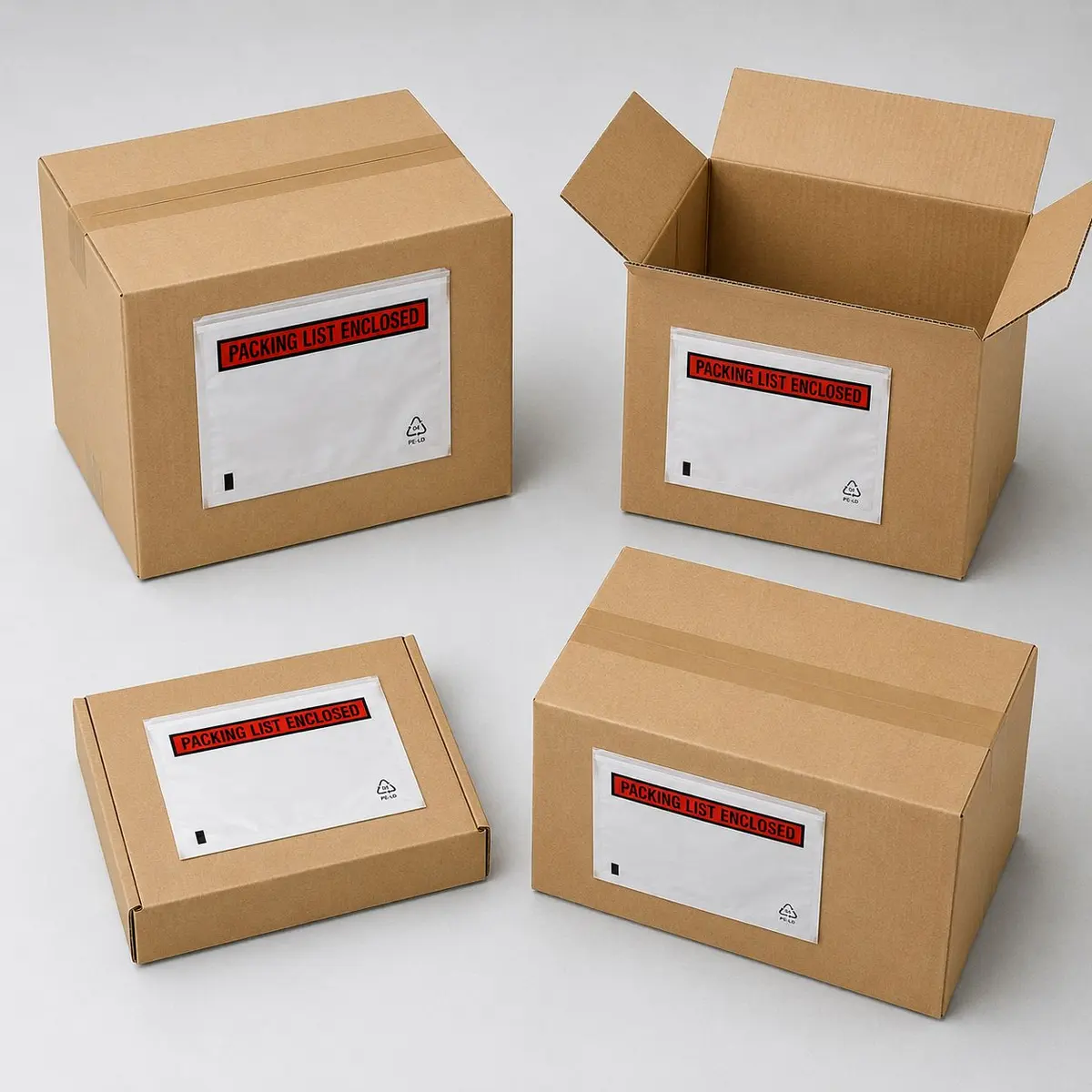
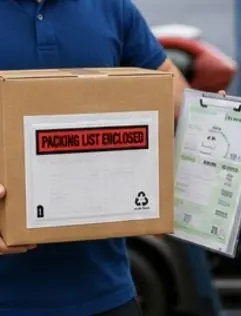
A printed, panel-face pouch has a banner across part of the front and a clear window below. The banner carries a legend such as “Packing List Enclosed”, “Documents Enclosed” or “Invoice Inside”.
This is a small point with a real effect. A printed legend makes it less likely that the receiver throws the box away before finding the paperwork. If you want your own logo or wording on it, we can print that for you through custom print. The full trade-off is in clear vs printed packing list envelopes.
What adhesive strength do I need?
Match the adhesive to the surface and the conditions, not to the document. The wrong glue is the most common reason pouches peel off in transit.
Standard pressure-sensitive adhesive holds well on clean cartons, smooth board and polybags in a normal warehouse. High-tack adhesive is for rough kraft, recycled board, cold chain, dust, oil or humidity, where standard glue lifts at the corners.
If you palletise, freeze, or ship through a monsoon, I would specify high-tack. Then test it on your actual cartons, because recycled board varies from batch to batch. We make both grades, and we would rather you buy standard where standard does the job.
What material should the envelope be made from?
Most packing list envelopes are LDPE or co-extruded polyethylene film. It is flexible, water-resistant, hard to tear and economical at volume. That is the default for a good reason.
There are 2 alternatives worth a look.
- Recyclable or recycled-content film, where kerbside recycling or recycled-content targets matter.
- Paper or plastic-free pouches, where a plastic-reduction policy or a fibre waste stream is the driver.
I will be honest about paper. It does not resist water as well as film, so it is a poor fit for open pallets in the rain. Settle size, format and adhesive first, then choose the film.
Which packing list envelope for which shipment?
Use this table to shortlist, then confirm with a sample.
| Your situation | Size | Format | Face | Adhesive |
|---|---|---|---|---|
| Ecommerce parcels, folded invoice | DL / 4.5 × 5.5 | Top-load | Printed | Standard |
| High-speed fulfilment line | DL / A5 | Side-load | Clear or printed | Standard |
| Export / multi-page customs set | A4 / 7 × 10 | Back- or side-load | Printed legend | High-tack |
| Cold-chain or humid transit | Match document | Side-load | Printed | High-tack |
| Rough kraft or recycled cartons | Match document | Top- or side-load | Printed | High-tack |
| Address shows through as label | Match document | Top-load | Clear / full-face | Standard |
A step-by-step for your buying team
Hand this list to whoever places the order.
- Measure your most common document, flat and folded.
- Choose the smallest size that fits without forcing, and standardise on no more than 2.
- Pick the format to suit your packing method and security needs.
- Decide clear or printed, based on whether the document must be read through the film.
- Specify the adhesive for your carton surface and climate.
- Select the material for any compliance or sustainability need.
- Order a sample pack, and let packers test fit, window, seal and adhesion on your own cartons.
Step 7 is the one people skip. I would never skip it.
You can browse formats and sizes on our products page.
Not sure which combination fits your operation? Send us your document size, carton type and monthly volume, and we will suggest a specification and send samples to test.
Frequently asked questions
How do I choose the right packing list envelope?
Make 5 decisions in this order: size, loading format, clear or printed face, adhesive strength, and film material. Each one narrows the next. Then order a sample pack so your packers can test fit and seal before a bulk run.
What size packing list envelope do I need?
Pick the smallest pouch that holds your document without forcing it. A standard invoice folded in three fits a DL or 4.5 × 5.5 pouch, and a flat A4 export set needs an A4 pouch. Measure the document both flat and folded before you decide.
What is the difference between panel face and full face packing list envelopes?
A panel-face pouch has a printed banner, such as 'Packing List Enclosed', across part of the front and a clear window for the rest. A full-face pouch is clear across the whole front, so the entire document shows through.
Should I use a clear or printed packing list envelope?
It depends on whether anyone needs to read the document through the film. If the address doubles as the shipping label, or a courier scans a barcode through it, go clear. If you want the parcel to announce that paperwork is inside, go printed.
What is the difference between top-loading and side-loading packing list envelopes?
Top-loading pouches open on the short top edge and suit hand packing and taller documents. Side-loading pouches open on a long edge. They feed quickly on fast lines and hold the document more securely once sealed.
How strong should the adhesive on a packing list envelope be?
Standard adhesive is enough for clean cartons and polybags in normal conditions. Rough kraft, recycled board, cold chain, dust or humidity call for high-tack, because standard glue can lift at the corners there.
Can I order a sample before buying packing list envelopes in bulk?
Yes, and I would insist on it. A sample pack lets your team test fit, window visibility, seal and adhesion on your own cartons before the bulk order. You can ask for one through our contact page.
Sourcing these in volume?
We make packing list envelopes in Jaipur for importers and distributors. Factory-direct, private label welcome.