
How to Format a Packing List (with a Checklist)
A packing list tells everyone what is inside a shipment and how it is packed. That means your warehouse, the carrier, customs and the consignee all read from it.
Get the format right and goods clear faster, claims are easier to settle, and the receiving team can tick off cartons in minutes. Get it wrong and a shipment sits at the port while someone sends emails.
We have made packaging in Jaipur since 1997 and shipped it to 20+ countries, and I have learnt that paperwork is where most avoidable delays begin.
Let us keep this practical. This article covers what to include, a checklist you can copy, the common mistakes, and how export and domestic formats differ.
What is a packing list for?
A packing list is an itemised record of what is physically in a shipment, with quantities, weights and how items are spread across cartons. It carries no prices.
It travels with the goods so the receiver can check what arrived against what was sent. We think of it as the shipment’s own ID card.
Unlike a commercial invoice, it has no unit prices or totals. That is deliberate, because it lets the list sit on the outside of a carton in a documents-enclosed pouch without showing values to handlers.
It does 3 jobs:
- Verification. The receiving team matches cartons and quantities against the list.
- Customs and inspection. Officials confirm contents and weights without opening every box.
- Claims. If goods arrive short or damaged, the list is the reference point.
What fields should you include on a packing list?
Every packing list needs 3 blocks: a header, a line-item table and shipment totals. Here are the standard fields we would expect to see, grouped by where they sit on the page.
Header: who, and which shipment
- Shipper or exporter, with full name and address.
- Consignee, with full name and address.
- Notify party, for export, if it is someone other than the consignee.
- Reference numbers, meaning the PO number, the invoice number, and the packing list number and date.
- Mode of transport and carrier, plus vessel or flight where known.
Line items: what is inside
- Item description in plain words, matching the invoice wording.
- Item or SKU code.
- Quantity per line and units per carton.
- Net weight, which is the goods alone.
- Gross weight, which is goods plus packaging.
Packaging and totals: how much, and how packed
- Carton or package count, with a numbering scheme such as 1 of 12.
- Dimensions of each package, length × width × height. This is essential for export.
- Total net and gross weight for the whole shipment.
- Marks and numbers, i.e. the shipping marks printed on each carton, which must match the list.
How is an export packing list different from a domestic one?
An export list is far more detailed, because customs and security checks depend on it. A domestic list mostly helps the consignee check the delivery. An export list has to describe the freight fully so officials can verify it without unpacking.
| Field | Domestic | Export |
|---|---|---|
| Shipper & consignee | Required | Required (plus notify party) |
| PO / invoice reference | Required | Required |
| Item description & quantity | Required | Required (match invoice wording) |
| Net & gross weight | Often per shipment | Per carton and total, in kg |
| Carton count & numbering | Recommended | Required |
| Package dimensions | Optional | Required |
| Shipping marks | Optional | Required, must match cartons |
| Country of origin | Rarely | Required |
| HS / tariff codes | No | Often required |
| Extra references (L/C, insurance) | No | As the destination requires |
For export, keep weights in kilograms, state the country of origin, and add HS codes where the destination asks for them. This is the level of detail we would put on our own export list.
Packing list checklist
Run every shipment through these 12 checks before the documents leave your desk. We put this list together because it catches the errors that most often hold up freight.
- Shipper and consignee names and addresses are complete and correct.
- PO and invoice numbers are present and match the invoice.
- The packing list number and date are filled in.
- Every line has a description, a code and a quantity.
- Net and gross weight are shown per carton and as a total.
- Cartons use a clear “X of Y” numbering scheme.
- Package dimensions are listed (export).
- Shipping marks on the list match the marks on the cartons.
- Country of origin and HS codes are added (export).
- Quantities reconcile with the commercial invoice.
- No prices appear on the packing list.
- A copy is sealed in a documents-enclosed pouch on the shipment.
What are the most common packing list mistakes?
Most delays come from mismatches and missing details. How the page looks matters much less. These 7 are the usual offenders:
- Quantities that disagree with the invoice. This is the fastest way to trigger a customs hold.
- Net and gross weight mixed up or merged into one figure.
- Vague descriptions like “parts” or “goods” instead of the actual item.
- Marks that do not match the cartons, so inspectors cannot tie boxes to the list.
- No carton numbering, which makes a short or damaged delivery impossible to trace.
- Prices left on the list, which exposes values and confuses it with the invoice.
- A lost or buried document. A list sealed inside a carton is no use at the door.
That last one is where I have a strong opinion.
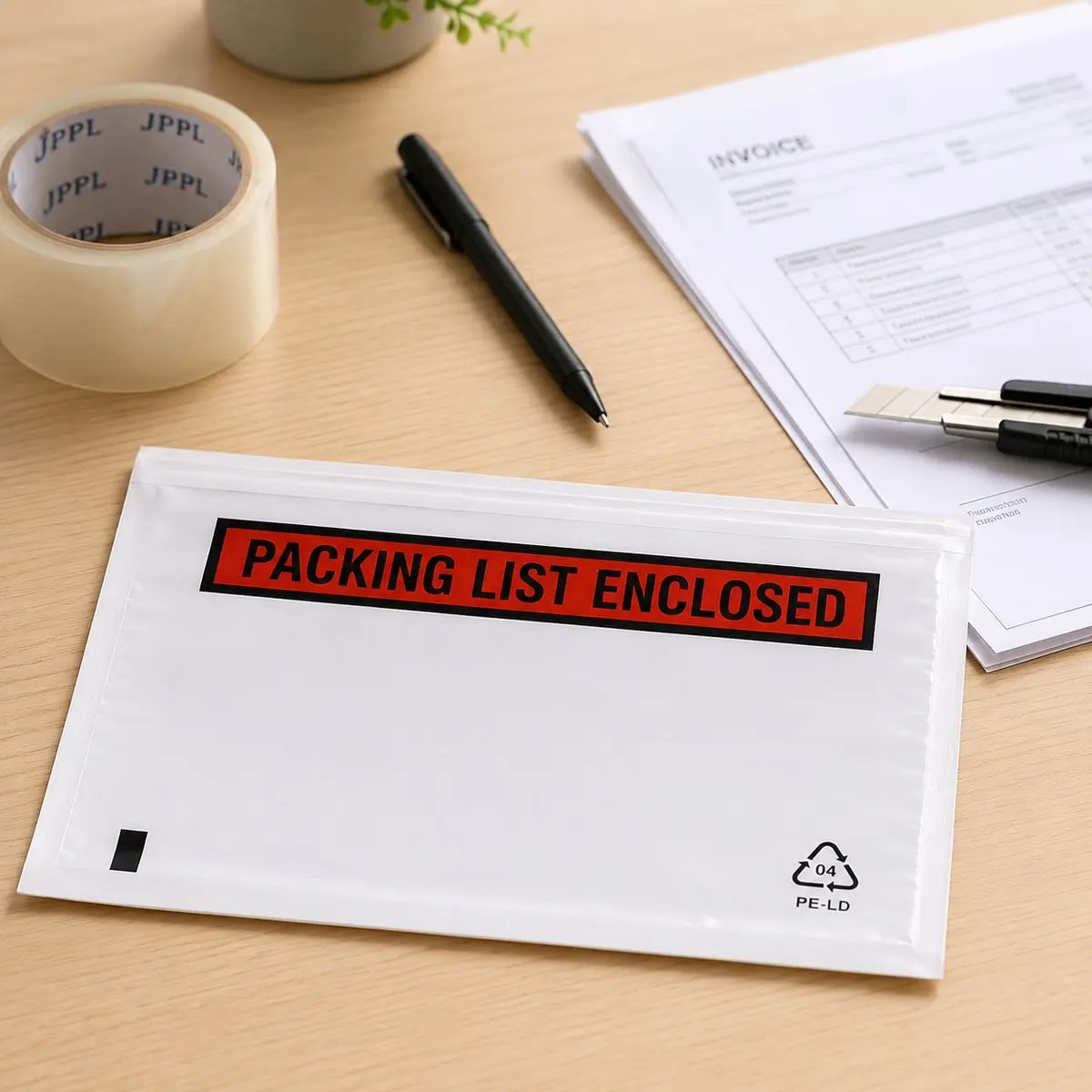
How you attach the list matters as much as how you format it. A clear, self-adhesive packing list envelope keeps the document flat, readable and dry for the whole journey.
It is the difference between a document that works and one that turns to papier-mâché in the monsoon.
We make these pouches for A4, DL and smaller documents. Our range is on the products page, and we can also print your own text or logo on the front if you want the pouch to carry your name.
How should you lay out the document?
Use one fixed layout every time: header at the top, line-item table in the middle, totals at the bottom. Consistency lets your staff and customs read any of your lists at a glance. We would start with these 4 habits.
- Keep field names the same across every shipment and every site.
- Put the most important header fields first, i.e. consignee, PO and carton count.
- Number cartons in sequence and print the same number on the box.
- File each list under a name that includes the PO number and date.
Here is my rule of the trade.
A plain packing list template you fill in the same way every time beats a fancy one that gets filled in differently each time. I would keep it boring and keep it identical.
Send us your document size and the kind of cartons you ship, and we will send packing list envelope samples to try.

Frequently asked questions
What information must be on a packing list?
At minimum you need shipper and consignee details, a PO or invoice reference, an itemised description with quantities, the carton count, net and gross weight, and package marks. Export lists add dimensions, country of origin and HS codes.
What is the difference between a packing list and a commercial invoice?
The packing list says what is physically in the shipment, i.e. items, quantities, weights and cartons, with no prices. The commercial invoice states the value for customs and payment. The two must agree on quantities, but they do different jobs.
Does a packing list need prices?
No, and it should not have them. Prices belong on the commercial invoice. Keeping them off the packing list means you can put it on the outside of the carton in a documents-enclosed pouch without showing your values to every handler.
What is the difference between net weight and gross weight on a packing list?
Net weight is the goods alone. Gross weight is the goods plus all packaging, including cartons, pallets and dunnage. List both per carton and as a shipment total, because carriers and customs work from the gross figure.
How detailed should an export packing list be?
Much more detailed than a domestic one. Every package needs its dimensions, net and gross weight in kilograms and its marks, plus the country of origin and often HS codes. Customs uses the list to check contents without opening every carton.
What are shipping or package marks on a packing list?
They are the numbers, symbols and handling instructions printed on the outside of each carton. Typical marks are the consignee mark, the carton number such as 3 of 12, and the destination port. The marks on the boxes must match the marks on the list.
Can one packing list cover multiple cartons?
Yes. One list can cover a whole shipment if it breaks down contents and weights per carton and shows clear carton numbers and totals. For large or mixed loads, that per-carton breakdown is what saves you in an inspection.
Sourcing these in volume?
We make packing list envelopes in Jaipur for importers and distributors. Factory-direct, private label welcome.