
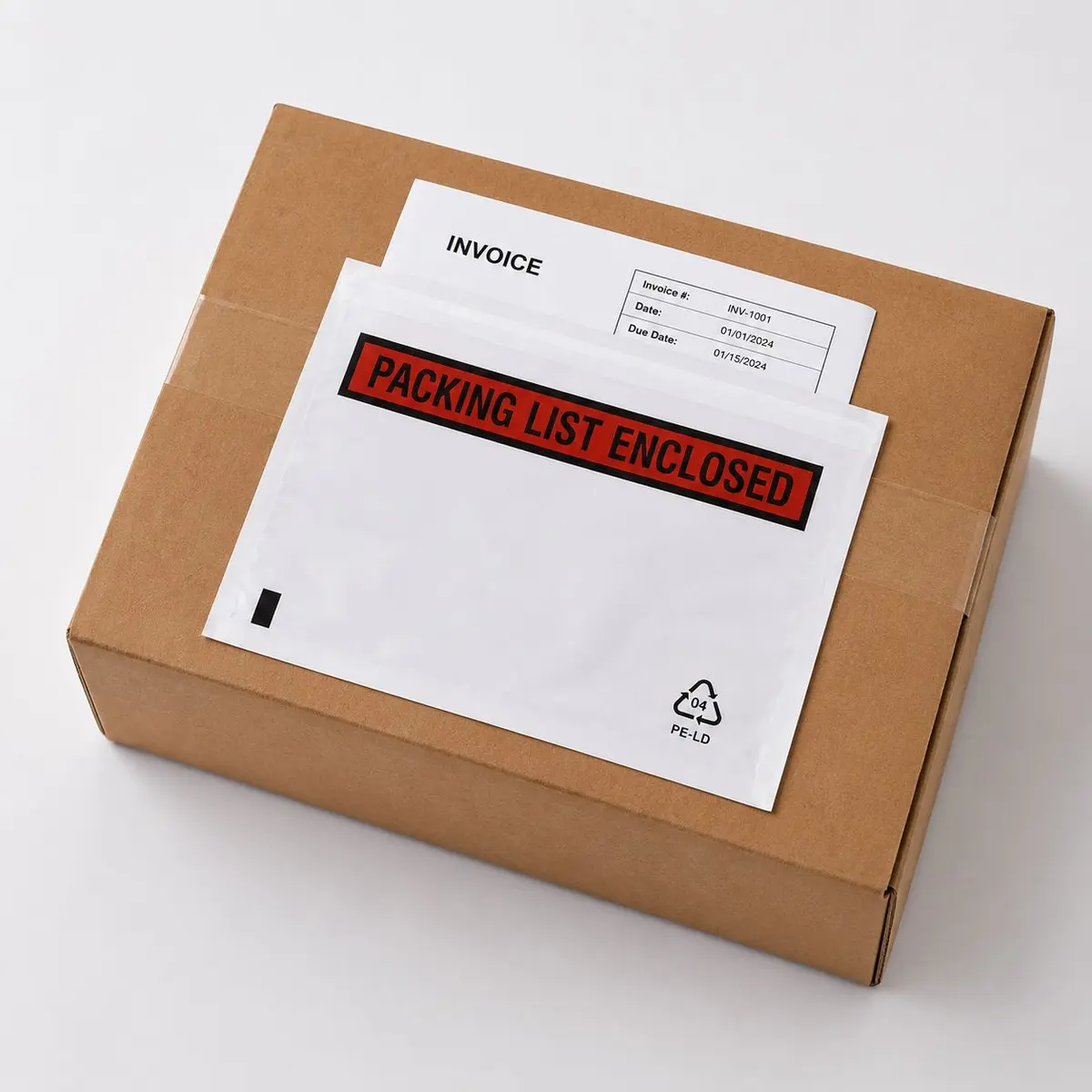
Returns Slips and Reverse Logistics Paperwork
Returns are part of the product now. Whether a customer buys from you again often depends on how painless it was to send something back, and that experience starts with the paperwork in the box.
Returns slips, RMA slips and return labels are the core of reverse logistics paperwork. I think a clear, self-adhesive documents-enclosed pouch is where they belong, because it keeps them dry, readable, scannable and hard to lose.
Below I cover the 3 core documents, where each one goes, and how resealable formats let the same packaging make the return trip.
What counts as reverse logistics paperwork?
It is the set of documents that lets a customer send an item back, and lets your warehouse receive, identify and process it. There are 3 main ones, plus a 4th for cross-border returns. Each has its own role, even when 1 printed sheet combines them.
- The returns slip is the customer’s instructions. It says how to start a return and gives reason codes, packing guidance and a returns reference or QR code for your returns portal.
- The RMA slip carries the Return Merchandise Authorization number. It usually has a barcode the warehouse scans to book the item back in and send it to refund, exchange or restock.
- The return label is the prepaid or customer-paid shipping label. It becomes the parcel’s new address on the way back and is linked to the RMA number for tracking.
- Cross-border documents are needed for international returns. A commercial invoice or customs declaration lets the parcel clear on its way home.
One point matters more than the rest. An RMA slip and a return label look similar, but they are not interchangeable. The slip identifies the return inside the warehouse. The label moves the parcel. Mixing them up is a common reason returns get mis-routed.
Returns slip vs RMA slip vs return label at a glance
The 3 differ by who reads them and where they end up on the parcel. We would plan the pouch around this table.
| Document | What it does | Who reads it | Where it goes |
|---|---|---|---|
| Returns slip | Explains how to return, reason codes, portal QR | Customer | Inside the box or in the pouch |
| RMA slip | Authorization number and barcode to receive the item | Warehouse or returns team | Inside the returned box |
| Return label | New shipping address for the send-back | Carrier | Outside the parcel, over the old label |
| Commercial invoice (cross-border) | Customs value and contents for the return | Customs | In the pouch or inside the box |
Where does each document go in the pouch?
On the outbound shipment, keep all returns paperwork together. That usually means a documents-enclosed pouch on the outside of the parcel, or one tucked inside. The moving around happens later, at the customer’s end.
A clean flow looks like this, and I would design the slip around it.
- Outbound. The return label pouch travels with the order and holds the packing slip, the returns slip and, where you offer one, the prepaid return label.
- At return time. The customer takes out the return label and sticks it on the outside, covering the original label and barcode, so the carrier reads only the new address.
- The RMA slip goes back inside the box, so your warehouse can scan it on arrival.
- For international returns, the commercial invoice goes in a pouch on the outside, where the carrier and customs can read it without opening the parcel.
Bundling the label and slips up front stops the classic failure, the customer who wants to return something but threw away the loose card that explained how.
How does a documents pouch make returns easier?
It turns a return from a support ticket into something the customer does alone. In my view, that is the biggest single lever on returns cost.
A returns documents enclosed pouch helps in 3 concrete ways.
- Nothing gets lost. A clear pouch holds the returns slip and label with the packing slip, instead of a loose insert that slides out of a poly mailer or goes in the bin with the wrapping.
- Self-service routing. A QR code for your returns portal lets the buyer start an exchange or refund without contacting you, which shortens the cycle and cuts support calls.
- Scannable on receipt. The clear film keeps the RMA barcode dry and legible through the return trip, so your warehouse scans it once and moves on. Smudged barcodes quietly slow down every returns line.
The same logic drives outbound document handling. See packing list envelopes for ecommerce for the wider fulfilment picture, and packing list envelopes for apparel, where return rates are highest.
Do you need to enclose a prepaid label in every parcel?
No, and many retailers deliberately do not.
Printing a prepaid label for every box means paying for labels on the many parcels that never come back. The more common approach now is a returns slip with a QR code or reference, which creates a label on demand through your returns portal. Then you pay only for real returns.
That said, I would still enclose a printed prepaid label for some customers. Older or less digital buyers, gift orders, and brands that promise instant, no-questions returns may be better served by it. The choice is commercial, not technical, and the pouch works with either model.
How do peel-and-reseal pouches and mailers support reuse?
They let the customer send the item back in the same packaging, using a 2nd adhesive strip. There is no tape and no new box.
- Two-strip mailers have one adhesive strip for the outbound seal and a second, covered strip for the return. The customer peels the second strip and reseals the same bag.
- Resealable document pouches can be opened and closed again without tearing, so one pouch can hold the outbound slip and then the return paperwork.
- Put the two together, i.e. a resealable mailer plus an enclosed return label, and the customer’s job is simple. Open, repack, peel, reseal and drop it off.
There is also less waste, because 1 mailer does 2 trips. I like that, because less packaging per order is good for everyone. I will be honest about the limit, though. A mailer that has been ripped open carelessly will not reseal well, so the tear strip and the instructions on the slip matter as much as the adhesive. Our guide to resealable packing list envelopes explains how the closure works.
Reverse logistics is where margin leaks without anyone noticing. Getting the paperwork clear, bundled and scannable is one of the cheapest fixes per parcel we know of. If you want your returns message printed on the pouch itself, see custom print. All formats and sizes are in our products section.
We have made packaging in Jaipur since 1997 and ship to 20+ countries, and a pouch that makes the return trip in one piece matters to us as much as the outbound one.
Planning your returns paperwork? Send us your parcel types, document sizes and how returns work for you today, and we will suggest pouch sizes and formats and send samples to try.
Frequently asked questions
What is the difference between a returns slip and an RMA slip?
A returns slip is written for the customer. It explains how to send the item back, with reason codes and a returns reference. An RMA slip carries the Return Merchandise Authorization number, often as a barcode the warehouse scans on receipt. In practice one printed slip often does both jobs.
Where does the return label go on a package?
On the outside, as the new address, covering the original shipping label. Until the customer is ready to send it back, keep it with the order in a documents-enclosed pouch so it does not get lost. The RMA slip goes inside the box.
Should returns paperwork go inside or outside the parcel?
On the way out, it can sit in a pouch on the outside or go inside with the order. When the customer returns the item, the label moves to the outside of the parcel and the RMA slip goes inside. A pouch keeps everything together until then.
What documents are included in reverse logistics paperwork?
Usually a returns slip with instructions, an RMA number or reference, a return label, and for cross-border returns a commercial invoice or customs declaration. Keeping them in one pouch makes the return self-service.
What is a peel-and-reseal mailer for returns?
It is a mailer with two adhesive strips. The first seals the outbound parcel, and the second, still covered, lets the customer reseal the same bag for the return. No tape and no new box are needed.
Do you need a return label inside every parcel?
Not always, and many retailers have stopped doing it. A QR code or reference that sends customers to a returns portal means you only pay for labels on parcels that actually come back. Where you do enclose a label, a pouch keeps it dry and scannable.
Can the same pouch hold the packing slip and the return label?
Yes. One documents-enclosed pouch can carry the packing slip, the returns slip and a prepaid return label together. Having them in one place makes it much less likely the customer loses the returns information.
Sourcing these in volume?
We make packing list envelopes in Jaipur for importers and distributors. Factory-direct, private label welcome.