
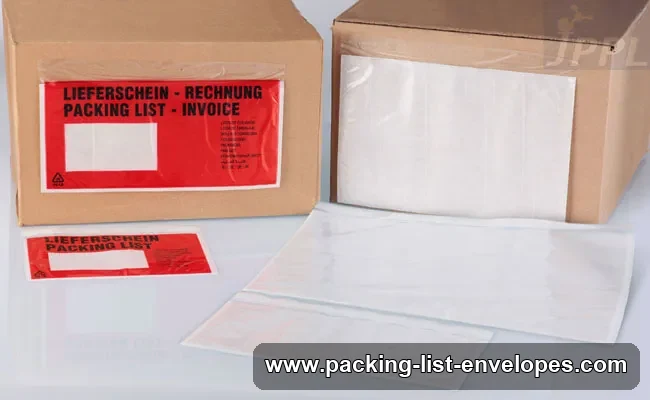
What Are Packing List Envelopes? What They Do and Which to Buy
A packing list envelope is a clear or printed self-adhesive pouch that you stick on the outside of a carton. It carries the paperwork for that shipment: the packing list, the invoice, the delivery note, and sometimes the full customs set. You will also hear it called a documents-enclosed wallet, a packing slip pouch, a doculope or a label-enclosed pouch. It is the same product under every name.
Its job is simple.
It keeps the paper with the goods, and it lets a driver, a warehouse picker or a customs officer read that paper without anyone having to open the box first.
This sounds like a small thing. Now picture a container waiting at the port because the commercial invoice is folded inside carton 14 of 300. Nobody is going to cut open 300 boxes to find it.
We have made packaging in Jaipur since 1997, and document-enclosed wallets have been a long-running export product of ours to the UK and Australia. I think of them as the cheapest insurance a shipper can buy against that container story.
What problem does a packing list envelope solve?
It solves the problem of paperwork that nobody can find. When the documents go inside the box, three things tend to go wrong.
- Your warehouse team cuts boxes open to hunt for the packing slip. This is slow, and every blade near a product is a damage claim waiting to happen.
- Customs holds the freight because the invoice is not somewhere an inspector can see it immediately.
- The customer writes in to ask where the paperwork went. That is a support ticket you paid for to save a little on a pouch.
A pouch on the outside stops all three.
The document stays visible and attached, and it survives a wet tarp and a rough forklift ride.
What is a packing list envelope made of?
It has three parts, and none of them is clever.
- A clear film face, so you read the document straight through without opening anything.
- A peel-and-stick back that holds on corrugated board, polybags, shrink wrap and stretch-wrapped pallets.
- A top-load or side-load opening with a flap, so the document slides in and stays in during transit.
You do not need tape. Many first-time buyers overlook this detail. You peel the liner, press the pouch down, and the job is done.
We make these in several films and adhesive grades, but that basic build stays the same on every one of them.
When do you actually need one?
You need one when goods leave your building and pass through other hands. Here is how that works in the usual cases.
| Scenario | Why a pouch helps |
|---|---|
| Ecommerce parcels | Returns slips and invoices stay attached and scannable |
| Export cartons | Customs paperwork is visible at inspection |
| Pallet freight | Delivery notes survive multi-stop transit |
| B2B wholesale | Purchase order references travel with the goods |
If a shipment never leaves your own premises, I would honestly skip the pouch. A stapled slip is fine there. The pouch earns its cost the moment goods cross a border or change hands more than once.
Should you buy plain, printed or custom-printed?
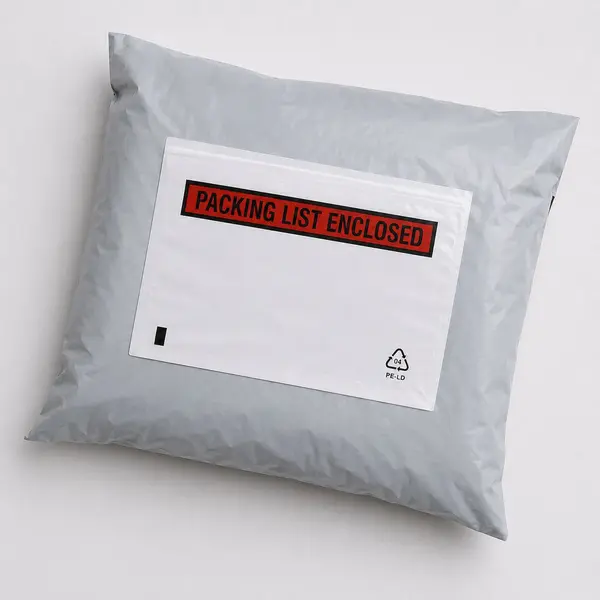
Plain clear pouches are sufficient for most shipments on most days. A printed “Documents Enclosed” or “Invoice Enclosed” legend adds one useful thing. It tells a busy handler that this is paperwork, not scrap packaging to tear off and throw away. (That does happen. A blank clear pouch on a brown box can look disposable.)
Custom-printed pouches put your logo or a barcode right on the carton. This is some of the cheapest branded space you will ever buy. You can see what is possible on our custom-print options page.
We print both the standard legends and customer designs at our factory. My own rule is simple, though, and I give it to every buyer who asks: if the parcel crosses a border or changes hands twice, use a printed pouch.
How do you pick the right size?
Size the pouch to the document, not to the box.
This is where most buyers quietly overspend.
A folded A4 invoice sits well in a DL or A5 pouch. A flat, multi-page customs set needs a full A4. If you buy one size for everything, you either fold paperwork into origami or pay for film you never use. Our packing list envelope size chart lists every common size, in millimetres and inches. If you would rather not measure, send us a sample document and we will suggest the size we would use ourselves, based on how the paper will travel and whether customs needs to read it flat.
Will the adhesive hold in cold or dusty conditions?
Not always. Brochures rarely mention it. A standard pouch that holds well at 25°C can let go on a cold morning in a freezer line. It can also slide off dusty recycled board.
Think of the adhesive like ghee. It is soft and grippy when warm and turns stiff in the cold, and a stiff adhesive cannot grab the surface. If you ship chilled goods, or send cartons into cold climates, ask for a high-tack or cold-grade adhesive. I say this plainly because we sell both grades: the standard one will let you down at the worst possible time. If you already have pouches falling off, this guide on why a packing list envelope will not stick goes through every cause.
A pouch is a very small line on your packaging bill. It still decides, more often than people expect, whether a shipment clears cleanly or sits in a bonded warehouse running up demurrage. That is why I would spend five minutes on the right type and size.
We are happy to help with that choice.
Not sure which pouch suits your paperwork? Ask for a free sample pack, tell us what you ship, and we will send a few sizes to try. If you already know what you want, the full range is here.
Frequently asked questions
What are packing list envelopes?
They are clear or printed self-adhesive pouches that stick to the outside of a parcel. Inside goes the shipping paperwork, such as the packing list, invoice or delivery note. The documents travel with the goods, and anyone can read them without opening the box.
What is the difference between a packing list envelope and a packing slip envelope?
There is no difference. 'Packing slip envelope' is the name you hear more in the US and in ecommerce, and 'packing list envelope' is more common in export and freight. Both mean the same adhesive document pouch.
What do you put in a packing list envelope?
It depends on the shipment. A domestic ecommerce parcel usually carries just the packing slip, and a B2B delivery carries the packing list and delivery note. For cross-border parcels, put in the commercial invoice and packing list, and use a printed 'Invoice Enclosed' pouch so customs can spot it.
Do packing list envelopes need tape?
No. The back is self-adhesive, so you peel off the liner and press the pouch onto the carton, polybag or pallet. Tape only adds cost and time.
Are packing list envelopes waterproof?
They are water-resistant, which is what most shipments need. A standard poly pouch keeps paperwork readable through rain, splashes and normal handling. It is not made to survive being fully under water.
Sourcing these in volume?
We make packing list envelopes in Jaipur for importers and distributors. Factory-direct, private label welcome.