
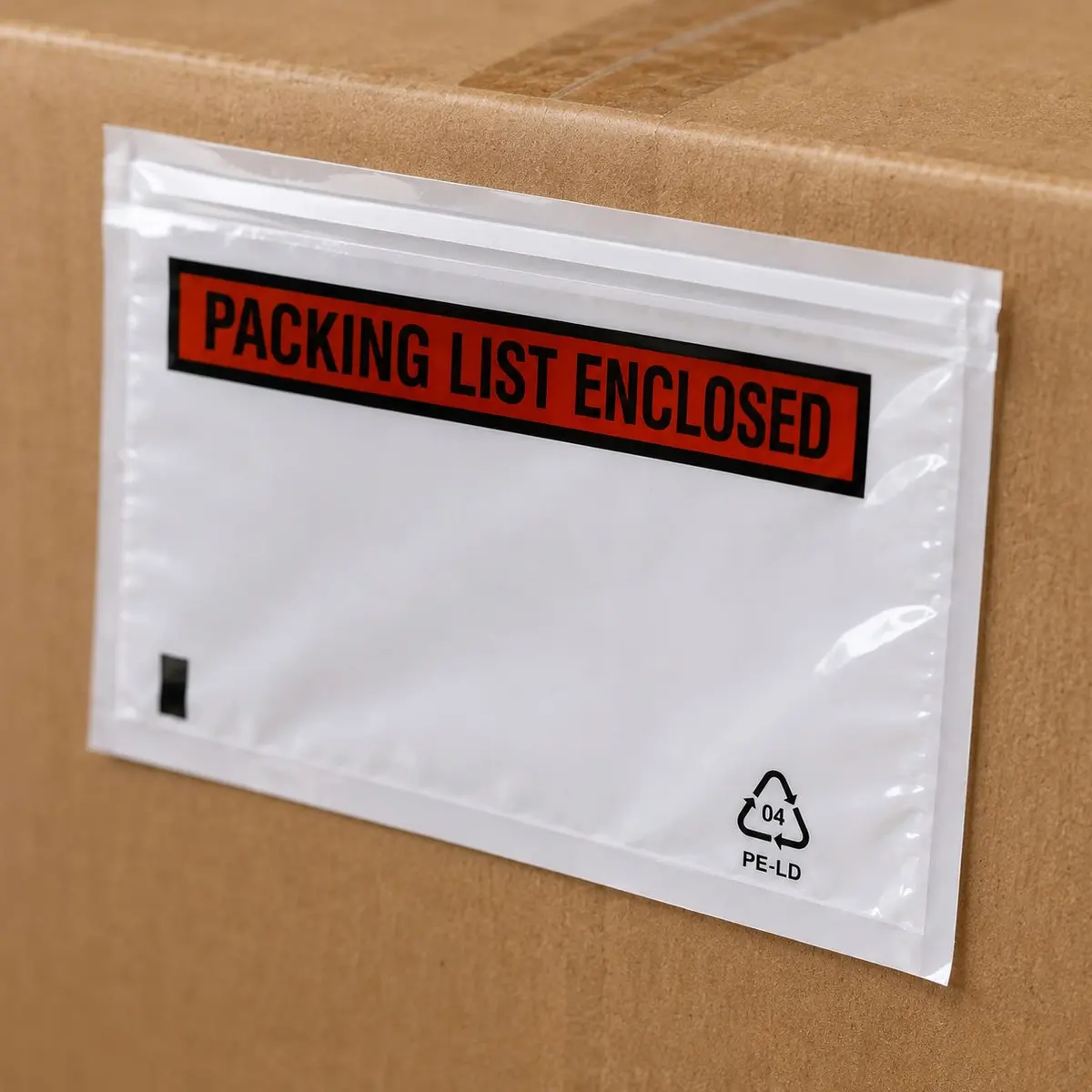
Why Won't My Packing List Envelope Stick? Causes and Fixes
If your packing list envelope won’t stick, the pouch is rarely the real problem.
The cause is almost always the surface, the temperature, the age of the stock or the pressure used. We have made packaging in Jaipur since 1997, and we ship these pouches to 20+ countries, from cold stores to hot, humid ports. The same 4 or 5 causes turn up in every climate.
A pressure-sensitive adhesive only bonds when it can flow into a clean, dry, firm surface under firm finger pressure. Dust, oil, water, cold, a waxy film or a half-hearted press all block that contact. Then the pouch lifts or falls off.
That is the whole story in 2 lines.
Below are the common causes, a quick diagnostic table, and the fixes. I will also tell you when to stop fighting the surface and switch to a high-tack grade.
Why won’t my packing list envelope stick at all?
Something is sitting between the adhesive and the carton, or the adhesive is too stiff to flow. A document pouch not sticking almost always comes down to one of these 7.
- Dust or paper fibres on the carton. Warehouse grit acts like a release layer, so the adhesive grabs the dust instead of the box.
- Oil or grease. Machine oil, hand cream, mould-release agents and food residue all push adhesive away.
- Moisture. A damp or sweating carton forms a barrier the glue cannot get through, and moisture weakens a bond that has already formed.
- Cold. Below roughly 5°C the adhesive stiffens and loses tack, so it never wets out.
- Low-surface-energy film. Polyethylene polybags, stretch wrap and shrink wrap feel slightly waxy, and a standard adhesive beads up on them.
- Old or badly stored stock. Heat, humidity and sun age the pad, and a damaged liner can spoil it before use.
- Too little pressure. Pressure is what switches the adhesive on, and a light or patchy press leaves air gaps that lift later.
How do I diagnose why the adhesive is not holding?
Match what you see to the likely cause, then apply the fix. If a buyer sends us a pouch that has lifted, these are the checks we would run first. Most failures get solved at the surface or pressure stage, without changing the pouch at all.
| Symptom | Likely cause | Fix |
|---|---|---|
| Pouch slides off, no grab | Dusty, oily or wet surface | Wipe clean, dry fully, re-apply to a firm spot |
| Beads up, will not wet out | Low-surface-energy film (PE, PP, shrink wrap) | Pull the film taut, specify a high-tack grade |
| Sticks, then peels at edges | Too little pressure, curved or flexing face | Press the whole pad, finish on the edges, pick a flat spot |
| Lifts in cold store | Cold carton, frost, condensation | Apply at room temperature, use a cold-temperature grade |
| Weak tack out of the box | Old or heat-aged stock, damaged liner | Use oldest stock first, store cool and dry, out of sun |
| Loose wrap lifts at seams | Slack stretch or shrink film | Tighten the film, apply over a taut, flat panel |
| Oozes or creeps in heat | Hot-melt adhesive softening in warm transit | Switch to an acrylic or high-performance grade |
How do I fix a dusty, oily or wet surface?
Clean it, dry it, and pick a firm spot.
This one rule fixes the majority of cases, and we give it to every buyer before we suggest any change of adhesive. Before the pouch touches down:
- Wipe the target area to clear dust, fibres and grit. A dry cloth is usually enough on corrugated board.
- Remove oil and residue with a quick solvent or detergent wipe, then let it dry completely.
- Dry off any moisture. A pouch will not bond to a damp carton, especially one just out of a chiller.
- Choose a flat, firm panel away from edges, tape ridges, seams and varnished print, which all reduce grip.
The same logic explains the cold-weather problem. A pouch going into cold storage bonds best when the pouch, the carton and the room are all warm at the moment of application. The bond then holds as everything cools. Our note on adhesion in cold storage and freezers covers that case in more detail.
Why won’t the pouch stick to polybags and films?
Polyethylene and polypropylene are low-surface-energy plastics. They feel faintly waxy, and a standard adhesive cannot spread across them, so it lifts. This is the most common “adhesive not holding pouch” complaint from anyone shipping in mailers and soft packs.
Here is what works, in the order I would try it.
- Make the film taut. Slack, wrinkled or seamed film peels no matter how good the adhesive is.
- Clean and dry it, because these films still collect dust and slip agents.
- Press hard across the full pad, edges included, to push out the air.
- Specify a high-tack grade made for these surfaces. It grabs faster and holds better than a standard one.
Am I pressing hard enough?
Probably not.
Under-pressing is the most underrated reason a packing slip pouch falls off.
A pressure-sensitive adhesive needs real, even force to wet out into the surface, and the bond keeps building for some hours after. On a packing line, I would train people to do it this way.
- Peel the liner off fully. A partial peel leaves dead patches with no tack. (Our guide on how to apply a packing list envelope shows the full sequence.)
- Line the pouch up before it touches. A permanent adhesive grabs on contact, so you cannot slide it into place afterwards.
- Press the whole pad firmly, working from the centre out, and finish on the edges and corners, because that is where lifting starts.
If you want the reason behind all this, read how a packing list envelope’s adhesive works.
When should I specify a high-tack adhesive?
Use high-tack whenever the surface or the conditions fight a standard bond. In my view it is the right answer more often than buyers expect. You need it for:
- Polybags, stretch wrap and shrink film.
- Dusty, rough or recycled-content kraft cartons.
- Cold cartons and chilled or frozen shipments, paired with a cold-temperature grade.
- Curved, ribbed or flexing faces where the edges want to lift.
- Long, rough export journeys where the bond has to take real abuse.
Now the honest downside, and we say it as the people who sell high-tack. High-tack costs more, and on smooth, clean, room-temperature corrugated you are paying for grip you do not need. A standard grade is fine there. We make both, and I would rather you buy the cheaper one when it does the job.
The trade-offs are laid out in high-tack vs standard adhesive, and the films and adhesive grades we make are on the products page. My advice is to clean and press properly first.
If the surface is difficult by nature, change the adhesive, not your technique.
Still getting pouches that lift or fall off? Tell us your surfaces, films and shipping conditions, and we will suggest the right adhesive grade and send a sample pack to test.
Frequently asked questions
Why won't my packing list envelope stick to the box?
In most cases the surface or the way it is applied is the problem, not the pouch. The usual causes are a dusty, oily, wet or cold carton, a waxy film like polyethylene, old stock, or too little pressure. Clean and dry the surface, press firmly, and use a high-tack grade on difficult films.
How do I get an adhesive pouch to stick to a polybag or shrink wrap?
Pull the film taut, wipe it clean and dry, and press hard across the whole adhesive pad. Polybags and stretch film are low-surface-energy plastics, so a standard adhesive beads up on them instead of spreading. A high-tack grade made for these surfaces is the real fix. Slack, wrinkled or seamed film will lift whatever you use.
Why does my packing slip pouch fall off in cold weather?
Cold makes the adhesive stiff, like butter straight from the fridge, so it cannot flow into the surface. Frost and condensation add a layer of moisture on top. Below roughly 5°C the bond becomes unreliable, so apply pouches at room temperature or ask for a cold-temperature grade.
How much pressure does a self-adhesive pouch need?
Firm, even pressure over the entire pad, with extra care at the edges and corners. Pressure is what makes a pressure-sensitive adhesive work, because it pushes the glue into the texture of the surface. A light press in the centre leaves air gaps, and those gaps lift later.
Can old or badly stored pouches lose their stickiness?
Yes, they can. Heat, humidity and direct sun age the adhesive, and a crushed or dirty release liner can spoil the pad before it is used. Store pouches somewhere cool, dry and out of the sun, keep the liner on until application, and use the oldest stock first.
When should I specify a high-tack adhesive?
Use high-tack whenever the surface fights a standard bond. That means polybags, stretch and shrink film, dusty or recycled kraft, cold cartons, curved faces, or long and rough export transit. For smooth, clean corrugated used indoors, a standard grade is usually enough and costs less.
Why does the pouch stick at first but peel off later?
That points to a weak final bond, not a lack of tack. The usual reasons are too little pressure, a slightly dirty or cold surface, a curved or flexing face, or a film that is too waxy for the grade used. These adhesives build strength over a few hours, so press firmly at the start and move to high-tack for tough surfaces.
Sourcing these in volume?
We make packing list envelopes in Jaipur for importers and distributors. Factory-direct, private label welcome.