
How to Avoid Customs Delays: Keep the Paperwork Visible
A customs hold is rarely about the goods. It is usually about the paperwork.
The factor you control most is simple: can customs find, read and trust your documents?
We make document pouches and we ship export cartons ourselves, so I see this from both sides. Below I have listed the common causes of holds, and how keeping the invoice visible removes the avoidable ones.
This is general guidance for shippers, not legal, customs or tax advice. Always confirm the rules for your lane and destination.
What actually causes customs delays?
Most avoidable holds trace back to documents, not cargo. Customs usually stalls because it cannot find a document, cannot read it, or does not trust it.
The usual culprits are a short list.
- Missing invoice. The commercial invoice is absent, or sealed inside the carton where customs cannot reach it.
- Incomplete invoice. HS codes, country of origin or values are missing, or the description says something vague like “general goods”.
- Mismatched documents. The invoice and packing list disagree on quantities, descriptions or values.
- Illegible paperwork. Rain, rubbing or a torn pouch leaves the sheet smeared.
- Hidden paperwork. The document is somewhere in the shipment, but the officer has to open boxes to find it.
- Wrong or missing consignee details, which stall the release.
The first five are about whether the document is there, what it says, what state it is in and where it sits. The shipper controls every one of them before the carton leaves the dock.
That is good news.
How does a visible documents pouch help?
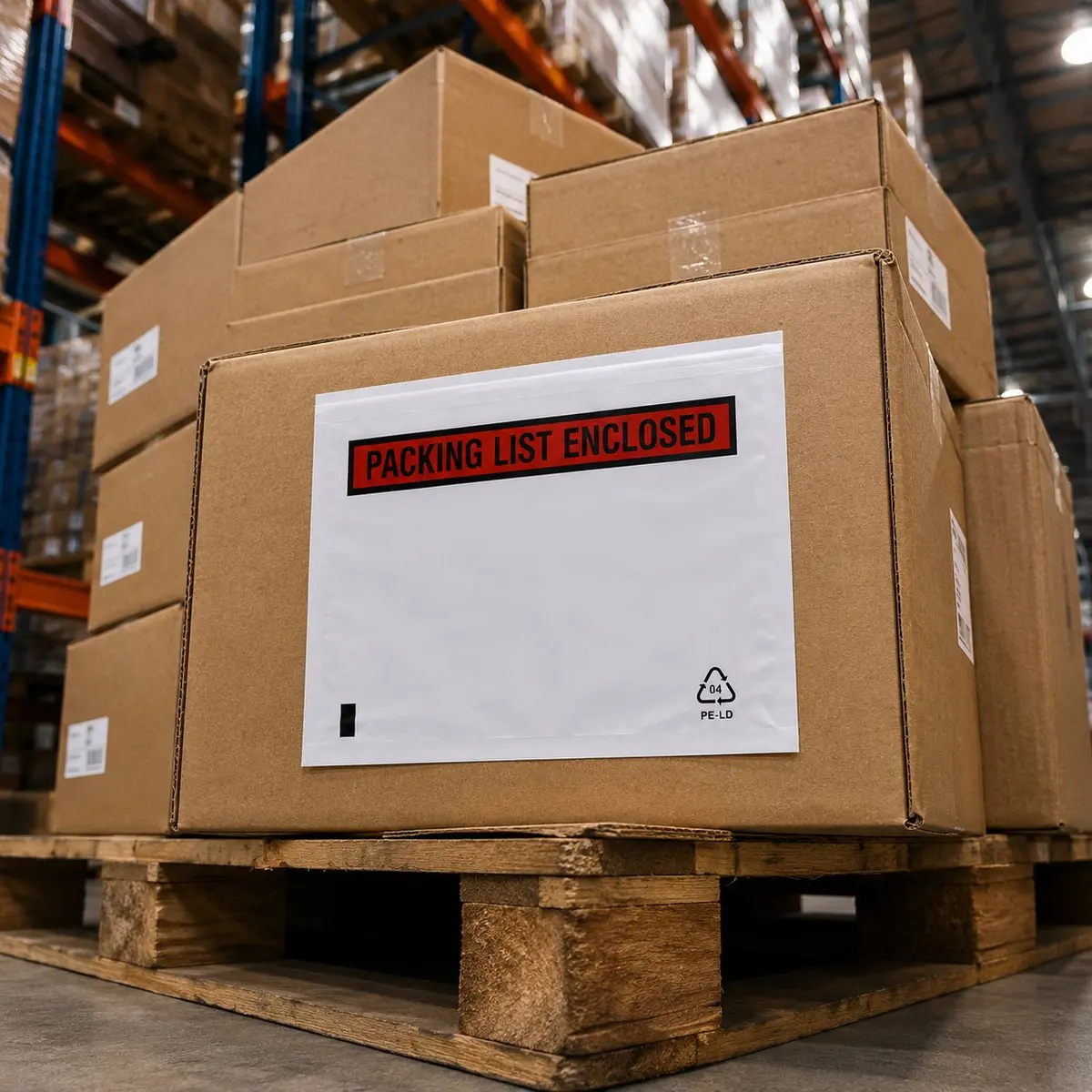
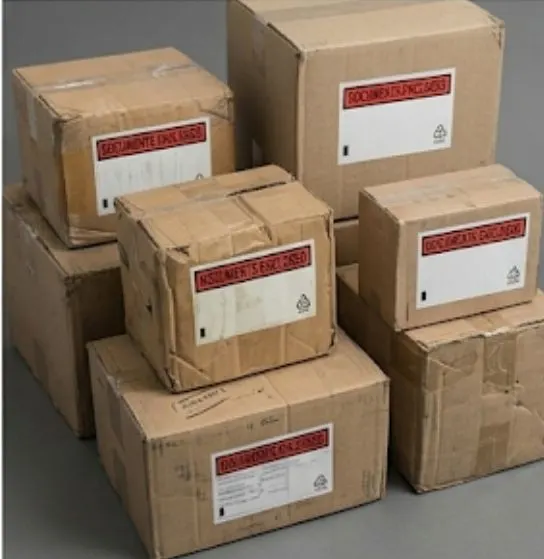
A pouch on the outside of the carton fixes the two problems that waste the most time. Customs cannot find the paperwork, and handlers open boxes to look for it. A printed “Invoice Enclosed” or “Documents Enclosed” pouch tells everyone where to look.
| Common cause of hold | Without a visible pouch | With a printed “Invoice Enclosed” pouch |
|---|---|---|
| Customs cannot locate the invoice | Officer opens cartons or holds the shipment | Invoice is in the marked pouch, read on the spot |
| Box opened to find paperwork | Slower handling, risk of damage to goods | Goods stay sealed, documents are read outside |
| Invoice smeared by rain or handling | Unreadable document, clearance stalls | Sealed pouch keeps the sheet dry and legible |
| Loose paperwork lost in transit | No invoice on arrival, full hold | Document stays attached to its carton |
| Officer unsure which box holds documents | Searches the whole consignment | Legend points to the right carton |
I will be honest about the limit here, even though we sell these pouches.
A pouch does not fix a bad invoice. It only makes sure the good documents you prepared reach the officer in one piece.
For which papers belong outside in the first place, see which documents go outside for customs.
Why does accuracy matter as much as visibility?
Because a visible invoice that is wrong still gets held. Customs cross-checks your documents, so the commercial invoice and the packing list must agree. The invoice must also carry what customs needs to classify and value the goods.
Before a carton ships, I would check the invoice against the packing list on five points.
- Item descriptions, which should be specific, not “samples” or “spare parts”.
- Quantities and units, with the same count on both.
- Values and currency, matching line by line.
- HS codes and country of origin, present and correct.
- Shipper and consignee details, the same on both.
Even small mismatches look like a red flag, and they invite a closer look.
The habit I trust is plain. Make the invoice and packing list from the same source data, then compare them before you seal the pouch.
This is the same habit that cuts mis-ships in general. Our note on how to reduce shipping errors with document pouches covers it.
What about the condition of the document?
A document that cannot be read might as well be missing. Border yards, airport aprons and container decks are wet and rough. A bare sheet taped to a box rarely arrives in a state customs will accept.
A proper pouch protects the paperwork in three ways. It keeps rain and condensation off the print. The film takes the scuffing instead of the paper. And a sealed pouch of the right size holds the full set flat, so nothing slips out or creases over the barcode.
Size the pouch to the document set, because folding hides things. We make pouches from A7 to A4, so there is always a size that avoids the fold. An A4 invoice plus packing list needs a pouch that takes a flat A4 sheet. A small parcel may only need a DL or 6 × 9 pouch. Folding an A4 invoice into a small pouch hides exactly the fields customs reads first.
A pre-ship customs checklist
Put the decision on paper so it does not depend on memory. For any cross-border carton, work through this list.
- Commercial invoice prepared, complete and signed where required.
- Packing list prepared and checked against the invoice.
- HS codes and country of origin on the invoice.
- Values, quantities and descriptions the same on both documents.
- Shipper and consignee details full and correct.
- Enough copies for origin, transit and destination customs.
- Documents in a pouch sized to the set, A4 kept flat.
- Pouch printed “Invoice Enclosed” or “Documents Enclosed” and fixed to the outside of the carton.
- Pouch sealed against weather and handling.
Step 8 is the one I would make automatic. International shipment means invoice plus packing list in a printed pouch on the outside, every time. This removes the “I thought the invoice was inside” mistake behind so many holds.
We have made packaging in Jaipur since 1997 and export to 20+ countries, so export paperwork is part of our own routine too. You can see the pouch sizes and printed legends on our products page, or put your own wording on them through custom print.
Shipping across borders? Tell us your document set and destinations, and we will send “Invoice Enclosed” pouch samples to try on your cartons.
Frequently asked questions
Why do shipments get held in customs?
Mostly because of the paperwork. A missing or incomplete commercial invoice, values that do not match the packing list, missing HS codes or origin, and documents customs cannot find or read are the usual reasons. Unpaid duties and random checks also cause holds, but document problems are the ones a shipper can control.
How long does customs clearance take?
With complete and consistent paperwork, express courier shipments often clear in under a day and air freight within 24 to 48 hours. Ocean freight commonly takes 1 to 5 business days. A document problem or an inspection can stretch that to a week or more, plus storage charges.
How can I avoid customs delays?
Send a complete, accurate commercial invoice that matches the packing list on values, quantities and descriptions, with HS codes and country of origin. Then keep the documents where customs can find and read them. A printed 'Invoice Enclosed' pouch on the outside of the carton solves the finding part.
What does 'Invoice Enclosed' mean on a package?
It is a printed legend on a document pouch stuck to the outside of a carton. It tells handlers and customs officers that the commercial invoice and shipping documents are in that pouch, so they can read them without opening the goods.
Why does the invoice need to be on the outside of the box?
Because customs has to read it before the goods are released. If the invoice is sealed inside, an officer must open the box or hold the shipment until the document turns up. A clearly marked outside pouch lets them read it straight away.
Do the commercial invoice and packing list have to match?
Yes, on every shared field. Customs compares the two, and a mismatch in quantity, description or value is a common trigger for a hold or inspection.
Does a damaged or illegible invoice cause customs delays?
It can. If rain, rubbing or a torn pouch leaves the invoice smeared, customs cannot act on it and may hold the shipment until a clean copy arrives. A sealed, weatherproof pouch keeps the sheet readable through handling.
Sourcing these in volume?
We make packing list envelopes in Jaipur for importers and distributors. Factory-direct, private label welcome.