
Customs Paperwork for Cross-Border Ecommerce Parcels
Cross-border ecommerce lives or dies on its paperwork.
A parcel can leave the warehouse in seconds and then sit for days in a customs hold. The usual reasons are boring ones: the declaration is missing, the invoice is sealed inside the box, or the values do not match.
We make the pouches that carry these papers, and we have made packaging in Jaipur since 1997. So I will stay on the part we know well, which is getting the right papers onto the outside of the parcel.
This post covers what each document does, which one your parcel needs, and where it has to sit on the package. It is general guidance for shippers, not legal, customs or tax advice. Rules change often and differ by country, so always confirm the requirements for your own lane.
What customs paperwork does a cross-border ecommerce parcel need?
Almost every international parcel needs a customs declaration. For commercial goods, it also needs a commercial or proforma invoice.
The declaration tells customs what is inside and what it is worth. The invoice backs that up with the commercial detail that customs uses to assess duty and tax.
For parcels in the postal network, the declaration is the Universal Postal Union’s CN22 or CN23 form. For courier and express parcels, the carrier’s own electronic customs data plus a commercial invoice does the same job. The principle does not change. Customs needs to read the value and contents before the parcel crosses the border.
You will meet these 3 documents most often.
- A customs declaration (CN22 or CN23). This postal form declares the contents, value, weight and reason for export.
- A commercial invoice. This is the financial document with the goods, their value, the parties and the terms of sale. Our note on commercial invoice basics for shippers lists every field.
- A proforma invoice. You use it instead of a commercial invoice when nothing is being sold, such as samples, gifts or returns.
CN22 vs CN23: which form does my parcel need?
Use CN22 for low-value, lightweight items and CN23 for higher-value or heavier ones.
The cut-off is set by the postal operator under UPU rules, and it combines weight and declared value. A widely used rule of thumb is CN22 up to around 2 kg and under the operator’s value limit, and CN23 for anything heavier or pricier. Check the figure for your destination, because no single number works everywhere.
| CN22 | CN23 | |
|---|---|---|
| Typical use | Low-value, lightweight postal items | Higher-value or heavier postal items |
| Common weight guide | Up to about 2 kg | Over about 2 kg |
| Detail captured | Short: contents, value, category | Full: itemised contents, HS codes, origin, weights |
| Invoice usually attached? | Not always | Yes, commercial or proforma |
| Format on parcel | Sticker on the address side | Printed sheet in a pouch on the outside |
Most ecommerce sellers end up using both forms. Small, cheap orders go with a CN22, and larger or pricier ones get a CN23 and an invoice. I would write that rule into your fulfilment process so packers never have to guess.
Where do the CN22, CN23 and invoice go on the parcel?
They go on the outside, where customs can read them without opening anything. This is the most important handling rule of all, and it is where a documents pouch earns its place.
- A CN22 is usually a self-adhesive label on the address side of the parcel.
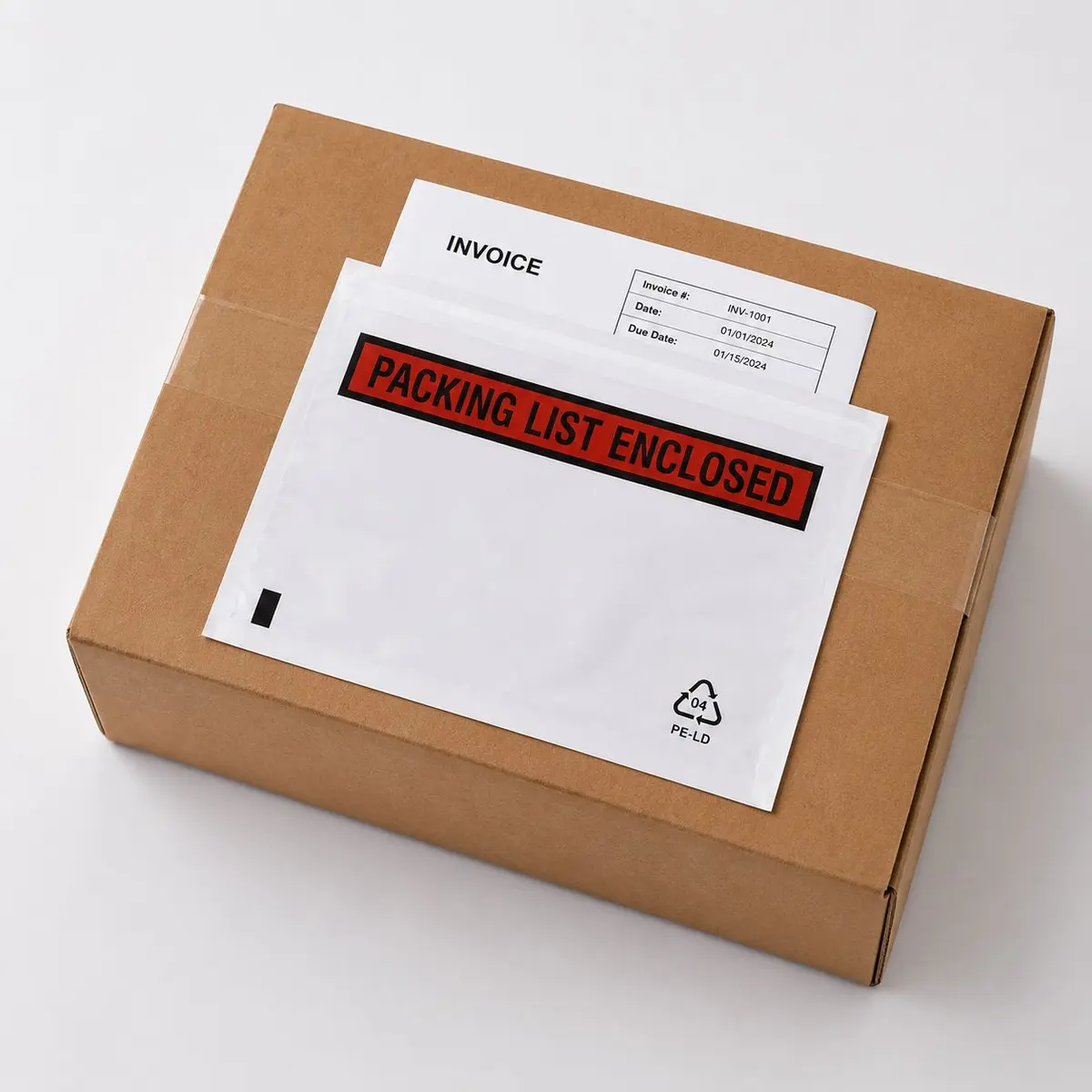
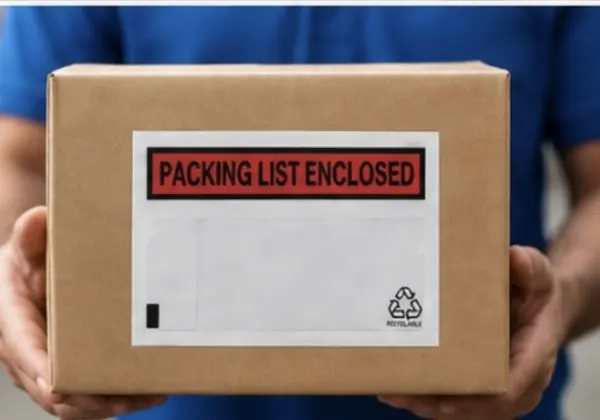
- A CN23 and the invoice are printed, folded if needed, and slipped into a clear documents-enclosed pouch fixed to the outside.
With the paperwork in a pouch on the surface, an officer can lift the documents, read them or keep a copy, and send the parcel on without cutting it open. Seal the invoice inside the box and you invite exactly the delay you were trying to avoid.
This is the same reason a visible invoice pouch is normal on cartons, which we cover in packing list envelopes for ecommerce.
A few practical points for the pouch.
- Put it on a flat face, usually a side panel. Do not wrap it over an edge or bury it under tape.
- Seal it flat, so the declaration and invoice stay readable through wet and rough handling.
- Use a clear or clearly printed pouch. A printed “Documents Enclosed” legend helps officers spot it quickly, and we can print that on for you through custom print.
- Include enough copies. Many shippers print 3, since an officer may keep one, and put a spare inside the parcel too.
The fields that must match across the declaration and the invoice are covered in what documents to enclose for international shipments.
Do low-value (de minimis) thresholds remove the paperwork?
No, they do not. A de minimis threshold is the declared value below which a country waives some or all import duty and tax. The parcel still has to be declared. The threshold only decides whether charges apply.
I would keep 2 points in mind here.
- Thresholds differ a lot by country. They are quoted in local currency or in a benchmark like SDR or euros. A value that goes duty-free into one market is fully taxed in another.
- They change often. Several major markets tightened or removed their low-value exemptions during 2025, and more reform is on the way. Treat any figure you remember as out of date until you check it again.
This is where I think most sellers go wrong. They think “it is cheap, so no paperwork is needed”. Declare every cross-border parcel, state the true value, and let the destination’s current rules decide the duty. Under-declaring to slip below a threshold is a fast route to a hold, a penalty or a returned parcel.
What simple rule should packers follow?
Make the decision automatic, so it never depends on memory. Every cross-border parcel gets the right declaration, a matching invoice, both sealed in a pouch on the outside, and one spare copy inside.
Here is a rule of the trade from the export side. Customs officers do not look for problems in a neat, complete, visible document set. They look hard at the parcel where they have to search for the papers. We have shipped export cartons to 20+ countries from Jaipur, and the paperwork on the outside is the part that decides how smoothly a box moves.
A written rule like this removes the two errors behind most avoidable holds: “I thought the invoice was inside” and “I was not sure which form to use”.
Thresholds will keep moving. A complete, readable, correctly placed document set clears whatever the rules say that year.
We make clear and printed documents-enclosed pouches in sizes from A7 to A4, and you can see them on the products page. For a folded CN23 and invoice, I would usually start with DL or A5.
Shipping ecommerce parcels across borders? Tell us your parcel sizes and the forms you use, and we will send samples of pouches that fit CN23 and invoice sets.
Frequently asked questions
What customs paperwork do I need for a cross-border ecommerce parcel?
Most international parcels need a customs declaration plus a commercial or proforma invoice. For postal items the declaration is a CN22 or CN23, and couriers use their own equivalent. Both should travel on the outside of the parcel where customs can read them.
What is the difference between CN22 and CN23?
CN22 is the short declaration for low-value, lightweight postal items. CN23 is the longer, itemised form for higher-value or heavier ones, and it almost always travels with an invoice. A common rule of thumb is CN22 up to about 2 kg and under the operator's value limit, CN23 above that.
Does a CN22 or CN23 go inside or outside the parcel?
Outside. A CN22 is usually a sticker on the address side. A CN23 and its invoice go in a clear documents pouch on the outside, so customs can read everything without opening the box.
Do I need a commercial invoice for a small ecommerce parcel?
For a commercial shipment, almost always yes, even when the parcel is small. Customs uses the commercial invoice to value the goods and work out duty and tax. A CN22 on its own is usually only enough for low-value, non-commercial postal items.
What is a de minimis or low-value threshold?
It is the value below which a country waives some or all import duty and tax. The figure varies widely by country and changes often, and several big markets tightened or removed their exemptions in 2025. A parcel below the threshold still needs a declaration.
How many copies of the customs documents should I include?
Three is a common choice, because a customs officer may keep one in transit. Put the set in a pouch on the outside and tuck a spare copy inside the parcel as a backup.
What happens if the customs paperwork is missing or wrong?
The parcel is usually held at the border until the documents are supplied or corrected. That means a late delivery, and it can also mean storage charges or a return. A value or description that does not match between the declaration and the invoice is one of the most common causes.
Sourcing these in volume?
We make packing list envelopes in Jaipur for importers and distributors. Factory-direct, private label welcome.