
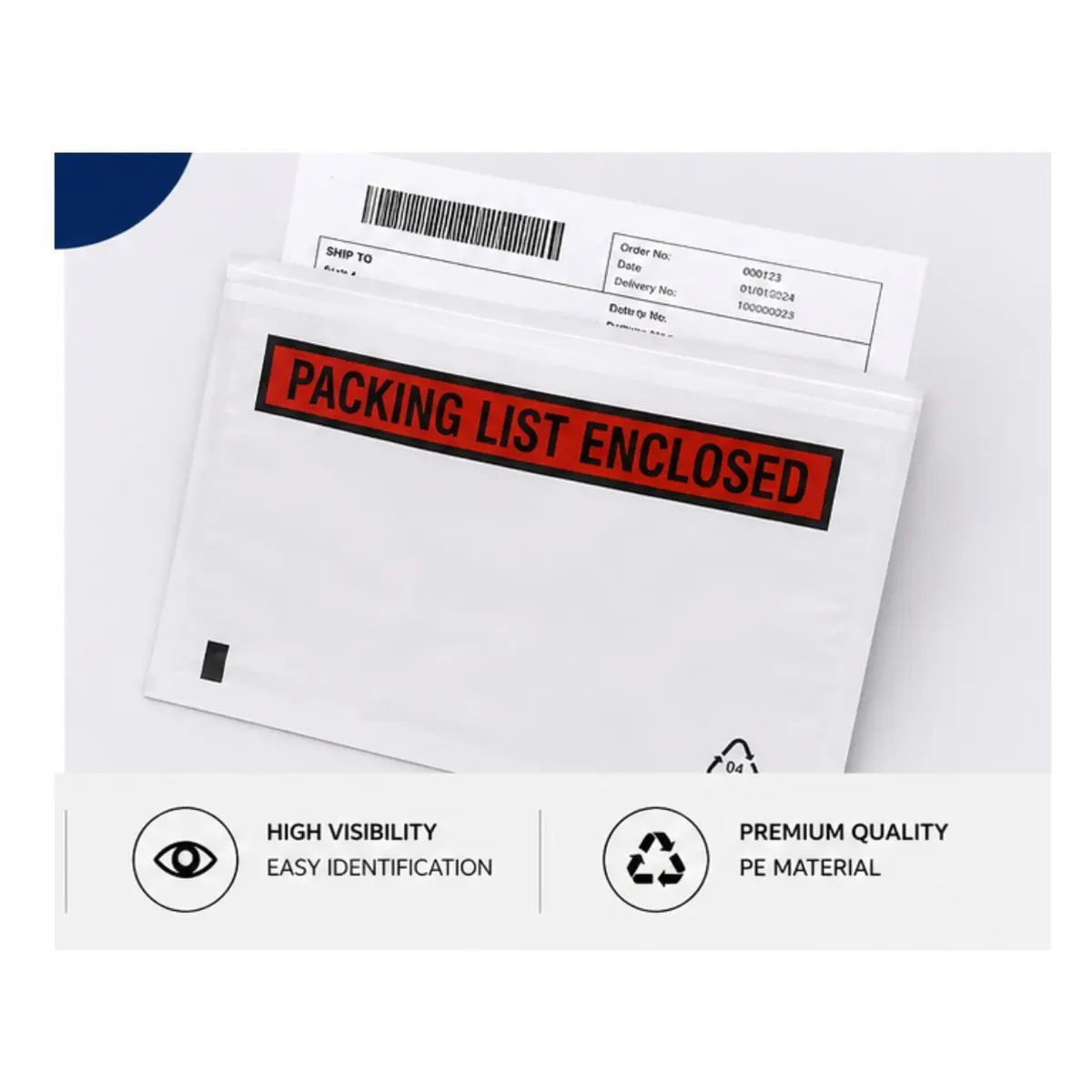
Which Documents to Enclose for International Shipments
Every international parcel needs at least 2 documents, a commercial invoice and a packing list. Many also need a certificate of origin and a customs declaration.
That part is well known.
We export to 20+ countries ourselves, so export paperwork is part of my working week. What gets far less attention, I think, is where the documents travel on the parcel. This guide covers both: what to enclose, and where each document belongs.
Which documents do I need to enclose for an international shipment?
At minimum, a commercial invoice and a packing list.
The invoice declares the value, and the packing list confirms quantities, weights and the carton count. Together they are the base of customs clearance.
Beyond those two, the set depends on your destination country, your goods and your trade terms.
I would always ask your buyer and the destination customs authority which documents they need before you ship. Requirements vary a lot between countries. A missing document is one of the most common reasons a shipment gets stuck at the border.
What does each export document do?
Each document has its own job, and customs reads them against each other.
- The commercial invoice declares the seller, the buyer, the goods, the value and the currency. Duties are assessed from it, and it is the first thing customs checks.
- The packing list confirms quantities, weights, dimensions and the number of cartons. Officers use it to check the physical shipment against the invoice without unpacking.
- The certificate of origin (COO) states where the goods were made, for duty and preferential-trade purposes. It is needed only for some destinations and goods, or when a buyer or letter of credit asks for it.
- The customs declaration, such as a CN22 or CN23, is a postal or courier form summarising contents and value. A CN23 in particular goes in a clear pouch on the outside.
Together these make one clearance set. In my view, the bigger decision is where they travel on the parcel.
That is what the rest of this guide is about.
Which documents go outside the parcel, and which go inside?
Clearance paperwork goes outside, in a clear documents-enclosed pouch. The recipient’s copy goes inside.
Customs needs to read the invoice, packing list, certificate of origin and customs declaration without opening the box. So those copies must sit on an outer face. A copy of the invoice or packing list for the consignee can travel inside the carton.
| Document | Outside (clear pouch) | Inside the box | Notes |
|---|---|---|---|
| Commercial invoice | Yes, usually 2 copies | 1 recipient copy | Carriers often ask for 3 copies in total |
| Packing list | Yes | Optional copy | Usually paired with the invoice |
| Certificate of origin | Yes, when required | No | Travels with the invoice for cross-checking |
| Customs declaration (CN22 or CN23) | Yes, CN23 in the outer pouch | No | A CN22 may attach directly on smaller items |
| Recipient delivery note | No | Yes | For the consignee, not for customs |
A common carrier convention is 3 copies of the commercial invoice. One is for the export country, one for the destination country and one for the recipient. The 2 customs copies ride in the outside pouch, and the recipient copy goes in the box. Confirm the count with your carrier, because it differs.
Why do customs documents belong in a pouch on the outside?
Because officers can then read and check the paperwork where it is.
Nobody has to cut the box open.
A clear, sealed pouch on a visible face lets customs check value, quantity and origin against the goods and release them quickly. If the only copy is tucked inside the carton, someone has to open the box. That is a bad start. It slows clearance and risks the papers getting separated from the goods.
A good outside pouch also keeps the set dry through long sea or air routes, with all the stacking and handling on the way. It keeps the pages together and in order. And it keeps them attached to the right parcel, not floating loose in a pile of packaging.
For sets of several pages, size the pouch so the documents lie flat and unfolded. Our guide to packing list envelope size for customs document sets shows how to match A4 sets to the right pouch.
How should I attach and present the pouch?
Put it on the largest flat, visible face, with the commercial invoice facing outward through the film. That way it is the first thing an officer sees.
- Choose the top or a long side of the carton, away from edges, seams and strapping, where it could be crushed or torn.
- Press the full adhesive area onto a clean, dry surface so it does not lift in transit. Our note on how to apply a packing list envelope covers the method.
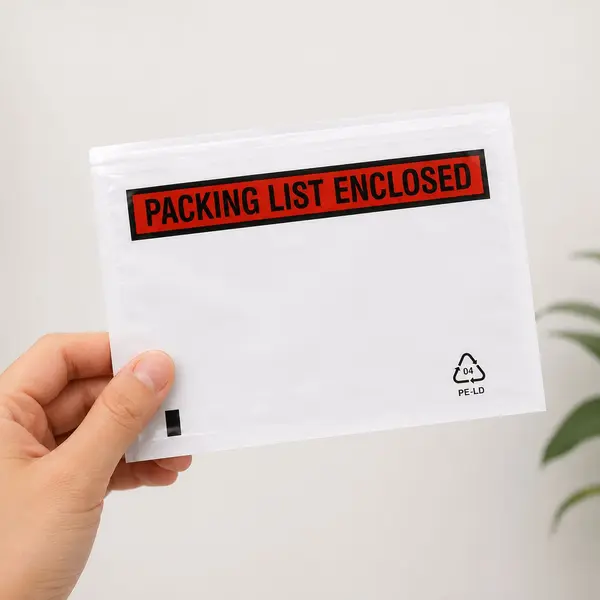
- Use a pouch with an “Invoice Enclosed” or “Documents Enclosed” legend, so it is recognised as official paperwork.
That printed legend does real work.
It marks the pouch as clearance paperwork, not a label or a marketing insert, so it gets read and not thrown away. If your parcels cross language borders, a legend in several languages helps every handler recognise it, which we cover in multi-language printed pouches. You can also have your own legend printed through custom print.
What about destinations with different requirements?
The destination decides the set. A certificate of origin is often required for some goods and regions and optional elsewhere. Postal forms like the CN22 and CN23 apply to particular weight and value bands.
Please do not guess.
Ask your buyer which documents their customs broker needs at import, and check the destination customs authority for rules on your goods.
Here is my rule of the trade. Standardise on one outside pouch that is big enough for the full set, usually an A4 pouch for A4 documents. Then you are never forced to fold or split documents when a destination asks for an extra certificate. You simply add or remove a sheet.
Document-enclosed wallets have been a long-running export product of ours to the UK and Australia. We have made them in Jaipur since 1997. You can see the full range on our products page.
Not sure which pouch size or legend suits your export document sets? Send us your document sizes and destinations, and we will suggest a pouch and send samples to try.
Frequently asked questions
Which documents do I need to enclose for an international shipment?
At minimum, a commercial invoice and a packing list. Depending on the destination and the goods, you may also need a certificate of origin and a customs declaration such as a CN22 or CN23. Confirm the exact set with your buyer and the destination customs authority before you ship.
Which documents go outside the parcel and which go inside?
Clearance paperwork goes outside, in a clear documents-enclosed pouch, so customs can read it without opening the box. That means the commercial invoice, packing list, certificate of origin and customs declaration. A copy of the invoice or packing list for the consignee usually goes inside.
How many copies of the commercial invoice should I include?
Many carriers ask for three. One is for the export country, one for the destination country and one for the recipient. The two customs copies travel in the outside pouch, and the recipient copy can go in the box, but check the count with your carrier.
Is a certificate of origin always required?
No. It is needed only for certain destinations or goods, or when a buyer or a letter of credit asks for it. When you do need one, put it in the same outside pouch as the invoice and packing list, so customs can check origin against the rest.
What is the difference between a CN22 and a CN23?
Both are postal customs declaration forms. The CN22 is for lower-value, lighter items, and the CN23 is for higher-value or heavier parcels. A CN23 usually goes in a clear pouch on the outside of the parcel, often with the commercial invoice.
What does the 'Invoice Enclosed' legend on the pouch do?
It tells carriers and customs that clearance paperwork is inside. The pouch then gets checked, instead of being mistaken for a label or thrown away with the packaging, which helps avoid clearance delays.
Sourcing these in volume?
We make packing list envelopes in Jaipur for importers and distributors. Factory-direct, private label welcome.