
Commercial Invoice Basics for Shippers
If your shipment crosses a border, the commercial invoice decides whether it clears quietly or sits in a customs hold.
That makes it worth knowing well. You need to know what it is, what goes on it, and where it travels on the carton.
The last part is the one people forget.
We have made packaging in Jaipur since 1997 and we export to 20+ countries, so we know this document from the exporter’s side of the counter too. We also make the pouches they travel in. I will cover both sides here.
Please treat this as general guidance for shippers, not legal, customs or tax advice. Always confirm the rules for your own lane and destination.
What is a commercial invoice?
A commercial invoice is the financial and legal document the exporter issues to the importer for an international shipment. It records the goods, their value, the parties and the terms of sale. Customs uses it to assess duty and tax.
So it does 2 jobs at once. It is proof of the sale between buyer and seller, and it gives customs what it needs to value the goods.
If it is wrong or missing, the shipment usually stops at the border until the paperwork is fixed.
What must a commercial invoice contain?
There is no single worldwide format, but a usable invoice carries the same core fields. Here is the checklist we would work from, and I would suggest you adjust it for each destination.
- Seller or exporter name, address and contact.
- Buyer or importer name, address and contact, plus the consignee if different.
- A unique invoice number and date.
- A description of each item: what it is, what it is made of, and what it is for. Itemise it. Do not lump lines together. (If I could fix only one field on most invoices, it would be this one.)
- Quantity and unit for each item.
- Unit price, total value and currency.
- Country of origin for each item.
- HS or tariff codes, which customs uses to classify goods.
- Net and gross weight, usually in kilograms.
- Incoterms, which say who pays for freight, insurance, duty and delivery.
- Reason for export: sale, sample, repair, gift, return and so on.
- Signature and date, where the exporter declares the details are true.
One rule sits above all 12. The values, quantities and descriptions must match the packing list. Customs checks the two against each other, and a mismatch is one of the most common reasons for a hold.
How is a commercial invoice different from a packing list?
The commercial invoice is the money document. The packing list is the contents document. They answer different questions for different readers, and a well-prepared shipment carries both.
| Commercial invoice | Packing list | |
|---|---|---|
| Core purpose | Value the goods for customs and payment | Verify what is physically in the cartons |
| Shows prices? | Yes, unit and total value, currency | Usually no |
| Shows weights and package counts? | Summary | Detailed: per-carton contents, marks, net and gross weight, dimensions |
| Main reader | Customs, accounts, the buyer | Customs, freight handlers, receiving warehouse |
| Carries HS codes, origin, Incoterms? | Yes | Sometimes, in less detail |
| Proof of sale? | Yes | No |
A packing list cannot stand in for a commercial invoice. Officers often use the list to check the cargo against the invoice, which is exactly why the two must agree. For how these sit alongside packing slips and delivery notes, see packing list vs packing slip vs invoice.
Is a commercial invoice the same as a normal sales invoice?
No, it is not.
A regular sales invoice is a request for payment, used for domestic accounting. A commercial invoice is made for cross-border trade. It carries the extra customs fields, like origin, HS codes, Incoterms and reason for export, that a domestic invoice never needs. One sale can produce both, but only the commercial invoice satisfies customs.
I would put it simply for our Indian readers. Customs does not care how neat your GST invoice is. It wants the fields it asked for.
Why must the commercial invoice be visible to customs?
Because customs has to read it to clear the shipment.
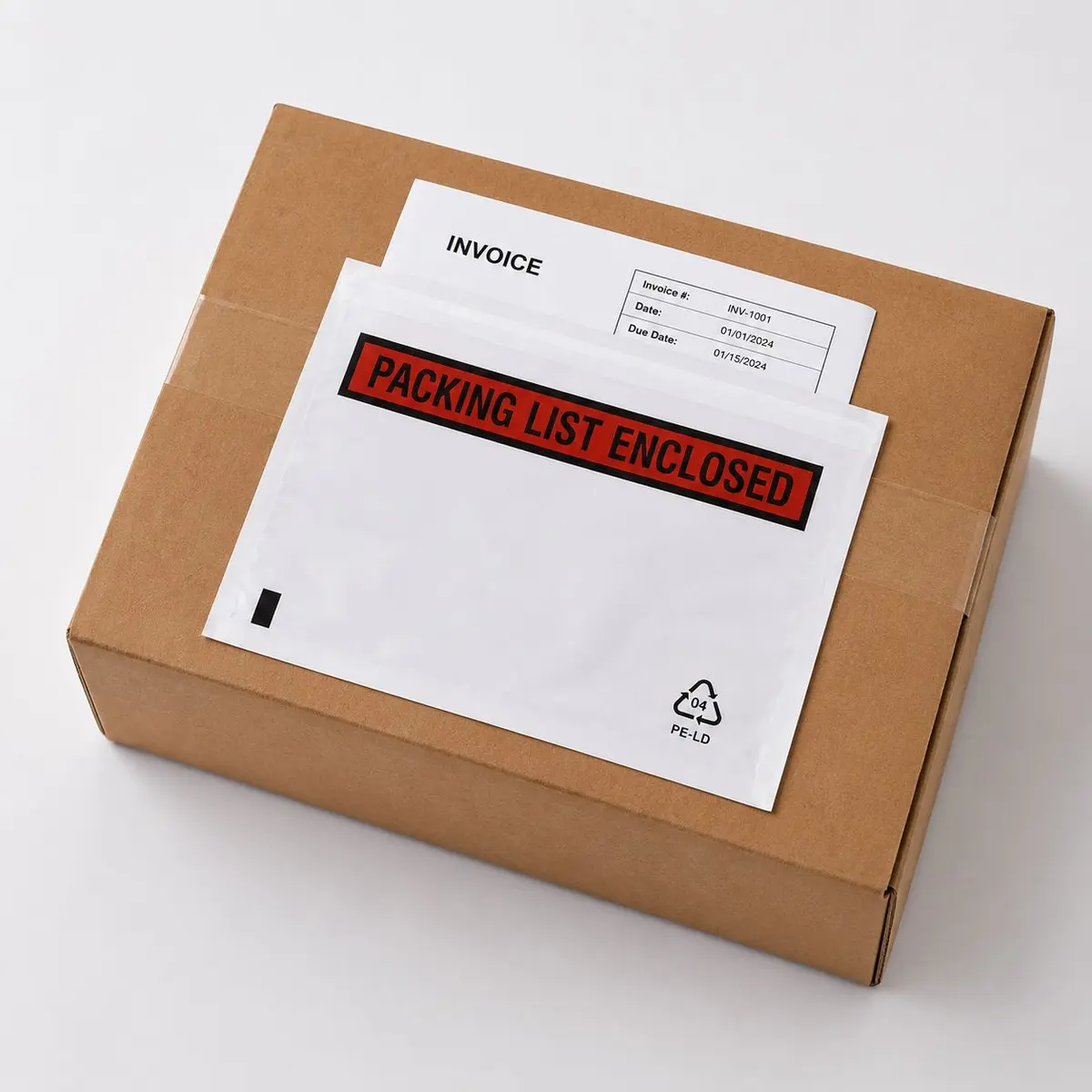
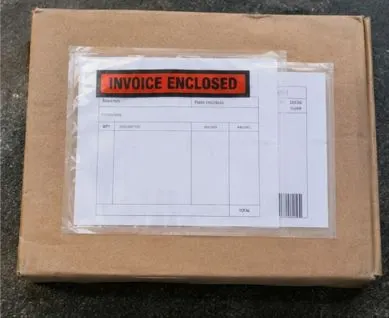
That is the whole reason the pouch exists. If the invoice is sealed inside the carton, an officer either cuts the box open to find it or holds the shipment until the paper turns up. Both cost you time, and the first one risks damage too.
The usual answer is a document pouch fixed to the outside of the carton, printed with a clear legend like “Invoice Enclosed” or “Documents Enclosed”. This tells handlers and officers exactly where the paperwork is, so they can read the invoice and packing list without opening the goods.
A few practical points:
- Size the pouch to the document set. An A4 invoice plus packing list needs a pouch that takes a flat A4 sheet without folding. A small parcel may only need a DL or 6 × 9 pouch.
- Keep the legend readable. A printed “Invoice Enclosed” panel is quicker to spot than a blank clear pouch. The common wordings are in printed legends explained.
- Seal it against rain and rough handling. Border yards and tarmacs are wet, and the invoice still has to arrive legible.
- Include enough copies. Many shippers add several signed copies so origin, transit and destination customs each get one. Check the number with your forwarder.
If you want your company name or your own wording on the pouch, we can print it through custom print. Our standard sizes, from A7 to A4, and our stock legends are on the products page.
What simple rule should packers follow?
Make the decision automatic, so it never depends on someone’s memory. International shipment means a commercial invoice plus a packing list, in a printed “Invoice Enclosed” pouch on the outside of the carton.
I would write that one line on the wall of the packing area. It removes the whole class of “I thought the invoice was inside” mistakes, and those are the ones that cause holds.
Shipping across borders? Send us your document size and the lanes you ship to, and we will suggest the right “Invoice Enclosed” pouch and send samples to try.
Frequently asked questions
What is a commercial invoice in shipping?
It is the financial and legal document the seller issues to the buyer for a cross-border shipment. It states the goods, their value, the parties and the terms of sale. Customs uses it to work out duty and tax, so a shipment without one is usually held at the border.
What must a commercial invoice contain?
There is no single global format. A usable one carries seller and buyer details, invoice number and date, a clear description of each item, quantity, unit and total value with currency, country of origin, HS codes, weights, Incoterms and reason for export. The values and quantities must match the packing list.
What is the difference between a commercial invoice and a packing list?
The commercial invoice is the money document and the packing list is the contents document. The invoice shows prices and terms so customs can calculate duty. The packing list shows what is physically in each carton, with weights but usually no prices, and customs checks one against the other.
Do I need both a commercial invoice and a packing list?
For most international shipments, yes. One does not replace the other. Customs officers often use the packing list to verify the cargo against the invoice, so the two must agree.
Is a commercial invoice the same as a regular sales invoice?
No. A sales invoice asks for payment and serves domestic accounting. A commercial invoice is built for cross-border trade, so it adds customs fields like country of origin, HS codes, Incoterms and reason for export.
Why does the commercial invoice need to be visible to customs?
Because customs has to read it before the shipment can clear. If it is sealed inside the carton, the box may be opened or the shipment held. A printed 'Invoice Enclosed' pouch on the outside lets officers read it without touching the goods.
Does a commercial invoice need a signature?
Often, yes. Many customs authorities and carriers expect the exporter to date and sign it as a declaration that the details are true. Requirements vary by country, so confirm with your forwarder for each destination.
Sourcing these in volume?
We make packing list envelopes in Jaipur for importers and distributors. Factory-direct, private label welcome.