
GST and VAT Invoices on Shipments: What to Know
A GST or VAT invoice sits between two worlds. One is tax compliance. The other is trucks, docks and cartons.
The same sheet of paper that satisfies a tax authority often has to travel with the goods, so the people moving and checking them can do their work. Both sides matter to us. We sell packaging inside India under GST, and we export from Jaipur to 20+ countries.
This post explains in general terms what a tax invoice is, why it goes with a shipment, and how Indian GST and EU and UK VAT frame it. It is guidance for shippers and ops teams, not tax or legal advice. Tax rules change and differ by country, so confirm your case with a qualified adviser or the authority.
What is a tax invoice on a shipment?
A tax invoice records a taxable sale and the tax charged on it. In India that tax is GST (Goods and Services Tax). In the EU and UK it is VAT (Value Added Tax).
The invoice names the parties, describes the goods, states the value and shows the tax rate and amount.
On a shipment it does 2 jobs. For the seller and buyer, it is the tax and accounting record behind the seller’s output tax and the buyer’s input-tax claim. For logistics, it is often the document the movement rests on. An e-way bill is built from it, and a carrier or officer may ask to see it. This second job is why a copy often needs to be readable from outside the package.
I think this is the part most people forget.
Why does the invoice go with the goods?
It goes with the goods because the people who move, inspect and receive them need to match the paperwork to the parcel.
The invoice tells them what is inside, what it is worth, who sent it and who should get it. It also shows that tax has been accounted for. Along the way, it supports 3 kinds of check.
- Tax and movement checks, for example an officer in India confirming that goods in transit are covered by a valid invoice and e-way bill.
- Receiving, where the warehouse matches the delivered goods against the invoice and the packing list.
- Returns, claims and disputes, where the invoice is the reference if a quantity or value is questioned later.
A tax invoice answers “what is it worth and what tax applies”. A packing list answers “what is physically in the box”. A good consignment carries both.
We would say the same for every carton that leaves a factory, ours included. The difference is set out in packing list vs packing slip vs invoice.
How do GST invoices, e-invoices and e-way bills fit together in India?
They are layers on one sale, not alternatives. People mix them up all the time, so I will take them in order.
- The GST tax invoice is what the supplier issues for the sale. It shows GSTINs, HSN codes, value and the GST charged, which is CGST and SGST within a state, or IGST between states.
- The e-invoice is the same invoice reported to a government portal to get an Invoice Reference Number (IRN) and a QR code. It applies to businesses above the turnover threshold. It is a reporting step, not a second invoice.
- The e-way bill is an electronic document needed to move goods above a threshold value. It is generated from the invoice or delivery challan and travels with the consignment.
Now the practical point about paper.
I am not a tax adviser, and I would not pretend to be one. Under the e-way bill rules, the person in charge of the vehicle must be able to produce the invoice (or challan) and the e-way bill for inspection. This is often met electronically, through the reference numbers, without a printed copy. The accepted formats and thresholds come from the rules in force at the time, so check them and ask your transporter what they do.
Exports add one more layer. For a GST-registered exporter, an export sale is generally a zero-rated supply. It goes either under a Letter of Undertaking without IGST, or with IGST paid and refunded later. The exporter usually issues a GST-compliant invoice for the sale and a commercial invoice for customs, side by side.
What changes with VAT in the EU and UK?
The idea is the same, but the cross-border rules are different. A VAT invoice generally shows the supplier’s VAT number, the customer’s VAT number for B2B sales, an invoice number and date, the goods and quantity, the net amount, the VAT rate and amount, and the total.
For B2B sales between countries, VAT often shifts to the customer under the reverse charge, and the invoice may need wording that says so. I would ask your EU or UK buyer, or their customs broker, what wording they expect to see. Exports out of the VAT area are commonly zero-rated, as long as the seller keeps proof of export such as shipping records and customs declarations.
The exact fields and wording differ by country.
Treat this as a map, not a checklist.
How do GST, VAT and commercial invoices compare?
They overlap, but each answers a different question. This table is a general guide, not a rule.
| GST tax invoice (India) | VAT invoice (EU/UK) | Commercial invoice | |
|---|---|---|---|
| Main job | Record GST on a sale | Record VAT on a sale | Value goods for customs and cross-border trade |
| Main reader | Supplier, buyer, GST authority | Supplier, buyer, tax authority | Customs, the importer |
| Tax identifiers | GSTINs, HSN codes | VAT numbers | Usually not the focus |
| Customs fields | Added for exports | Added for exports | HS codes, origin, Incoterms |
| Role in movement | Basis for the e-way bill | Supports the supply and proof of export | Travels for customs clearance |
A domestic sale needs a tax invoice. A cross-border shipment usually needs a commercial invoice as well. For an Indian exporter the two are issued together, and I would check that the values and descriptions match line by line before dispatch. A mismatch between them is an easy way to earn a question from customs. The cross-border document is covered in commercial invoice basics for shippers.
Where should the invoice travel on the carton?
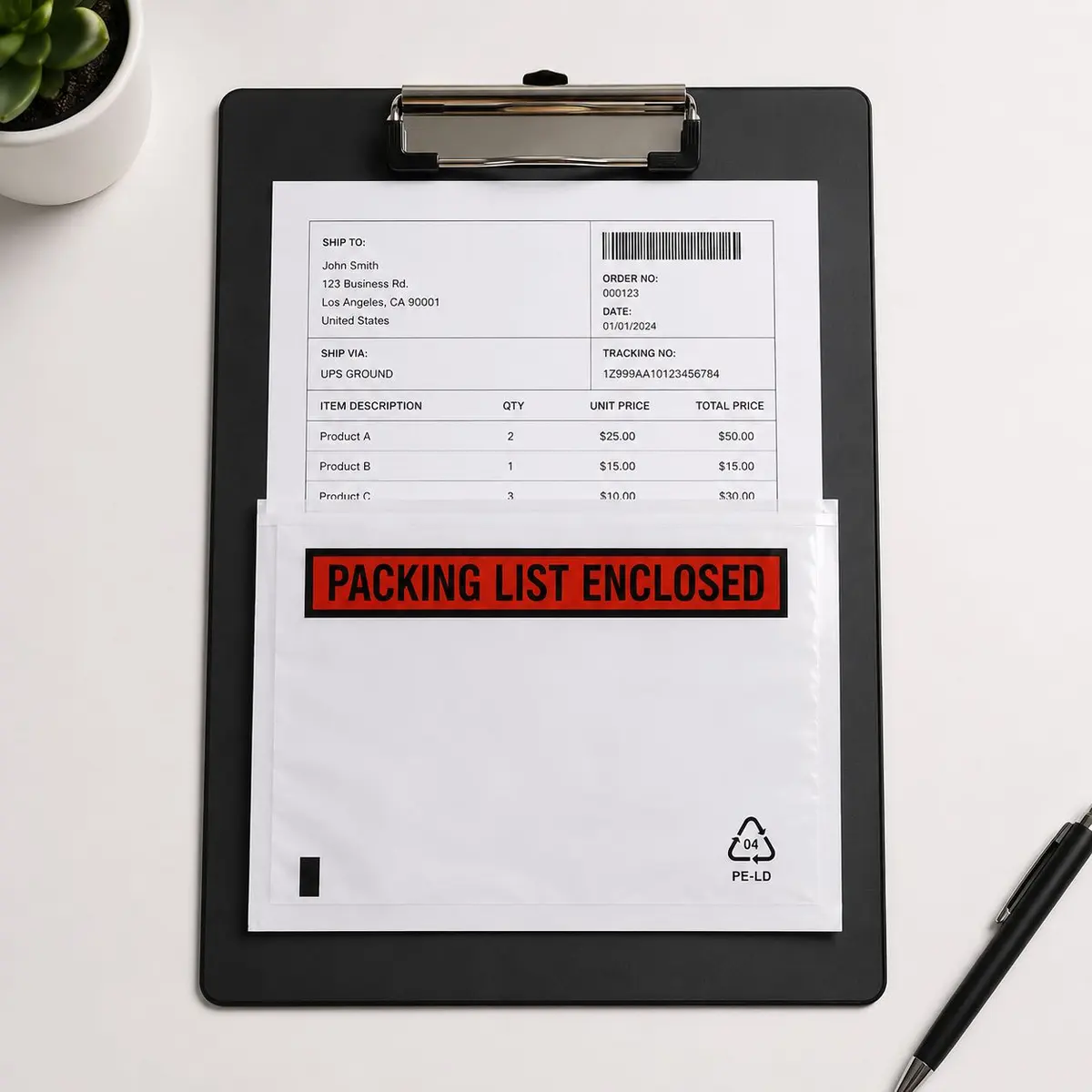
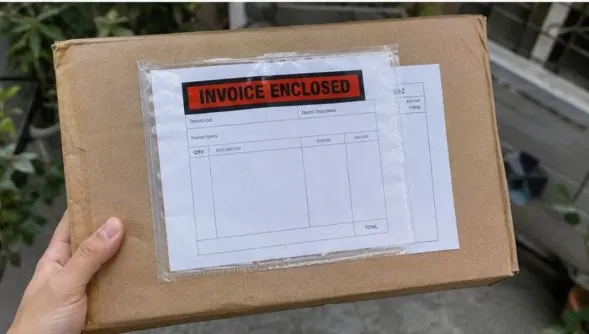
It should travel on the outside, in a documents-enclosed pouch, whenever a printed copy has to go with the goods. Handlers and officers can then read it without opening the carton.
I would follow 4 habits here.
- Use a clear pouch, or one printed with a legend such as “Invoice Enclosed”, so the paper is easy to spot. We offer these printed legends, and you can put your own wording on through custom print.
- Match the pouch to the document set. A flat A4 invoice plus packing list needs an A4 pouch. A small parcel may only need a DL or 6 × 9 pouch. If you are unsure, send us the set and we will tell you which size we would use.
- Plan for weather and rough handling. Yards, docks and trucks are wet and dusty, and the invoice has to arrive readable.
- Keep paper and electronic records in step. Even when the movement is covered electronically by an e-way bill number or an IRN, a readable copy in a pouch speeds up any manual check.
Here is a rule of the trade worth keeping: the invoice copy on the outside is for the person who stops the truck, not for your accounts team. Print it so a tired officer at night can read it in ten seconds.
We make these pouches in sizes from A7 to A4, and we have made packaging in Jaipur since 1997. You can see the sizes and printed legends for tax and customs sets on our products page.
Need pouches that fit your GST, VAT or customs papers? Send us your document size and how many sheets travel, and we will send samples of clear and printed “Invoice Enclosed” pouches to try.
Frequently asked questions
What is a tax invoice on a shipment?
It is the document that records a taxable sale and the tax charged on it. That is GST in India and VAT in the EU and UK. It shows the parties, the goods, the value and the tax, and on a shipment it often also supports the movement of the goods.
Does the GST invoice have to physically travel with the goods?
Not always on paper. Under India's e-way bill rules, the person in charge of the vehicle must be able to produce the invoice or delivery challan and the e-way bill for inspection. This can often be done electronically through the reference numbers. Confirm the current rule and your transporter's practice, because accepted formats can change.
What is the difference between a GST tax invoice and a commercial invoice?
A GST tax invoice is a domestic tax document that shows the GST charged. A commercial invoice is made for cross-border trade and carries customs fields like HS codes, country of origin and Incoterms. A GST-registered Indian exporter often issues both for one export sale, and the two must agree.
What must a GST tax invoice include?
The usual fields are supplier and recipient names, addresses and GSTINs, an invoice number and date, goods with HSN codes, quantity and value, the GST rate and amount (CGST and SGST, or IGST), and the place of supply. Check the current GST rules for the exact list for your transaction.
What must an EU or UK VAT invoice include?
Generally the supplier's VAT number, the customer's VAT number for B2B sales, an invoice number and date, a description and quantity of goods, the net value, the VAT rate and amount, and the total. Cross-border invoices may need extra wording such as a reverse-charge note. Requirements vary by country, so confirm locally.
What is an e-way bill and when is it needed?
An e-way bill is an electronic document needed under Indian GST to move goods above a threshold value. It is generated from the invoice or delivery challan details and travels with the consignment, usually as a reference number. Thresholds and exemptions change, so check the current rules.
Is a tax invoice the same as an e-invoice?
Not exactly. In India, e-invoicing means reporting the tax invoice to a government portal to get an Invoice Reference Number (IRN), for businesses above the turnover threshold. The buyer still receives the invoice itself, and e-invoicing is the reporting step on top of it.
Sourcing these in volume?
We make packing list envelopes in Jaipur for importers and distributors. Factory-direct, private label welcome.