
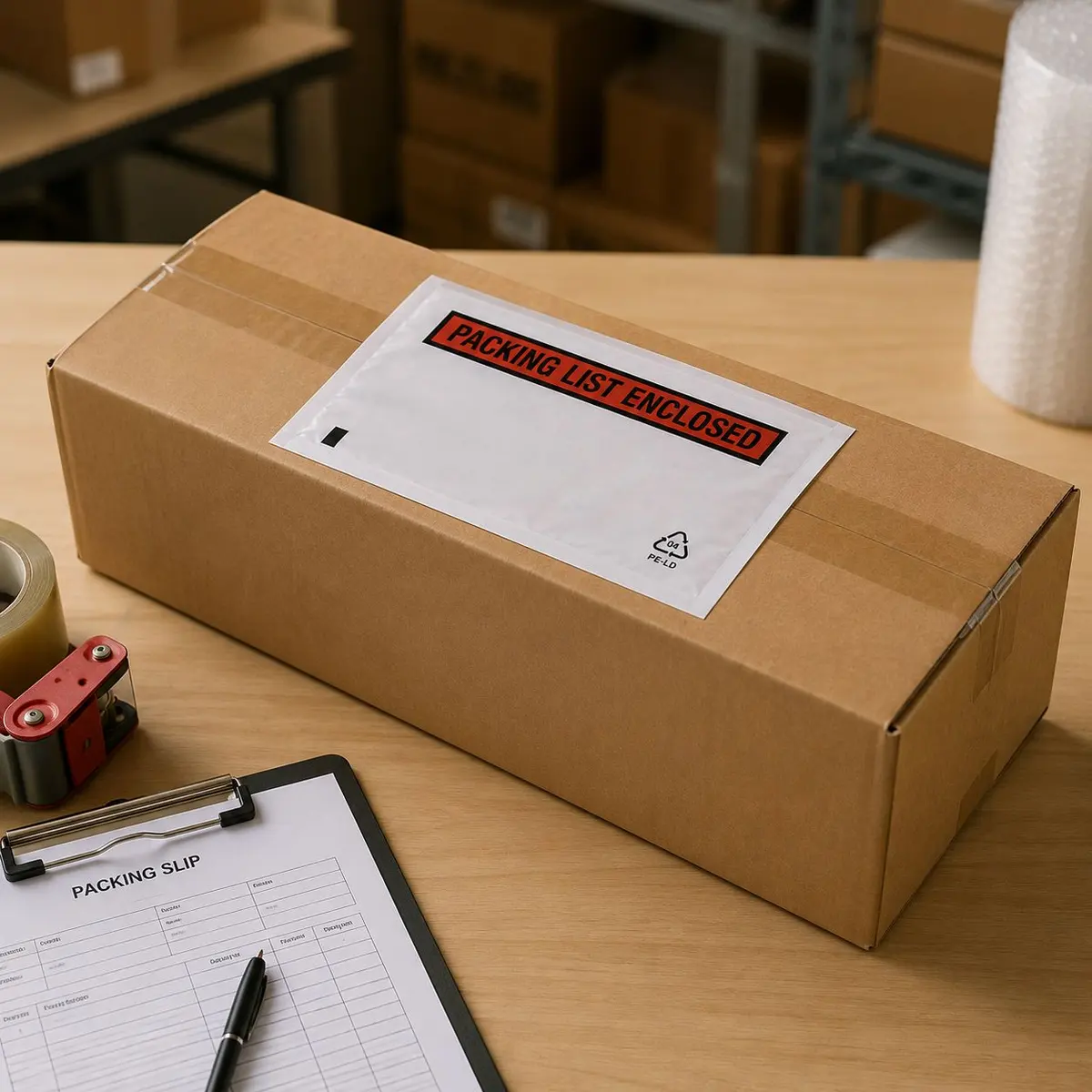
Handling Oversize and Multi-Page Documents in a Pouch
Size the pouch to the document set as it will travel, full size and unfolded.
Then size it for thickness, not just for the page. I say this first because a set measured as one flat sheet on a desk often becomes a 6-page bundle by the time the certificates, declarations and inspection reports are added.
An oversize set needs three things from its pouch. It needs the right footprint (usually A4), enough depth to lie flat, and film heavy enough to survive the journey. Get those three right and a thick set stays flat, sealed and readable through the window.
How do I handle an oversize or multi-page document set in a pouch?
First work out which problem you actually have.
“Oversize” hides two different problems, and they need different fixes.
A large footprint, like a flat A4 sheet, is solved by a bigger pouch. A thick stack of many pages is solved by extra depth, a gusset or heavier film. Buyers often mix these up, and then they either crease their paperwork or pay for film they never needed. I would treat the two separately, every time.
A4 flat or folded: which is right?
Keep any document an inspector must read flat, in an A4 pouch. Fold only single slips that are not critical.
Folding saves pouch size, but it works against you on anything important, because the document that matters most is exactly the one someone will want to read without opening the pouch.
- Fold a single domestic packing slip or returns label into a DL or 4.5 × 5.5 pouch. Nobody needs to read the whole sheet, so a folded view is fine.
- Keep flat any multi-page set, commercial invoice, packing list or certificate of origin. Folded pages are hard to read through the window. The officer is more likely to slit the pouch open, and creased papers look careless at a border.
Here is the rule of the trade I would pin above every packing table. If you are folding A4 to make it fit, the pouch is too small. Step up to A4 rather than crease a customs set. The full size chart is in our guide to packing list envelope sizes.
How many pages can a pouch actually hold?
A flat pouch holds a thin set of a few sheets comfortably. Past that, it stops lying flat and the seal lifts.
Page count alone does not decide it. Three things work together.
- Footprint. The pouch must be bigger than the unfolded sheet so it can seal around it.
- Depth. A flat pouch has almost none, so a thick stack bulges and pushes the edges up.
- Film and paper weight. Heavier film holds more without splitting, and lighter paper packs more sheets into the same depth.
This is why we do not publish a fixed page count, and I would be wary of anyone who does. It moves with all three.
The practical test is simple, though. If the sealed pouch will not lie flat against the carton, you are over capacity. Go larger, gusseted or thicker.
| Document set | Pouch choice | Why |
|---|---|---|
| Single packing slip (1 to 2 sheets) | DL or A6, fold if needed | Light and non-critical, so only the footprint matters |
| Invoice and packing list (2 to 4 pages) | A5 to A4, flat | A4 if any page is full size, so the set stays readable |
| Full customs set: invoice, packing list, certificate of origin | A4, heavier film | Several pages that must read flat and stay sealed on a long route |
| Bulky set with extra certificates (inspection, fumigation) | A4 gusseted, or thicker film | Depth is the limit here, not footprint |
For customs sets in particular, see what size packing list envelope to use for customs document sets.
When should I use a larger or gusseted pouch?
Go larger when the page is bigger than the pouch. Go gusseted or thicker when the stack is too deep for a flat pouch.
Each one fixes a different failure.
In my experience of packaging, the larger footprint is the easier problem. It is for a document that is physically wider or taller than the pouch. A flat A4 sheet in an A5 pouch is the classic case, and only more size fixes it.
A gusseted pouch has an expanding fold in the sides or base. It lets the pouch grow in depth to take a thick stack. Use it when the page size is fine but the set is many sheets deep.
Heavier film wraps a bulky set without splitting. It also copes better with stacking and damp on long international routes, where a carton may be handled, restacked and stored in humid warehouses several times before delivery.
A bulky set often needs two of these at once, for example an A4 footprint plus a gusset. A larger documents-enclosed wallet is another way to carry a multi-document set without forcing it. We have exported document-enclosed wallets to the UK and Australia for years, from our factory in Jaipur, and the thick multi-certificate set is where a flat pouch gives up first.
How do I keep a thick set flat and readable?
Match capacity to the set and seal it flat. A pouch that bulges lifts at the edges, weakens the adhesive and hides the paperwork.
The clear film only earns its place if an officer can read the top sheet without opening anything.
Four habits help.
- Do not over-stuff. An over-filled pouch bulges, the edges lift and the window distorts. Size up before you cram, just as you would not force one more roti into a full tiffin.
- Press the full adhesive area onto a clean, dry, flat face of the carton. Keep away from edges, seams and strapping, where a thick pouch is most likely to be crushed or torn.
- Put the top sheet facing out, with the Invoice Enclosed or Documents Enclosed legend visible, so the pouch gets checked and not ignored. A printed legend can be added through custom print.
- Keep the whole set in one pouch, in order. I am strict about this one. Then nothing gets separated in transit and there is one place to inspect.
I would add one honest caveat.
A gusseted or heavy-film pouch costs more than a flat one. If your sets are only ever 2 or 3 pages, you do not need it, and a flat A4 pouch will do the job well. We would rather sell you the simpler pouch than an expensive one that sits half empty.
Not sure if your set needs a larger, gusseted or thicker pouch? Send us your page count and your shipping route, and we will suggest a pouch and send samples to try. You can also browse the range on our products page.
Frequently asked questions
How many pages can a packing list envelope hold?
A standard flat pouch takes a thin set of a few sheets comfortably. Past that, it stops lying flat and the seal starts to lift. The real limit depends on film thickness and paper weight, so check your set thickness with the supplier before you order.
Should I fold an A4 document to fit a smaller pouch?
Only for a single slip that nobody needs to read in full. Folding a customs set makes it hard to read through the window, invites someone to slit the pouch open, and creases the paperwork. Use an A4 pouch and keep it flat.
What is a gusseted document pouch?
It is a pouch with an expanding fold in the sides or base. The fold lets it grow in depth, so it can hold a thick stack of pages that would make a flat pouch bulge.
When should I use a larger pouch instead of a thicker one?
Go larger when the page is bigger than the pouch, like a flat A4 sheet going into an A5 pouch. Go thicker or gusseted when the number of pages is the problem, not the page size.
What film thickness do thick document sets need?
Heavier sets and long, rough routes need thicker film, because it resists tearing and stays sealed under stacking pressure. The right thickness depends on the route and the sheet count. Ask us through the contact page and we will suggest one.
Can one pouch hold a whole customs document set?
Yes, and it should. The commercial invoice, packing list and certificate of origin travel best together in one A4 documents-enclosed pouch, so customs can check value, quantity and origin in one place.
Does a thick pouch still seal reliably to the carton?
It does if it is not over-filled. An over-stuffed pouch bulges, lifts at the edges and weakens the bond. Keep the set within capacity and press the whole adhesive area onto a clean, dry, flat face.
Sourcing these in volume?
We make packing list envelopes in Jaipur for importers and distributors. Factory-direct, private label welcome.