
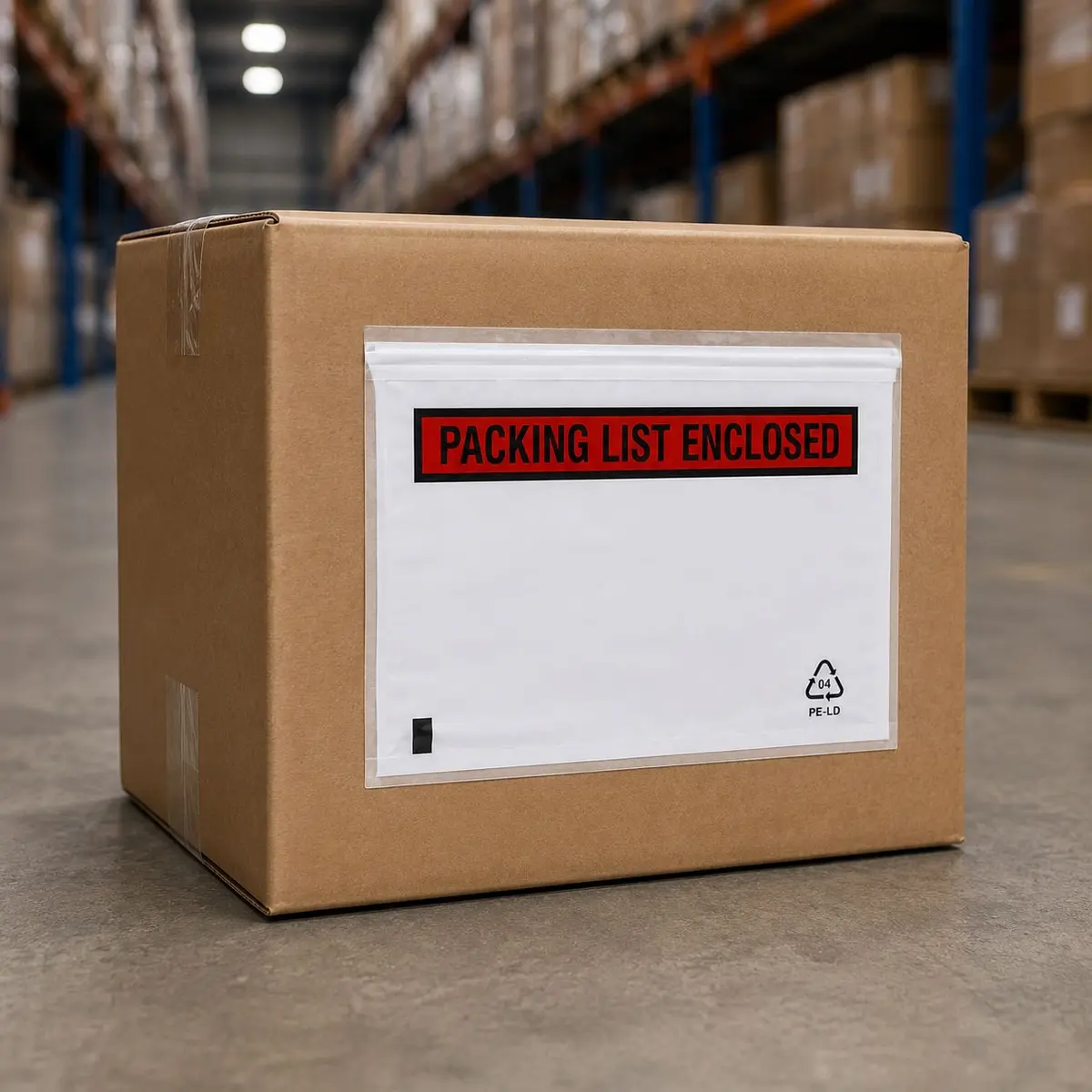
How to Apply a Packing List Envelope Correctly
Applying a packing list envelope takes about as long as reading this sentence.
Getting it wrong costs you a lost invoice at the other end.
We make these pouches, and I would rather you get the method right than blame the product. The adhesive bonds on contact, with no water, heat or tape. So the whole method comes down to 3 things: the surface, the placement and the pressure. Get those right and the pouch stays on for the life of the shipment. Get them wrong and it lifts somewhere between your dock and your customer’s.
How do you apply a packing list envelope step by step?
Clean the surface, insert the document, peel the liner, position it flat and press hard. Once a packing line knows these 5 steps, they take seconds. This is the order I would teach a new packer.
- Prepare the surface. Wipe the panel free of dust, grit, oil and condensation, because the adhesive has to touch the carton, not a layer of dirt.
- Insert the document. Fold the packing slip so the heading reads correctly through the clear film, and slide it fully inside.
- Peel the liner off completely, in one smooth pull. A partial peel leaves dead patches that never stick.
- Line it up before it touches. A permanent adhesive grabs at once, so you cannot slide it into place afterwards.
- Press firmly. Smooth from one edge to the other, then press out from the centre with the heel of your hand, and finish on all 4 edges.
How should the surface be prepared?
It must be clean, dry and firm.
In my view, this one factor decides most bonds. A pressure-sensitive adhesive works by flowing into the tiny texture of the carton surface. Anything sitting in between stops that contact.
- Dust and grit. The pouch grips the dust instead of the box, so wipe or brush the panel first.
- Oil and grease. These push the adhesive away completely. Pick a clean face.
- Moisture, frost and condensation. These form a slippery layer the glue cannot grip. Dry the panel and apply in dry air.
- Loose film. A slack polybag or baggy shrink wrap flexes away from the bond, so pull it taut first.
- Textured or hard plastic. The adhesive only touches the high points, so pick the smoothest flat patch and press hard from the centre outwards.
Corrugated, kraft and smooth cartons are the easiest surfaces, because their texture helps the adhesive lock in. If you want the reason behind this, see how packing list envelope adhesive works.
How do you insert the document the right way?
Fold it with the printed side facing out through the window and the heading readable, then slide it right in. The point of a documents-enclosed pouch is that people can read the paperwork without opening the carton.
So legibility comes first.
Fold the sheet to fit the pouch so it lies flat, not crumpled. Push it fully inside, because a corner sticking out invites snags and water. Then close the flap, or the reseal strip if the pouch has one.
If your documents keep hanging out of the pouch, I would say the pouch is simply too small for them. That is a sizing problem, not a packing problem, and you can match the size to your sheet from our products range.
Where should the envelope go on the carton?
Put it on the largest flat panel, fully visible, and away from seams, tape, edges and corners. Flatness helps both the bond and the reading.
| Placement | Result | Why |
|---|---|---|
| Flat panel, centred | Best | Full adhesive contact, pouch lies smooth and readable |
| Over a carton seam or fold | Poor | The pouch bridges a gap and peels at the ridge |
| Across an edge or corner | Poor | Bending lifts the film, and corners catch on conveyors |
| On tape or a label | Poor | The adhesive bonds to the tape, and the tape peels away |
| On loose or baggy film | Variable | Slack film flexes and breaks the bond |
The rule of the trade is simple. One smooth flat panel wins every time, and I would not try to be clever about it.
The face you choose also matters for customs. For what belongs on the outside, see which documents go outside for customs.
How do you press it down without air bubbles?
Put one edge down at a slight angle, smooth across to the far edge, then press out from the centre. This pushes the air ahead of the film instead of trapping it.
I would train people to peel the liner slowly, so the adhesive does not curl or grab too early. Then touch down one edge and roll the rest of the pouch down, never slap it flat in one go. Press with the heel of your hand or a flat card, from the centre outwards.
The edges go last, and they need the most care.
That is where a bond fails first.
What mistakes should you avoid?
Almost every failure comes from a short list of habits. If you send us a pouch that has lifted, we would check these first.
- Skipping surface prep and sticking the pouch over dust, oil or condensation.
- Peeling the liner only partly, which leaves patches that never stick.
- Placing the pouch over seams, edges or tape, which builds in a lift point.
- Pressing too lightly. The adhesive needs real hand pressure to flow and grip.
- Pulling up a permanent pouch to move it. You will tear the film or the carton. Ask for a removable grade if you move pouches often.
- Wetting or heating the adhesive. It is applied dry, and water or heat only contaminate it.
How do you apply pouches on cold or dusty surfaces?
Warm the surface if you can, clean it well, and press extra hard.
Cold and dust are the 2 conditions that most often beat a good pouch.
In the cold, the adhesive stiffens and loses tack, a bit like butter straight from the fridge. Below roughly 5°C the bond becomes unreliable, and frost or condensation make it worse. Dust simply blocks contact.
So apply at room temperature when you can. Let the pouch, the carton and the document warm up first, and the bond will hold as they cool. In dusty areas, wipe the panel just before application. For chilled, frozen or constantly dusty lines, ask for a cold-temperature or high-tack adhesive. Our note on adhesion in cold storage and freezers covers the cold case in more depth.
We have made these pouches in Jaipur since 1997 and ship them to 20+ countries. Clear, well-applied paperwork also cuts mis-ships and customs holds, which we cover in reduce shipping errors with document pouches.
Applying pouches in the cold, on films or on awkward surfaces? Tell us your cartons and conditions, and we will suggest the right adhesive grade and pouch size and send samples to try.
Frequently asked questions
How do you apply a packing list envelope correctly?
Clean and dry a flat area of the carton, put the folded document in, peel the liner off completely, line the pouch up over a flat panel and press it down hard, edges included. The adhesive grabs on contact, so position it before it touches. No water, heat or tape is needed.
Which way up does the document go in the pouch?
Printed side out, with the heading readable through the clear film. Slide it all the way in so no corner sticks out of the opening, then close the flap. Handlers and customs can then read it without opening the carton.
Where on the box should the packing list envelope go?
On the largest flat panel, usually the top or a side, where it is easy to see. Keep it clear of seams, tape, edges and corners, because those are the places a pouch lifts in transit.
Do I need to wet or heat the adhesive first?
No. The pouch is applied dry. The adhesive under the liner is already tacky, so you just peel and press, and adding water or heat only spoils the bond.
How do I avoid air bubbles when applying the pouch?
Put one edge down first at a slight angle, then smooth across to the other edge instead of slapping it flat. Finish by pressing out from the centre with the heel of your hand or a flat card. Working from one side pushes the air out ahead of the film.
Can I reposition the envelope after sticking it down?
Usually not. Most shipping pouches use a permanent adhesive, so the first placement is the final one, and pulling it up can tear the film or the carton face. If your team needs to reposition or reopen often, ask for a removable or resealable grade.
How do I apply pouches on cold or dusty surfaces?
Warm things up and wipe them clean first. Cold makes the adhesive stiff and dust blocks contact, so apply at room temperature where you can and press extra hard. For chilled, frozen or dusty lines, a cold-temperature or high-tack grade is worth asking about.
How do I keep a packing list envelope stuck on textured plastic?
Find the smoothest flat patch, wipe it clean and dry, and press the pouch down hard from the centre outwards, because on a textured surface the adhesive only touches the high points. Test one pouch on the real container before a full run. If it still lifts, ask for a high-tack grade made for plastic.
Sourcing these in volume?
We make packing list envelopes in Jaipur for importers and distributors. Factory-direct, private label welcome.