
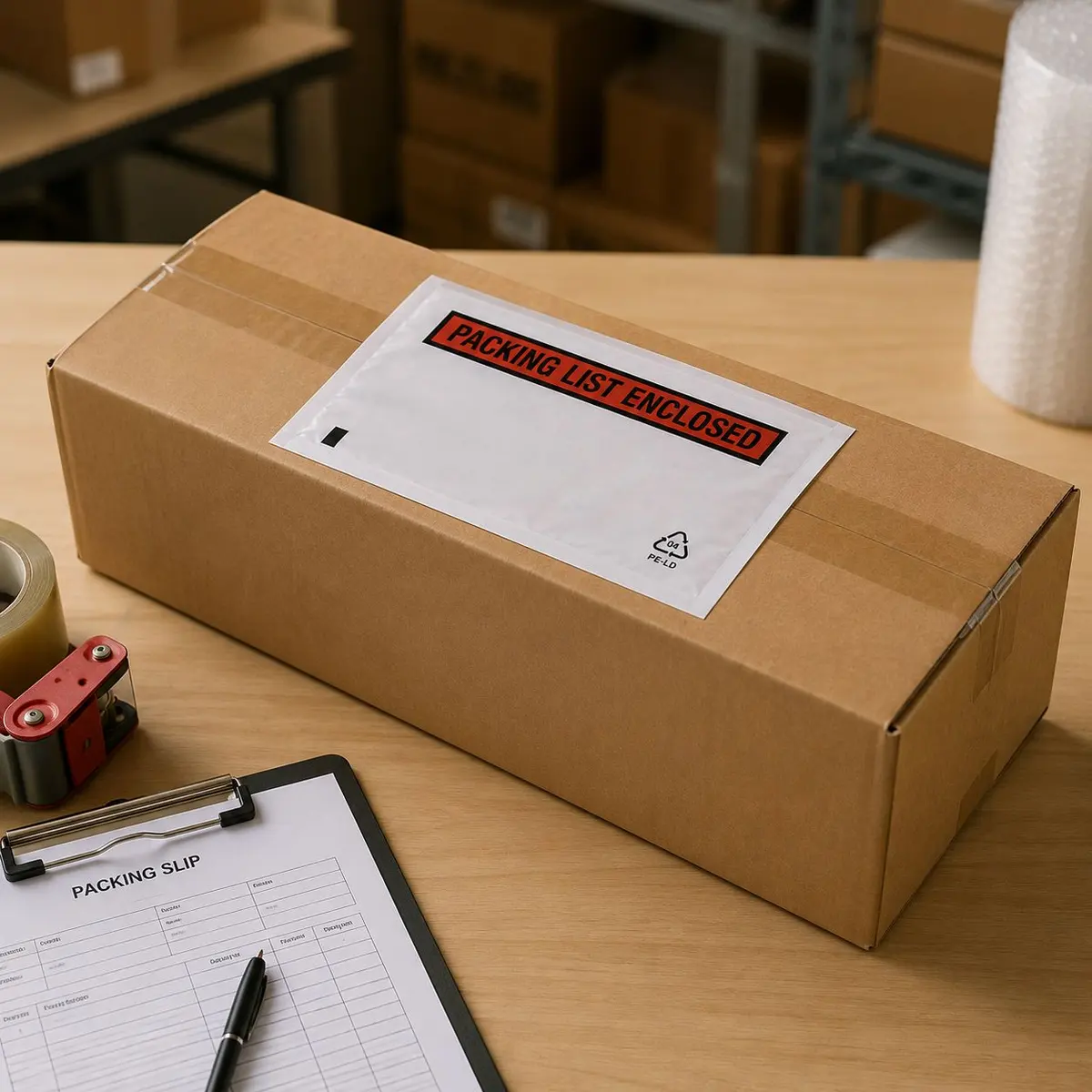
Packing List Envelopes for B2B Wholesale and Distribution
Wholesale and distribution run on paperwork that has to travel with the goods. There is a delivery note the customer checks against the pallet, a copy that comes back signed as proof of delivery, and a purchase order number that lets the trade buyer book the load in.
Packing list envelopes keep all of that attached, readable and dry from your dock to theirs. These are the adhesive, clear-fronted document pouches that stick to the outside of a carton or pallet.
We have made packaging in Jaipur since 1997 and export to 20+ countries. Document-enclosed wallets have been a long-running export product of ours to the UK and Australia, so B2B paperwork is familiar ground for us. Below I cover delivery notes and POD, PO numbers, why consistency matters, and branded trade pouches.
What do wholesalers and distributors use packing list envelopes for?
They use them to carry the delivery note, packing list and POD copy on the outside of every carton and pallet.
The receiver can then check and sign without opening the load. That is the whole idea.
In a B2B delivery, four documents start working the moment the truck arrives.
- The delivery note, with the order number, ship-to address, SKUs, quantities and carton count.
- The proof of delivery (POD), i.e. the signed copy confirming receipt and condition.
- The purchase order reference, which is the customer’s PO number for booking in.
- A copy invoice or returns form, where the account asks for one on delivery.
Because the pouch is read through the window, the goods-in team can check the delivery against the pallet and sign the POD without breaking the load down. At a busy distribution bay, that saves more time than anything else in the handover.
How do delivery notes and POD sign-off work in a pouch?
A clear pouch lets the receiver read the delivery note, check it against the goods and sign the POD on the spot. Nobody has to pull out the paperwork or open a carton.
The delivery note answers one question for the person at goods-in. Did everything that was supposed to arrive actually arrive?
We think of it as the checklist.
The POD closes the loop. It matters most. It is the countersigned record that the customer got the right goods in good condition. Any shortage or damage is written on it before the signature, which is exactly why the paper needs to be visible at the point of delivery.
| Document | What it confirms | Who signs | Pouch role |
|---|---|---|---|
| Delivery note | What is in the delivery | Driver presents | Visible through the window for check-off |
| Proof of delivery (POD) | Goods received and their condition | Receiving customer | Signed copy kept dry and attached |
| Purchase order reference | Matches the buyer’s order | Nobody | PO number readable for booking in |
| Copy invoice | Amount due and billing | Nobody | Carried alongside, protected |
Keep these together in one pouch. A signed POD that gets separated from its delivery note in a busy yard is a common cause of disputed deliveries and chasing calls.
For how these documents differ, see packing list vs packing slip vs invoice.
How do you handle purchase order references on the pouch?
Make the PO number visible through the window. Print it on the delivery note, or ask for a printed panel and barcode zone on the pouch face.
My suggestion to any distributor shipping against customer POs runs to four points.
- Place the PO number in the top zone of the delivery note, where it reads through the window.
- Print a barcode or order-ID panel on the pouch if your customers scan goods in.
- Keep the window clear over the PO line, and brand the rest of the face if you like.
- Use one pouch per consignment, so each PO travels on its own and can be traced. For a 1 page docket a DL or A5 pouch is enough, and a 3 or 4 page set needs A4.
When the PO reads without opening anything, goods-in is faster. Short-delivery disputes are also easier to settle, because the paperwork and the pallet were checked together.
Why does bulk consistency matter for distributors?
Distributors apply pouches in large numbers, and often on semi-automatic lines.
Any drift in size, tack or window clarity between batches shows up fast. It shows up on the line first.
This is what hurts most when each depot buys locally.
- The size drifts, and pouches stop feeding cleanly through an applicator.
- The adhesive varies, and pouches peel off shrink wrap or corrugated in the yard.
- The window turns hazy, and delivery notes and PO numbers get hard to read.
- Print versions multiply, so legends and branding differ from depot to depot.
My rule of the trade here is simple, and we would give the same advice even to a buyer who never orders from us. One approved spec, bought for every branch, is worth more than a slightly lower price at each branch.
It keeps your trade paperwork uniform and your lines running. It also means one depot can cover another’s overflow with the same pouch. You can see the formats on our products page.
Can you brand packing list envelopes for trade customers?
Yes. A pouch can carry your logo, a “documents enclosed” legend, return instructions or barcode zones, so every delivery reaches the customer’s goods-in bay with your name on it.
The usual options for wholesale are these.
- Your company logo and brand colours on the face.
- A “delivery note enclosed” or “documents enclosed” legend in your house style.
- Return and contact details printed on the pouch.
- A barcode or PO panel placed where the customer’s scanner expects it.
- Text in more than one language for cross-border accounts.
A practical approach, and the one I would pick, is a plain house pouch for most of your volume and a branded one for key accounts. You get the branding where it counts without paying for print on every consignment. Our custom print page shows what can go on the face.
The honest downside of branding is flexibility. We will not pretend otherwise. Printed stock is tied to one design, so if your logo or legend changes, the old stock becomes waste. Order printed pouches in quantities you will actually use.
Why buy wholesale packing list envelopes from a manufacturer?
Buying direct at volume lowers your landed cost. We see it clearly on export orders. It lets you combine several sizes and print versions in one order, and it gives you the same spec at every depot.
We are a manufacturer with 30+ years in packaging, ISO 9001, CE and RoHS, and we export to 20+ countries. For trade distribution we supply bulk packing list envelopes in heavy-gauge film that resists oil and water, with high-tack adhesive that bonds to corrugated, shrink wrap and stretch-wrapped pallets. You can have them plain or branded.
A direct relationship also gives you one contact for forecasts, combined shipments and uniform quality. At scale, I think that matters far more than the unit price on a single pack.
Standardising delivery-note pouches across your depots, or planning a branded pouch for key accounts? Send us your sizes, PO panel needs and volumes, and we will quote and send samples to try.
Frequently asked questions
What documents do wholesalers put in a packing list envelope?
Usually the delivery note with a signature line for proof of delivery, the packing list, and sometimes a copy invoice or returns form. The pouch sits on the outside of the carton or pallet, so the receiving team can check quantities and sign without opening the load.
What is the difference between a delivery note and a proof of delivery (POD)?
The delivery note lists what is being delivered: order number, SKUs, quantities and carton count. The POD is the signed copy that comes back once the customer confirms receipt and condition. A clear pouch lets the receiver check one against the goods and sign the other on the spot.
How should a purchase order reference appear on the pouch?
Put the customer PO number near the top of the delivery note so it reads through the window. Or ask for a printed panel and barcode zone on the pouch face. When the PO matches the goods at the dock, the trade customer can book the delivery in without a phone call.
Why does batch-to-batch consistency matter for distributors?
Because distributors apply pouches in large numbers, often on semi-automatic lines. If size, adhesive tack or window clarity drifts between batches, you get jams, pouches peeling off pallets and paperwork nobody can read. One consistent spec from one manufacturer removes that variation.
Can packing list envelopes be branded for trade customers?
Yes. They can carry your logo, a ‘documents enclosed’ legend, return instructions or a barcode zone. A branded pouch puts your name in front of the customer's goods-in team on every delivery.
What size pouch suits wholesale delivery notes and POD?
Most trade delivery notes are A4 or A5, so an A4 or A5 pouch is the usual choice for multi-line orders and multi-page sets. Single-page dockets fit a DL or A5 pouch. Two sizes, A4 and A5, cover almost every order type.
Do these pouches survive pallet shipping and outdoor handling?
A heavy-gauge film that resists oil and water, paired with a high-tack adhesive, will bond to corrugated, shrink wrap and stretch-wrapped pallets and hold up in the yard. That keeps the delivery note readable and attached, so the POD can still be signed at the far end.
Sourcing these in volume?
We make packing list envelopes in Jaipur for importers and distributors. Factory-direct, private label welcome.