
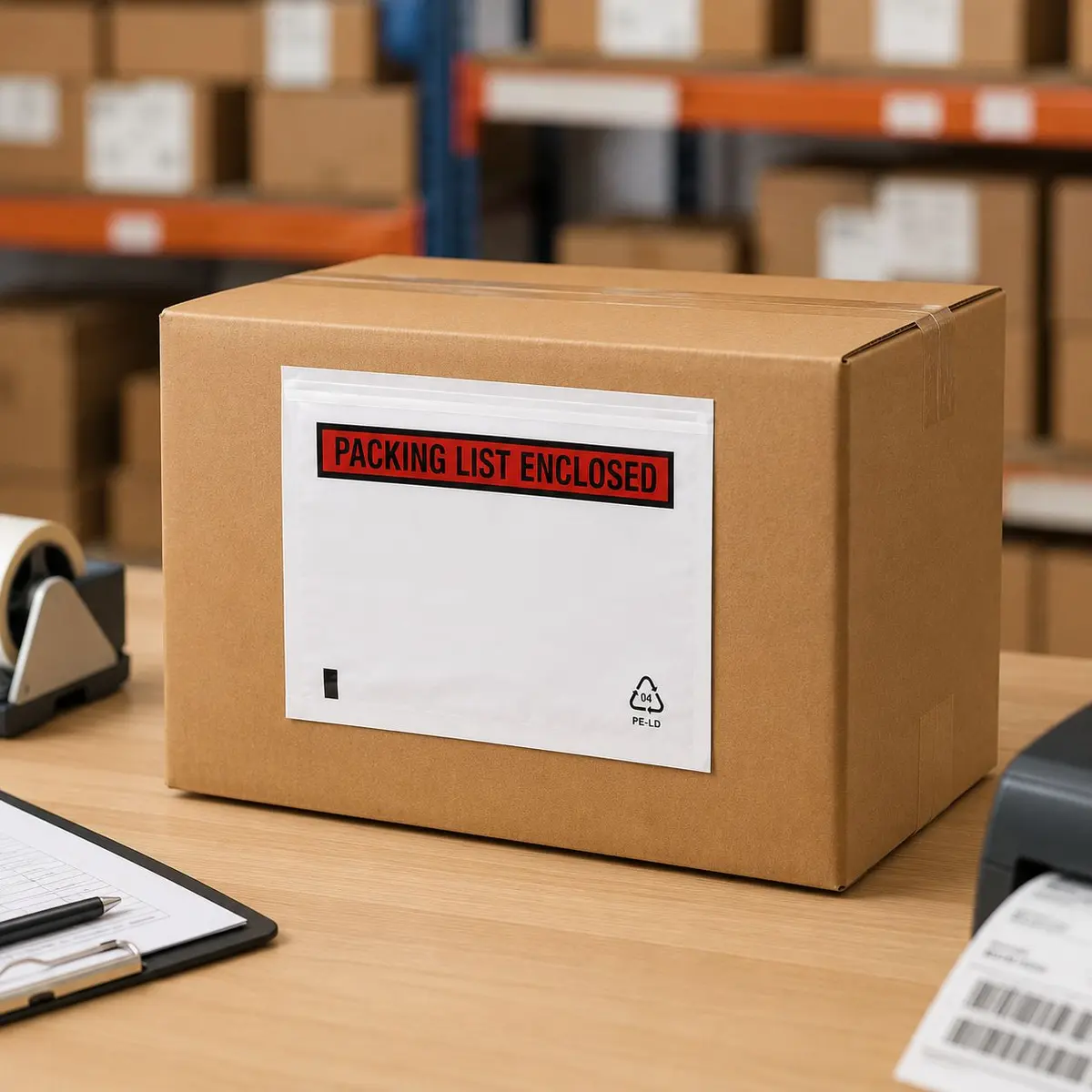
Packing List Envelopes for Exporters and International Freight
For an exporter, the paperwork on the outside of a carton matters as much as what is inside it. A missing or unreadable commercial invoice, packing list or certificate of origin can hold a shipment at the border for days.
I know this from our own side of the trade. We are an exporter too, from Jaipur to 20+ countries, and document-enclosed wallets have been one of our long-running export products to the UK and Australia.
This topic sits close to home for me.
Packing list envelopes for export are clear, self-adhesive pouches. They keep the paperwork visible, attached and in one piece through long-haul sea and air freight. This article covers what goes in the pouch, why a second-language legend helps, and which film survives the journey.
Why do exporters use packing list envelopes?
Because the pouch keeps customs paperwork on the outside of the carton, where an officer can read it and take a copy without opening the shipment.
That one fact prevents a lot of customs delays.
When a carton crosses a border, customs checks the declared contents against the documents. If the paperwork is sealed inside, an officer may have to open and repack the carton, or simply hold it. A clear pouch next to the shipping label lets the invoice, packing list and COO be checked in seconds.
It does 4 jobs at once. It keeps the documents readable through a clear window. It stays stuck through handling, sortation and line-haul. It guards paper against humidity and rough handling. And it lets officers take their copy and release the shipment faster.
What documents go in an export document pouch?
The outer pouch carries the customs set, meaning the documents an officer must see and may remove. A spare set usually travels inside the carton.
That spare is your backup.
| Document | Purpose | Typically in outer pouch? |
|---|---|---|
| Commercial invoice | Value, currency, Incoterms, parties for duty | Yes |
| Packing list | Cartons, weights, dimensions, contents | Yes |
| Certificate of origin (COO) | Country of origin for tariffs / preference | Yes |
| Bill of lading / air waybill | Carrier transport contract | Often |
| Inspection / phytosanitary certs | Regulatory compliance | Where required |
A common convention is 3 copies of the commercial invoice. One is for the export country, one for destination customs and one for the consignee. The rule changes by destination.
So check with your freight forwarder.
For how these documents differ, read our guide on the packing list, packing slip and invoice. For sizing, see choosing a pouch size for full customs document sets.
Why do multilingual legends matter on export pouches?
A pouch printed with “Documents Enclosed” in the destination language helps officers find the paperwork at once. That lowers the chance a pouch is missed, or a shipment waits while staff hunt for documents.
English is widely understood in trade. Still, a legend in the import market’s own language says clearly what the pouch holds. Which pair you need depends on your lanes:
- English and Spanish for Latin America and Spain.
- English and French for France, francophone Africa and Canada.
- English and Arabic for the Gulf and MENA markets.
- English and Russian for the CIS region.
- English and the local language for a high-volume, single-market lane.
In my view this is one of the cheapest upgrades an exporter can make. A second language is only a small print change, and it pays for itself the first time it prevents a hold. We can print the legend in your markets’ languages, and our article on multi-language printed pouches shows how the text is laid out.
What film and adhesive survive long-haul air and sea freight?
Use a heavy-ply, oil- and water-resistant polyethylene film with a high-tack adhesive. It has to bond to corrugated board, shrink wrap and stretch-wrapped pallets, and hold for weeks.
Each mode tests the pouch in a different way:
| Mode | Main stresses | Pouch priority |
|---|---|---|
| Sea freight | Humidity, salt air, condensation, weeks in transit | Water-resistant film, durable adhesive |
| Air freight | Pressure and temperature swings, fast handling | Curl-free film, high first-contact tack |
| Multimodal | Repeated sortation, pallet wrap, manual handling | Heavy-ply face, clean reseal |
The clear face must stay clear.
If it clouds or yellows, the documents are hard to read on arrival.
The adhesive must hold from the origin warehouse to the destination port without lifting at the edges. Here is a rule of the trade I would pass on to any exporter: a peeled corner is how a customs copy goes missing.
I would never save money on the adhesive for a sea shipment. For moisture performance, see whether packing list envelopes are waterproof.
How should exporters choose pouch size and style?
Match the pouch to your largest document set, then standardise on it. Most exporters carry A4 invoice and packing list sets, so an A4 or A5 pouch covers most cartons, with smaller formats for samples and parcels.
- A4 takes a full commercial invoice, packing list and COO, unfolded.
- A5 takes folded document sets on smaller cartons.
- A full-face clear pouch suits a set that must be readable from outside.
- A tamper-evident pouch suits high-value or preferential-origin shipments.
I would keep to 1 or 2 sizes. Purchasing stays simple, and nobody at the dock hunts for the right pouch. You can see the formats on our products page.
Where should exporters source export document pouches?
Buy direct from a manufacturer that also exports. You get the same film, adhesive and print on every order, legend options for your markets, and a lower landed cost at volume.
The honest downside is that buying direct means a minimum order and a lead time. A local office-supply shop has neither.
That is the trade-off. But shop stock can vary from one lot to the next, and that is a real risk when the pouch is holding customs papers.
We have made packaging in Jaipur since 1997, with ISO 9001, CE and RoHS, and we are a recognised Star Exporter. We build our export pouches with heavy-ply film, high-tack adhesive, full-face clear windows and legends in the languages you need.
Send us your document size, your main export lanes and how your cartons travel, and we will suggest a pouch and send samples to try.
Frequently asked questions
How do you attach a commercial invoice and packing list to an export carton?
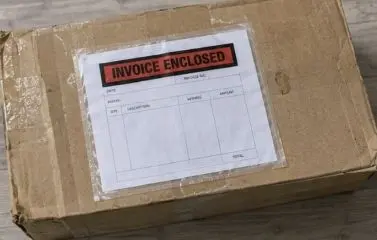
Slide the printed documents into a clear adhesive pouch and stick it on the outside of the carton, next to the shipping label but not over any barcode. Customs can then read the papers and take a copy without opening the box. Many exporters also put a spare set inside the carton in case the outer pouch gets damaged.
How many copies of the commercial invoice should go in the pouch?
Three copies is a common practice: one for the export country, one for destination customs and one for the consignee. The outer pouch carries what customs needs, and a spare often travels inside. The exact count depends on the destination, so confirm it with your freight forwarder.
What is the difference between a commercial invoice and a packing list?
The invoice carries the value, currency, Incoterms and parties, which customs uses for valuation and duty. The packing list describes the physical shipment, i.e. cartons, weights, dimensions and contents. Both usually travel together in one external pouch.
Should export document pouches have multilingual legends?
Yes, where the destination uses another language. A 'Documents Enclosed' legend in that language next to English helps officers spot the paperwork fast, so the pouch is less likely to be missed. Common pairs are English with Spanish, French, Arabic or Russian.
What film and adhesive hold up for long-haul sea and air freight?
A heavy-ply, oil- and water-resistant polyethylene film with a high-tack adhesive is the safe choice. Sea freight brings humidity, salt air and condensation for weeks. Air freight adds pressure and temperature swings. The pouch has to survive both without peeling or clouding.
Do customs officers need to see documents through the pouch?
Yes, and that is the main point of the pouch. A clear front lets officials read the invoice, packing list and certificate of origin without opening the carton. Use a full-face clear window when the whole set must be readable from outside.
Can a certificate of origin travel in the same pouch?
Yes. Exporters commonly carry the commercial invoice, packing list and certificate of origin together in one outer pouch. For high-value or preferential-origin shipments, a tamper-evident or full-face pouch keeps the set protected and still visible.
Sourcing these in volume?
We make packing list envelopes in Jaipur for importers and distributors. Factory-direct, private label welcome.