
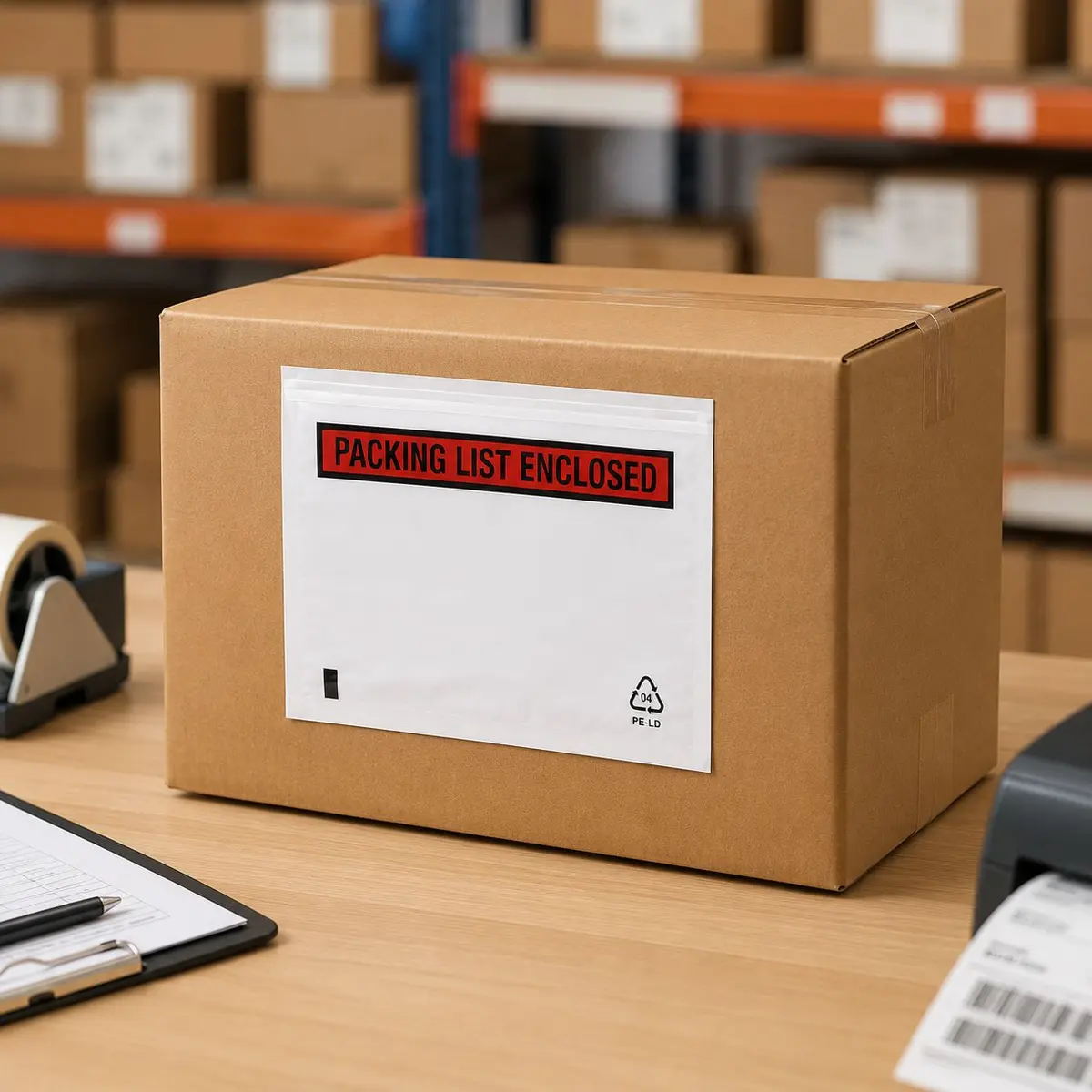
Packing List Envelopes for Electronics Shipments
On an electronics shipment, the packing list envelope does more than its size suggests. It keeps the export paperwork readable on the outside of the carton. It carries the serial-number list with the goods. It also does all this without going anywhere near the static-sensitive product inside.
I will explain where the pouch sits next to ESD-safe packing, which documents go where, and what size to pick. We make these pouches in Jaipur, and we have shipped them to 20+ countries.
Why do electronics shipments need a document pouch on the outside?
A copy of the packing list and commercial invoice on the outside lets customs, forwarders and couriers check the shipment without opening the box. With electronics that are expensive, sealed and sensitive, not opening the box is exactly what you want.
The usual export practice is simple.
You make 2 copies. One copy of the paperwork goes inside the carton. The other goes on the outside in a self-adhesive “documents enclosed” wallet. Customs checks the outside copy against the invoice and transport documents.
This helps in three ways:
- Customs checks go faster because officers confirm contents without breaking seals.
- Forwarders read weights and carton numbers at a glance.
- The copy inside survives even if the outside pouch gets torn off.
How do packing list envelopes work with ESD-safe packaging?
The envelope goes on the outer carton. The static protection goes around the device inside.
They are 3 separate layers doing separate jobs, and the pouch is only the outer one.
General ESD guidance says only ESD-safe material should touch bare electronics, and paperwork should sit on the outer packaging. This is why an external pouch fits so well. It keeps invoices and slips off the product completely and still keeps them in view.
| Layer | Item | Job | Touches the device? |
|---|---|---|---|
| Inner | ESD or anti-static bag | Protects against electrostatic discharge | Yes |
| Middle | ESD-safe foam, rigid carton | Cushions and contains | Indirectly |
| Outer | Packing list envelope | Carries visible, scannable paperwork | No |
Electronics normally ship in a rigid box, not a soft mailer, so the carton face gives the pouch a flat, firm surface to grip.
Some projects ask for a document wallet that is ESD-safe in its own right.
I would not guess a rating here. The right spec depends on the device and the destination, so check it against the standard for your application and talk to us about what you need.
What documents travel in an electronics export paperwork pouch?
Most electronics exports carry a commercial invoice, a packing list and a transport document. Add a battery declaration where lithium cells are involved. A copy of this set usually rides on the carton in the pouch.
- The commercial invoice gives a full description and value of the goods. It usually has to travel physically with an international shipment for clearance.
- The packing list gives line-by-line contents, often with serial numbers so receiving staff can match counts.
- The transport document is the air waybill or bill of lading, with shipper and consignee details.
- A battery or dangerous-goods declaration applies where lithium batteries or other regulated items are inside.
You can still email the financial copy of the invoice to the buyer. The pouch handles the paper set that customs and carriers look at in transit.
Where do serial numbers and warranty documents belong?
Serial numbers go on the packing slip that travels with the shipment. Warranty cards and registration inserts go inside the box with the product.
Splitting it this way puts each paper where its reader expects it. The distributor’s goods-in team checks serial numbers against the packing list, which also helps after-sales tracking later. The warranty card is for the end customer, not customs, so it stays with the device. A copy of the packing list and invoice goes outside for clearance and proof of delivery.
Serial tables and barcodes are dense.
Keep them flat and on one panel, because a scanner will miss anything that lands across a fold.
What size and format suit electronics cartons?
I would pick A4 flat or A5 for electronics.
Export sets often run to several pages, and they scan better flat or folded once.
A set folded in three and pushed into a narrow pouch can bury a serial table or barcode in a crease. This is a common mistake with electronics paperwork, and I think it is the easiest one to avoid.
- A4 flat suits multi-page customs sets, such as an invoice plus a long packing list plus declarations. See our guide to packing list envelope size for customs sets.
- A5 suits one or two pages on a standard carton, with an A4 sheet folded once into two readable halves.
- Smaller formats like DL or A6 can work for accessory packs with only a few lines. Check that the serial table and barcode still fall on one panel.
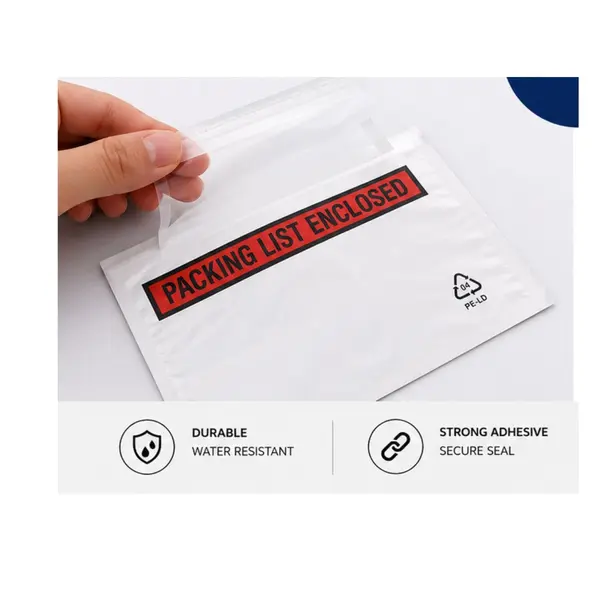
A clear film keeps the papers dry and the barcodes scannable through many carrier touch points. On a long international lane, that matters a lot.
Does presentation matter on a high-value electronics parcel?
It does.
A clean, correctly sized pouch tells a distributor or retailer that the sender runs a tidy operation, and they will judge you on it.
Loose paperwork under a strip of tape looks improvised. Buyers notice it.
A flat wallet with a clear legend looks planned. Standard legends such as “Packing List Enclosed” or “Invoice Enclosed”, printed in more than one language if needed, help handlers find the paperwork across a multi-country network. Your own branding on the pouch is possible through custom print.
I will be honest about one thing. A printed pouch costs a little more than plain clear, and on low-value accessory packs it may not be worth it. On a carton of laptops going to a new distributor, I think it is.
We will tell you which way we would go for your parcels.
You can see formats on our products page.
Quick checklist for electronics shippers
- Outside the carton, put the packing list and a commercial invoice copy in a clear self-adhesive pouch.
- Inside the box, put the warranty card, registration insert and a duplicate paperwork copy.
- Around the device, use ESD-safe protection and keep all paperwork off bare electronics.
- On the slip, list serial numbers for goods-in checks, with barcodes on one flat panel.
- For format, use A4 flat or A5 for multi-page export sets.
We have made document pouches in Jaipur since 1997 and export to 20+ countries. We hold ISO 9001, CE and RoHS certification.
Shipping electronics across borders? Send us your carton size, document set and any ESD requirement, and we will suggest a format and send samples to try.
Frequently asked questions
Do electronics shipments need a packing list on the outside of the box?
It is common practice, yes. One copy of the packing list goes on the carton in a clear pouch and another goes inside. Customs and forwarders check contents, weights and carton counts from the outside copy without opening the box.
Can you put a packing list envelope on an ESD-safe electronics package?
Yes, because the pouch goes on the outer carton and never touches the device. General ESD guidance says paperwork belongs on the outer packaging, away from bare electronics. An external pouch does exactly that while staying visible to customs.
Where do serial numbers and warranty cards go in an electronics shipment?
Serial numbers go on the packing slip so receiving staff can match units on arrival. Warranty cards and registration leaflets go inside with the product, since they are for the end customer. A copy of the packing list and invoice rides outside in the pouch.
What documents travel in an electronics export paperwork pouch?
Usually a commercial invoice, a packing list and the transport document, such as an air waybill or bill of lading. A battery declaration may apply when lithium cells are involved. The pouch holds the copies customs and carriers must read without opening the box.
Are document pouches the same as anti-static or ESD bags?
No. An ESD bag protects the device from electrostatic discharge and sits inside the box. A packing list envelope is a document wallet on the outside of the carton. You use both, for different jobs.
What size packing list envelope suits electronics cartons?
A4 flat or A5 works best. Export sets often run to several pages, and serial-number tables and barcodes scan better when the paper is flat or folded only once. For multi-page customs sets, see our size guide.
Can electronics document pouches be custom printed?
Yes, they can. Pouches can carry your branding or legends like 'Packing List Enclosed' or 'Invoice Enclosed', in one language or several. Contact us for print options.
Sourcing these in volume?
We make packing list envelopes in Jaipur for importers and distributors. Factory-direct, private label welcome.