
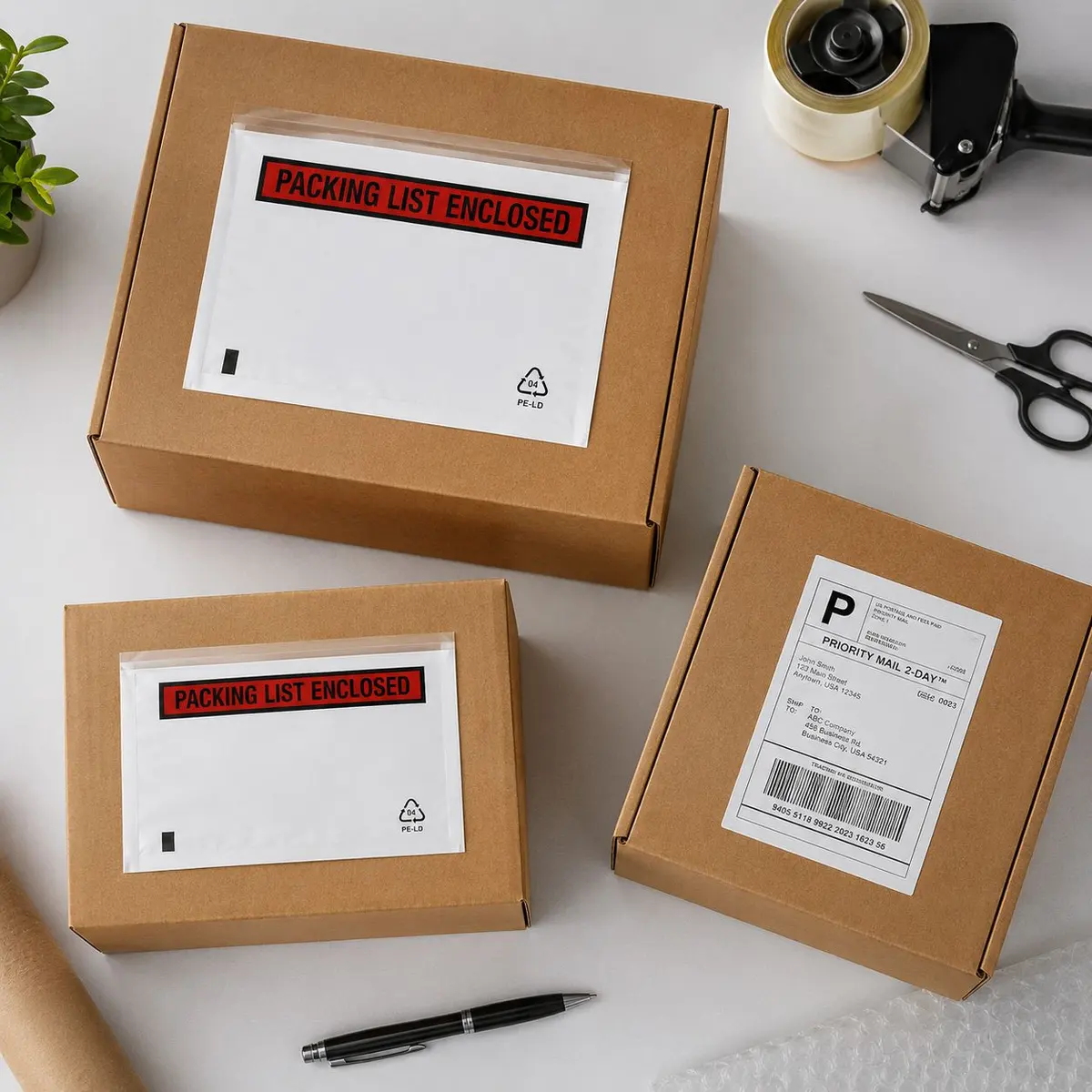
Packing List Envelopes for Furniture and Pallet Freight
Pallet and furniture freight needs a bigger, stickier and tougher document pouch than a parcel does.
I would not send a pallet out with a small parcel pouch on it.
The right choice is usually an A4 or A5 documents-enclosed pouch with a high-tack adhesive. It holds a full multi-page delivery note and stays stuck to stretch wrap and shrink film through rough LTL handling.
This is a different job from ecommerce. The paperwork is bigger, the surface is plastic instead of a flat carton, and the trip involves forklifts, restacking and weather. Below I cover the size, how to make the adhesive hold on film, where to put the pouch, and how to keep a thick set dry.
What makes pallet and furniture freight different?
It breaks most of the assumptions behind a small ecommerce pouch. I see 3 differences.
- The paperwork is full-size. Delivery notes, multi-page packing lists and export customs sets are printed on A4. They need a wallet that takes the set flat or folded once, not a 4.5 × 5.5 ecommerce pouch.
- The surface is film, not card. Furniture is often blanket-wrapped, stretch-wrapped or shrink-wrapped, and pallets are held together with stretch film. The adhesive has to grip plastic.
- The trip is rough. LTL (less-than-truckload) freight is loaded, unloaded and reshuffled many times. Forklift tines, pallet-on-pallet rubbing, rain on a loading dock and long export hauls all attack a weak pouch.
So choose a large pouch, a high-tack adhesive and a secure flap.
Then put it where it will survive.
What size pouch do you need for a pallet?
Size it to your largest document. For pallets and furniture that is almost always A4, so an A4 wallet, or an A5 pouch for a set folded once, is the right default.
- An A4 wallet takes a multi-page delivery note or customs set flat, with the first page at the window. It suits thick sets and international paperwork best.
- An A5 pouch takes an A4 sheet folded once. It is a good balance of room and footprint for domestic delivery notes.
- Small ecommerce sizes like 6 × 9 or 4.5 × 5.5 are the wrong tool here. They force extra folds and overstuffing, which bows the pouch and lets water in.
There is a second reason we would go bigger. A larger pouch has a wider adhesive border, and that extra contact area helps it hold on a flexible, awkward film. For matching a pouch to a paper set, see packing list envelope size for customs sets.
How do you make the pouch stick to stretch wrap and shrink film?
Use a high-tack grade on clean, taut film, and then trap the pouch under one more wrap. Film is the real challenge, because stretch wrap and shrink film are polyethylene, a low-surface-energy plastic that resists ordinary adhesives.
- Specify a high-tack adhesive. A high-tack pressure-sensitive grade wets out on polyethylene far better than a standard permanent grade. The trade-offs are in high-tack vs standard adhesive.
- Stick it on clean, taut film. Slack, wrinkled, dusty or damp wrap will lift any adhesive, so smooth the area first and use a flat panel, not a loose fold.
- Trap it under a final wrap. Apply the pouch, then run one more pass of stretch film over its edges. Now it is glued and physically held, so it stays on even if the adhesive gives up.
That third step is my rule of the trade for pallets.
If it were our own export load, we would not skip it. Glue alone is a hope. Glue plus an over-wrap is a method, and it is what keeps documents on the load through a rough LTL or export trip.
I will add one honest downside. A pouch trapped under film is a little slower for the receiver to open, because they have to cut the wrap. I think most receivers would take that over a lost delivery note.
Where should the document pouch go on the load?
Put it on a flat vertical face at eye level, next to the shipping label, on the side that faces out when the pallet is loaded. The receiver should find it in the first place they look.
- Avoid the top, because it gets crushed under stacked freight and collects rain.
- Avoid the corners, because they rub against other pallets and racking.
- Use 2 pouches on large loads, one on each of two neighbouring faces. The paperwork can then be found from more than one side and survives damage to either.
How does a pallet pouch compare with an ecommerce pouch?
They solve different problems, and we make both. This table shows why a pallet load needs the heavier spec.
| Factor | Small ecommerce pouch | Large-format pallet or furniture pouch |
|---|---|---|
| Typical size | 4.5 × 5.5, 6 × 9, DL | A5 or A4 |
| Document capacity | A single slip | Multi-page delivery note and customs set |
| Target surface | Flat corrugated carton | Stretch wrap, shrink film, blanket wrap |
| Adhesive grade | Standard permanent | High-tack |
| Transit stress | Parcel network | LTL freight, forklifts, export haul |
| Best securing method | Stick to the carton | Stick to film and trap under a final wrap |
| Cost of failure | Re-label one parcel | Lost customs set, held shipment |
How do you keep a multi-page set dry and readable?
Face the first page to the window, fold once at most, and do not overstuff. A sealed polyethylene pouch with a closed overlap flap keeps out rain, dock spray and dust.
We see what the monsoon does to paper every year in India. That is the whole reason paper goes inside a pouch instead of being stapled to the wrap.
- Put the first page at the window, so the consignee, PO number and piece count read without opening.
- Fold once, not three times. Extra folds make the set thick, bow the pouch and open a gap at the flap.
- Match the pouch to the set. An overstuffed pouch lets water in, so size up to A4 instead.
- For sea freight or monsoon transit, ask for heavier film and a secure overlap flap, and still trap the pouch under stretch wrap.
A pouch that holds a customs set on a pallet has to work harder than almost anything else we make. We have been making packaging in Jaipur since 1997 and ship to 20+ countries, and furniture and pallet loads are where document pouches earn their money. You can see the sizes and adhesive options on our products page. If you want your company name or a “Delivery Note Enclosed” legend on the face, see custom print.
Shipping furniture or palletised freight? Send us your load type, wrap and route, and we will send large-format high-tack samples to try on your own pallets.
Frequently asked questions
What size packing list envelope is best for a pallet?
An A4 pouch, or A5 for shorter notes. Delivery notes, packing lists and customs sets are usually printed on A4, so an A4 wallet takes them flat and readable. The bigger adhesive border also gives more grip on a wrapped load.
Can you attach a packing list envelope to stretch-wrapped or shrink-wrapped pallets?
Yes, but the film is the hard part. Stretch and shrink film are low-surface-energy plastics that resist adhesives, so use a high-tack grade on clean, taut, wrinkle-free film. Then run one final wrap of stretch film over the pouch edges, so it is held by the film as well as the glue.
Where should the packing list go on a pallet?
On a flat vertical face at eye level, next to the shipping label. Avoid the top, which gets crushed and rained on, and the corners, which rub against other pallets. On large loads, a second pouch on the next face is good practice.
How do you fit a multi-page delivery note in a document pouch?
Fold the A4 set once and use an A5 pouch, or keep it flat in an A4 wallet. Put the first page against the window so the consignee, PO number and piece count show without opening. Do not overstuff it, because a crammed pouch bows, the flap gaps and water gets in.
Are pallet document pouches waterproof enough for LTL freight?
For normal LTL and export transit, a sealed polyethylene pouch with a closed flap keeps out rain, spray and dust well. For long sea hauls or monsoon conditions, ask for heavier film and a secure overlap flap, and trap the pouch under stretch wrap too.
What is the difference between a document pouch and a pallet label?
They do different jobs. A shipping label carries the address and barcode for scanners. The pouch holds the paper set a person needs to receive and clear the goods, such as the packing list, delivery note, invoice and customs papers, so pallets normally carry both side by side.
How many packing list envelopes should go on one pallet?
At least one per pallet. On a multi-pallet consignment, put the full document set on the lead pallet and a piece-count slip on each of the others. For large or high-value furniture loads, use 2 pouches on different faces.
Sourcing these in volume?
We make packing list envelopes in Jaipur for importers and distributors. Factory-direct, private label welcome.