
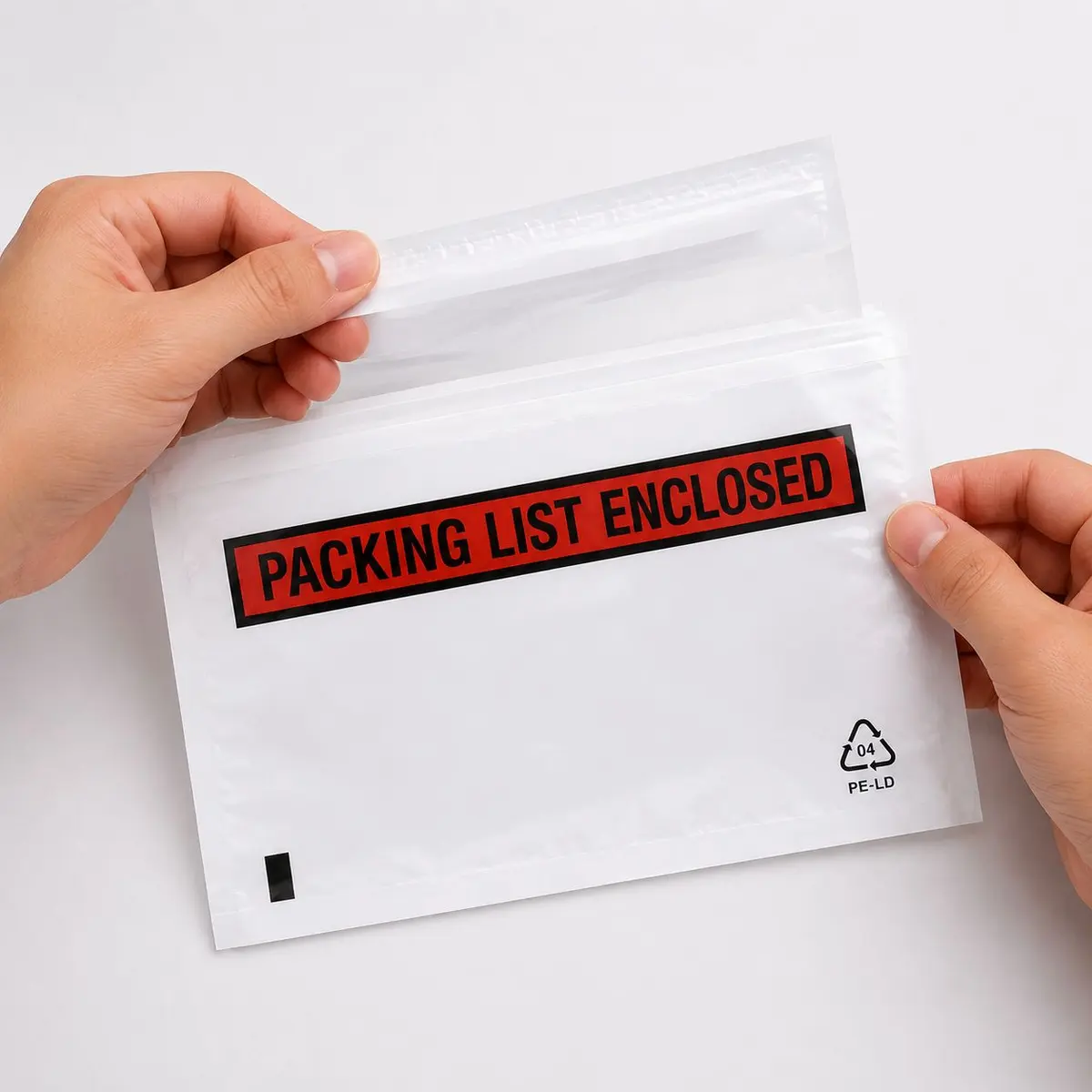
High-Tack vs Standard Adhesive Packing List Envelopes
A high-tack packing list envelope grabs harder and resists peeling more than a standard permanent one. You need it when the surface or the journey fights the bond.
That means rough or recycled corrugated, plastic films, cold-chain shipments, dusty warehouses and long export hauls. The catch is that the stronger hold makes the pouch harder to remove, and more likely to leave residue.
We make both grades, so I have no reason to push you to the dearer one.
Here is how I would think about it.
What is the difference between high-tack and standard adhesive?
Both are permanent pressure-sensitive adhesives, and neither is meant to come off.
The difference is where they sit on the strength scale.
A high-tack grade puts more adhesive on each square centimetre and uses a grabbier formula that wets out faster. So it bites straight into surfaces that a standard adhesive would slide off.
- Standard permanent bonds well to clean, flat corrugated and smooth cartons. It is the everyday grade for general shipping.
- High-tack is for difficult surfaces and hard journeys, such as rough, dusty, cold or plastic.
A strong adhesive document pouch is not better in every case. It is the right tool when conditions are tough, and a waste of money when they are not. For how the adhesive actually works, see how a packing list envelope’s adhesive works.
When do you need extra-strong adhesion?
I would use high-tack whenever the surface, the temperature or the length of the trip puts stress on the bond. Each of these weakens a standard adhesive, and together they add up.
- Rough or recycled board. Coarse, fibrous corrugated has an uneven face that a standard adhesive cannot fully wet. High-tack flows into the texture and keys in.
- Cold and cold-chain. Pressure-sensitive adhesive stiffens as it cools and loses tack below roughly 5°C. Special high-tack and cold grades stay grabby for chilled and frozen goods.
- Long haul and export. Weeks or months of vibration, stacking, humidity swings and rough handling will work a weak bond loose.
- Plastic films and polybags. Polyethylene and polypropylene are low-surface-energy plastics that resist bonding, and high-tack grips them far better.
- Dusty warehouses, where fibres in the air settle on every carton and weaken any bond.
Think of it like the tape on a school notebook cover. On a clean new cover any tape holds. On an old, dusty one only the strong tape stays.
Does high-tack leave residue?
Yes, and that is the catch.
The stronger the hold, the harder it is to undo. We would rather you know this before you order than after.
High-tack is made to be permanent. Removing the pouch is difficult, and it can leave adhesive behind or tear the carton surface. You are trading reversibility for grip.
This has three practical effects.
- First placement is final. Line the pouch up before it touches, because you cannot cleanly move a high-tack pouch.
- Do not expect clean removal. If a returns process or a reusable tote needs the pouch to come off without a mark, high-tack is the wrong choice.
- Choose a removable or resealable grade when you really need to lift or reopen. See resealable packing list envelopes for that route.
High-tack vs standard adhesive: side by side
The table shows where each grade fits. Use it to match the packing list envelope adhesive strength to your real conditions, instead of one grade everywhere.
| Factor | Standard permanent | High-tack (extra-strong) |
|---|---|---|
| Initial grab | Good, holds on contact | Very high, bites instantly |
| Peel resistance | Enough for clean cartons | Strong, survives rough handling |
| Rough or recycled board | May lift over time | Keys well into texture |
| Plastic films, polybags | Unreliable | Much better |
| Cold and cold-chain | Unreliable below about 5°C | Special grades hold in the cold |
| Long export haul | Risk of working loose | Made to last the journey |
| Removal or repositioning | Difficult | Very difficult, residue likely |
| Relative cost | Lower | Slightly higher |
| Best for | Clean, flat cartons, domestic | Difficult surfaces, harsh transit |
How do you choose the right grade?
Ask two questions. What surface am I sticking to, and how hard is the journey?
Those two answers decide the grade more than anything else.
- Clean, flat cartons and short domestic transit call for standard permanent. It holds fine and costs less.
- Rough, dusty, plastic or cold surfaces, or long export hauls, call for high-tack. The small premium is cheaper than a lost document or a customs hold.
- If you need to remove, move or reopen the pouch, use a removable or resealable grade, not high-tack.
Now the rule of the trade that applies to every grade. Clean, dry and taut wins. Frost, condensation, dust, oil or slack film will defeat even a high-tack adhesive.
Also, apply at room temperature where you can, ideally well above 5°C, because the adhesive flows best when it is warm and the bond then holds as it cools, even on a pouch going into a freezer.
The common mistake is to ask for “the strongest one” by default.
I would rather you match the grade to the risk. We have made packaging in Jaipur since 1997 and ship these pouches to 20+ countries, and we would much rather sell you the right grade than the dearest one. You can see the formats and adhesive options on our products page.
Not sure if your cartons need high-tack or standard? Tell us your surfaces and shipping conditions, and we will send a sample pack of both grades to test.
Frequently asked questions
What is a high-tack packing list envelope?
It is a document pouch with a more aggressive pressure-sensitive adhesive than a standard permanent grade. It uses more adhesive and a grabbier formula, so it bites into rough, dusty, cold or plastic surfaces where an ordinary pouch would lift. It is the heavy-duty option for difficult cartons and films.
What is the difference between high-tack and standard permanent adhesive?
Both are permanent. High-tack grabs harder on first contact and resists peeling more strongly. A standard grade holds a clean, flat corrugated carton well, while high-tack is for surfaces that fight the bond. The extra hold makes removal harder and residue more likely.
When do I need a high-tack adhesive instead of standard?
When the surface or the journey is hard on the bond. That means rough or recycled corrugated, polybags and stretch film, chilled or frozen shipments, dusty warehouses, or long export hauls. For clean, flat cartons shipped domestically, standard is enough and costs less.
Does high-tack adhesive leave residue?
It can, yes. High-tack is meant to be permanent, so pulling the pouch off is hard and may leave adhesive behind or tear the carton surface. If you need to reposition or reopen, ask for a removable or resealable grade instead.
Does high-tack adhesive work in cold and freezer conditions?
Special high-tack and cold-temperature grades are made to grab on cold, frost-free surfaces. A standard pressure-sensitive adhesive becomes unreliable below roughly 5°C. Whatever the grade, apply it to a clean, dry, frost-free surface, because frost or condensation beats even high-tack.
Will a high-tack pouch stick to plastic polybags and stretch film?
Much better than a standard grade will. Polyethylene and polypropylene are low-surface-energy plastics and are hard to bond, and a high-tack formula grips them far more reliably. The film must still be clean and taut, because slack or dirty film lifts any adhesive.
Is a high-tack envelope more expensive than standard?
Usually a little, because it uses more adhesive and a more specialised formula. In my view the small premium is cheaper than one lost document or a customs hold caused by a pouch peeling off. Match the grade to the risk rather than to the lowest price.
Sourcing these in volume?
We make packing list envelopes in Jaipur for importers and distributors. Factory-direct, private label welcome.