
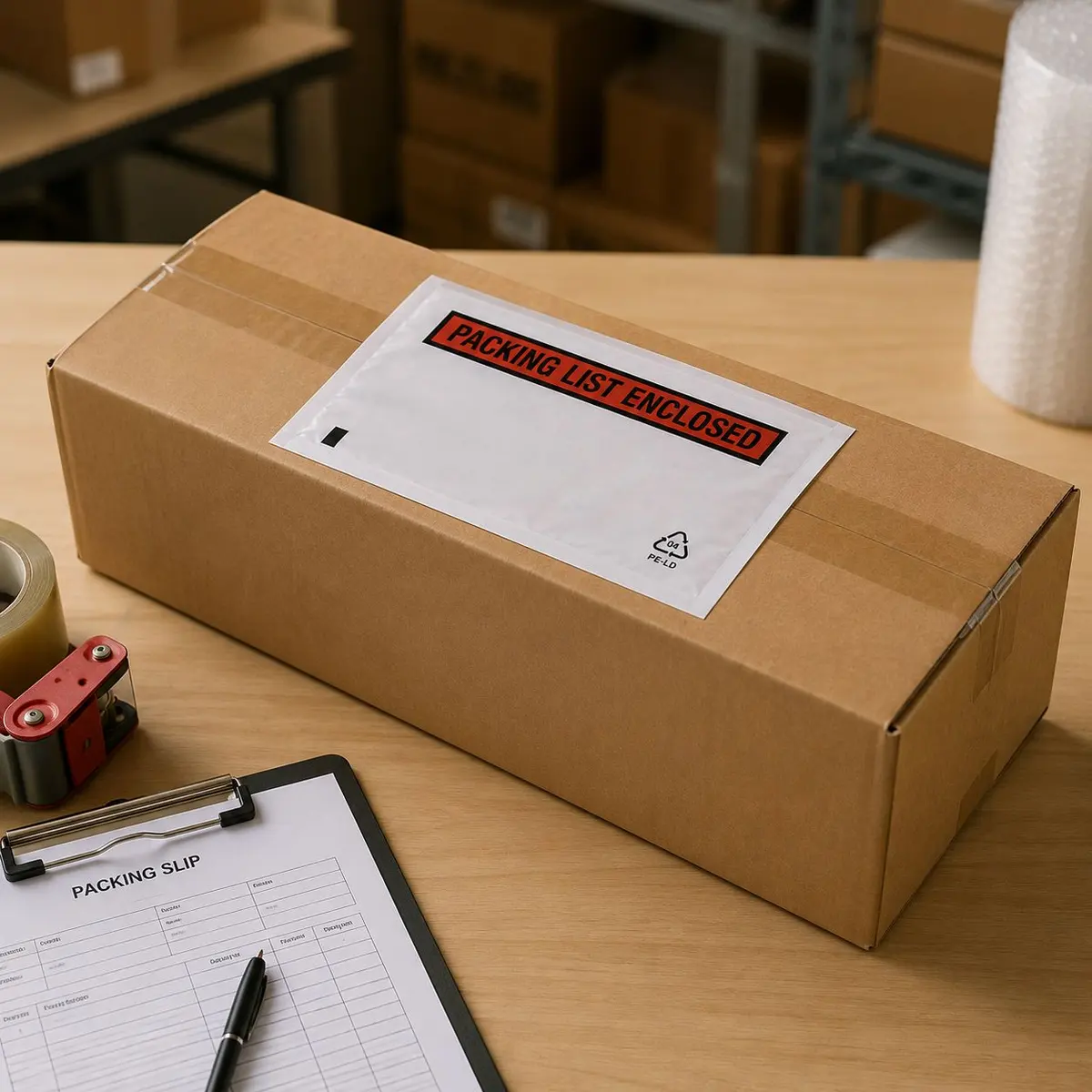
Packing List Envelopes for Pharma and Medical Shipments
On a pharmaceutical or medical shipment, the packing list envelope has one serious job. It keeps the compliance paperwork together, protected and readable on the outside of the carton, so customs, inspectors and goods-in can check the consignment without opening the box.
In this sector, one document mismatch can put a whole shipment into quarantine. So the humble documents-enclosed wallet is part of your compliance chain, not just packaging.
This post covers four things that matter for pharma and medical freight. They are keeping the documents intact, keeping them visible, making the pouch stick in the cold, and deciding on tamper evidence. I will keep it general, because your own regulatory and quality teams own the specifics. I make pouches, I do not write your SOPs.
What documents does a pharma packing list envelope carry?
It carries the paperwork that proves what is in the box and that it is compliant. The envelope’s job is to keep that set whole and easy to reach.
Across regulated markets, a pharma or medical carton typically travels with:
- The commercial invoice, which values and identifies the goods for customs.
- The packing list, which lists quantities, units and how the pack is made up.
- A certificate of analysis or other quality papers, which confirm the product meets its specification.
- Batch, manufacturing and expiry records, the identifiers that authorities cross-check.
- Origin and regulatory certificates, where the destination market asks for them.
The invoice and packing list are expected to match each other and the physical pack, down to quantities, SKUs and batch numbers. If the carton cannot be tied to its documents, the consignment loses its traceable history. A pouch that keeps the full set together, flat and legible is what makes that check quick.
Why must batch and compliance paperwork stay visible?
Because checking happens on the outside of the box, again and again, by people who should not be opening it.
Customs officers, inspectors and warehouse staff compare batch numbers, expiry dates and quantities against the carton at several points on the journey. A clear pouch on the outside lets them do it without breaking the pack.
This is where the format of the envelope matters.
- A clear, full-face pouch keeps the whole document, barcodes and 2D codes included, scannable through the film. See clear vs printed pouches for the trade-offs.
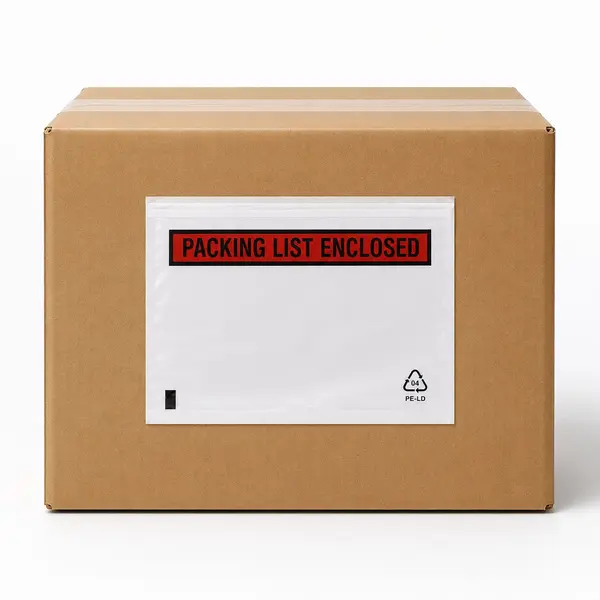
- A printed “Documents Enclosed” legend sends handlers straight to the paperwork. You can add one through custom print.
- Water-resistant film keeps print and barcodes readable through rain, wash-down or condensation. Paper wallets fail here, as we explain in are packing list envelopes waterproof?
For compliance purposes, a document that cannot be read or scanned is a missing document.
Do packing list envelopes work in cold chain and cold storage?
Only if the adhesive is chosen for the temperature. A standard pouch can let go on a chilled or frozen carton.
Many general-purpose adhesives stiffen and lose tack as the temperature drops. Then the condensation that forms when cartons move between cold and warm zones makes it harder still. Think of butter straight out of the fridge. It will not spread, however hard you press.
| Condition | Risk to a standard pouch | What to specify |
|---|---|---|
| Ambient, room temperature | None, standard adhesive is fine | Standard self-adhesive pouch |
| Chilled (fridge, about 2 to 8 °C) | Less tack, edges may lift | Cold-store or low-temperature adhesive |
| Frozen, deep freeze | Adhesive can turn brittle and release | Freezer-grade adhesive, applied warm |
| Condensation or wash-down | Moisture breaks the bond, paper wallets fail | Water-resistant film and a cold-rated adhesive |
In my view, two rules do most of the work. Apply to a clean, dry, frost-free surface. And apply before the carton is chilled wherever your process allows, so the adhesive bonds at room temperature and then goes cold.
If your network runs at several temperatures, we would suggest you ask for an adhesive rated across the whole range, not for one point. Our guide on how the adhesive works explains why.
When should a pharma pouch be tamper-evident?
When proof of integrity is part of your compliance or customer requirement. And that is a decision for your quality team, not your packaging supplier.
Tamper-evident packaging is required for many over-the-counter medicines. It is also widely expected across regulated pharma and medical logistics, to protect chain of custody and patient safety.
A standard self-adhesive pouch protects and shows documents, but it can usually be eased open. A tamper-evident pouch adds a permanent or “void” closure that leaves clear, irreversible marks if someone opens it after sealing. For audits and customs reconciliation, these are often combined with sequential numbering or barcodes, so each pouch maps to one manifest entry.
The deciding question is simple. Does anyone need to prove this pouch was not opened in transit? If yes, specify tamper-evident, and our guide to tamper-evident security document pouches walks through the closure types. If no, I would not pay for it. A standard sealed pouch is lighter, cheaper and does the job.
How do I choose the right pouch for a pharma shipment?
Put the four factors together and the specification falls out quickly.
- Size. Match your largest document. An A4 invoice plus certificate of analysis usually wants an A4 or A5 pouch, and dispatch notes fit DL or 6 × 9. Hold the full set flat, never forced.
- Face. Clear, so barcodes scan. Add a printed legend or branding to guide handlers.
- Adhesive. Match it to the coldest point in your network, and apply to a clean, dry surface.
- Security. A standard sealed pouch for routine freight. Tamper-evident, perhaps numbered, where integrity must be provable.
Here is the rule of the trade I would keep in mind. Specify the pouch for the document and the conditions, not for the box. A DL invoice on a frozen vaccine carton is a different job from the same invoice on an ambient parcel.
We have made packaging in Jaipur since 1997 and hold ISO 9001, and we export to 20+ countries. Even so, your quality team sets the compliance rules. Our part is to give them a pouch that meets them. The full range is on our products page.
Shipping pharma or medical freight? Send us your document size, temperature range and any security need, and we will suggest a pouch and send samples to test in your own cold chain.
Frequently asked questions
What documents go in a packing list envelope on a pharma shipment?
Usually the commercial invoice, the packing list and quality papers such as a certificate of analysis, plus any batch and expiry records the destination asks for. The envelope keeps them together, dry and readable on the outside of the carton, so nobody has to open the box to check them.
Do packing list envelopes stick in cold storage and freezer conditions?
Not always. Standard adhesives stiffen and lose tack in the cold, so a pouch meant for ambient shipping may let go on a chilled or frozen carton. For cold chain, ask for a low-temperature adhesive and apply it to a clean, dry, frost-free surface, ideally before the carton is chilled.
Should pharmaceutical document pouches be tamper-evident?
That is a decision for your quality team, based on your market's rules and your customer's audit terms. Tamper-evident packaging is required for many over-the-counter medicines and widely expected in regulated pharma. Whether the document pouch itself needs it is a separate question, so confirm it internally.
Why does the packing list need to be visible from outside the carton?
Because customs officers, inspectors and warehouse staff check batch numbers, quantities and declarations against the box at several points. They should be able to do that without opening it. A missing or mismatched document can send a consignment into quarantine.
What size packing list envelope suits pharma paperwork?
Match it to your largest document as it travels. An A4 invoice with a certificate of analysis usually suits an A4 or A5 pouch, while smaller dispatch notes fit DL or 6 × 9. The full set should sit flat without forcing, so text and barcodes stay readable.
Are clear or printed pouches better for medical shipments?
Clear is usually better for pharma, because the whole document and its barcodes stay scannable through the film. A printed 'Documents Enclosed' strip helps handlers spot the paperwork quickly. Many shippers use both, i.e. a clear window with a printed instruction band.
Can document pouches handle moisture and condensation?
Yes. Plastic packing list envelopes are water-resistant, so they protect paperwork from rain, wash-down and the condensation that forms when cartons move between cold and warm zones. A paper wallet would smear or fall apart in the same conditions.
Sourcing these in volume?
We make packing list envelopes in Jaipur for importers and distributors. Factory-direct, private label welcome.