
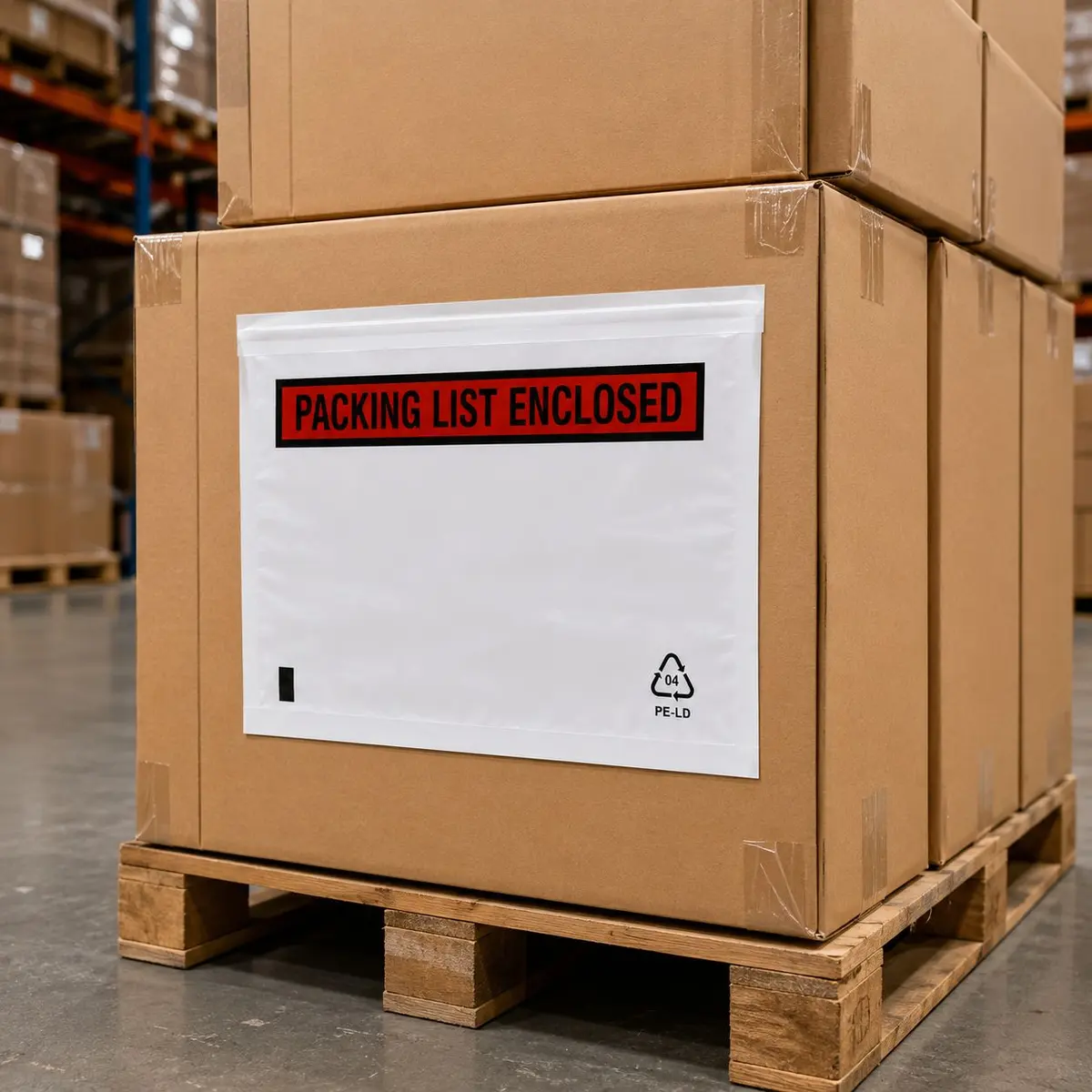
Automating Packing List Envelope Application on the Line
Applying packing list envelopes by hand is fine at 50 cartons a day. At a few thousand, it becomes one of the slowest and most boring jobs on the pack bench.
An applicator takes that job away. I am a fan of these machines where the volume is there, and I will also tell you where they are a waste of money. It peels each pouch off a reel and presses it onto the carton as the box goes past. Below we explain how these lines work, which pouch specs they need, what speed is realistic, and when the money actually comes back.
How does automatic packing list envelope application work?
An automatic applicator feeds pouches from a continuous reel and places one on each carton at machine speed. The pouches sit on a release liner. The machine moves the web forward, separates one pouch and applies it when the carton reaches the head.
There are two broad approaches.
- Apply-only. Pre-made adhesive pouches come on a reel and go onto the carton. The slip is inserted separately, or it is loaded before.
- Print-and-apply. The system prints the packing slip, then either folds it into an adhesive pouch and applies it, or applies the pouch and inserts the slip in line. This is the automated packing slip application model you see in big fulfilment centres.
Both remove the manual fold, stuff, peel and stick cycle. The paperwork ends up attached, dry and visible without a person handling every box. If you want to see the manual method this replaces, read how to apply a packing list envelope.
What pouch specs suit automation?
Consistency from batch to batch matters more than any single spec. A machine does not adjust the way a person does. If the size, the liner release or the tack changes even a little, you get jams, skewed pouches or two pouches fed at once.
A reel-fed pouch built for an applicator needs:
- Supply on a core, with a defined wind direction and core size.
- A web width and pitch that match your machine.
- An even release liner, so every pouch peels at the same force.
- Even perforation or die-cut spacing, so the machine stops at the right point each time.
- Flat film that does not curl, so pouches feed straight.
- A high-tack adhesive that bonds to corrugated board on first contact.
| Spec | Hand application | Applicator line |
|---|---|---|
| Supply format | Sheets or pads | Reel-fed on liner |
| Size tolerance | Loose, the operator adjusts | Tight, batch to batch |
| Liner release | Not critical | Even and predictable |
| Perforation or pitch | Not needed | Even, machine-indexed |
| Adhesive | Standard tack | High-tack, first contact |
| Print registration | Cosmetic | Must stay consistent |
The two formats are not interchangeable, and we would rather say so plainly. Retail sheet packs are made for hands. They rarely hold this level of consistency, and I would not try to force them through a machine. You can see our pouch formats on the products page.
What throughput can an automatic pouch applicator achieve?
Roughly 10 to 25 cartons a minute is a typical range for document and packing slip automation. That is about 600 to 1,500 cartons an hour. The exact figure depends on the machine, the carton handling and the way the slip goes in.
Here is what really sets the speed.
- Slip insertion. The print, fold and insert steps usually set the pace, not the pouch.
- Carton movement. The line cannot run faster than boxes can pass the applicator head.
- Pouch feed. A reel that feeds cleanly keeps the line at its rated speed. Uneven pouches force slowdowns and stops.
- Single-pass lines. Some lines apply the shipping label, the packing slip pouch and a returns label in one pass, which raises output per carton.
This is the part I see most buyers miss. They compare machines on rated speed, and then lose that speed to a cheap reel that stops the line every few hundred cartons. We think of the pouch reel as a consumable that decides machine uptime, because an applicator with inconsistent liner release or irregular perforation spacing will stop, restart and misalign regardless of its catalogue specification. The machine is only as fast as the pouch lets it be.
When does automating pouch application pay off?
It pays off in high, steady volume. Once daily carton counts run into the thousands and hand application is the bottleneck, a line starts to make sense. Below that, the capital rarely comes back.
Here is how we would think about it:
- Tens of cartons a day. Stay manual. An applicator will sit idle and never earn its cost.
- Growing or mixed volume. Look at a semi-automatic applicator. It helps with peel and place without full line integration, and it costs far less.
- Thousands a day, steady mix. Full print-and-apply is where small time savings per carton add up to real labour savings. Busy fulfilment sites often talk about payback within a year, but do your own maths with your own wages and volumes.
In our view, three things drive the numbers. The first is labour saved per shift. The second is fewer errors, meaning fewer mis-shipped orders and fewer missing-paperwork claims. The third is output gained at the end of the pack line. If you run several sites or clients, settling on a small range of applicator-ready pouches helps even more. Our note on packing list envelopes for 3PL and fulfilment centres goes into that.
How do you specify pouches for an applicator line?
Test a sample reel on your own applicator before you commit to a bulk order. I would not skip this step even with a supplier you trust, and that includes us. A reel that runs well on one model can misbehave on another, because of wind direction, core size or pitch.
The pouch face, adhesive and print can all be chosen to suit you, as long as size, liner and tack stay consistent. Printed pouches with a “Documents Enclosed” legend, a barcode zone or your logo run on a line just like plain ones. See custom print for what we can put on the face.
When you ask for a quote, send:
- Applicator make, model and target line speed.
- Web width, core size and the wind direction the machine expects.
- Pouch size and print (plain, “Documents Enclosed”, barcode zone or branded).
- Perforation or die-cut pitch needed for indexing.
- The surface the adhesive must bond to, such as corrugated board, shrink wrap or a stretch-wrapped pallet.
We have made packaging in Jaipur since 1997 and export to 20+ countries. I would much rather spend ten minutes on your machine details before the first reel than have your line stop on day one.
Planning an applicator line? Send us your machine make, web width and pouch size, and we will talk through the reel format and send samples to trial on your own equipment.
Frequently asked questions
Can packing list envelopes be applied automatically?
Yes, if the pouches come on a reel. Reel-fed pouches on a release liner, with consistent sizing and a high-tack adhesive, run on automatic and semi-automatic applicators. The machine peels each pouch off the liner and presses it onto the carton without anyone placing it by hand.
What is a print-and-apply document pouch system?
It is a machine that prints the packing slip and applies it in one pass. Some lines fold the slip into an adhesive pouch and then apply the pouch. Others apply an empty pouch and insert the document in line. Either way, the manual fold, stuff, peel and stick steps go away.
How fast can an automatic pouch applicator run?
Roughly 10 to 25 cartons a minute is a typical range for document automation, which is about 600 to 1,500 an hour. The real figure depends on the machine, how cartons move past the head and how the slip is inserted. Slip insertion usually sets the pace, not the pouch.
What pouch specs are needed for automation?
Consistency matters more than anything else. You need reel-fed supply on an even release liner, the same size and pitch batch after batch, a web width matched to the machine, flat film that does not curl, and an adhesive that grabs on first contact.
Are reel-fed packing list envelopes different from sheet packs?
The pouch itself is the same. The difference is the format. Reel-fed pouches are wound on a core with a continuous liner, a set wind direction and an even pitch so a machine can feed them. Sheet and pad packs are made for hands, and they rarely hold the consistency an applicator needs.
When does automating pouch application pay off?
It pays off in high, steady volume, typically once you pack thousands of cartons a day and hand application is holding the line back. At a few dozen cartons a day, the machine will mostly sit idle. In between, a semi-automatic applicator is often the sensible step.
How do I make sure pouches will run on my applicator?
Test a sample reel on your own machine before you order in bulk. Share the make and model, web width, core size and target speed with the pouch maker, so the reel is built for your line and not supplied as a generic roll.
Sourcing these in volume?
We make packing list envelopes in Jaipur for importers and distributors. Factory-direct, private label welcome.