
Delivery Note and Proof of Delivery (POD) Explained
When a consignment is handed over, two questions decide whether the deal closes cleanly. What was delivered? And can you prove it arrived?
The delivery note and the proof of delivery (POD) answer those two questions. They are closely related, and often they are the very same sheet of paper at two different moments.
But they are not the same thing.
In my view, mixing them up is behind a lot of the delivery disputes that shippers end up fighting weeks after the truck has gone. We make the pouches that carry this paperwork, so we see the problem from the packaging side.
This is general guidance for shippers and operations teams, not legal advice. Please confirm what your customers and carriers need on your own routes, because we are a packaging maker, not a lawyer.
What is a delivery note?
A delivery note is the document that travels with the goods and lists what is being delivered. It goes with the consignment from dispatch to the door and is shown to the recipient at handover.
It usually shows the sender and recipient, an order or consignment reference, the date, and a list of goods or the number of packages. Its job is to let the recipient check the goods against the order before accepting them.
It is not a request for payment. That is the invoice’s job.
A delivery note normally shows no prices.
What is proof of delivery (POD)?
Proof of delivery is the evidence that the goods reached the recipient and were accepted. In practice it is most often the delivery note after it has been signed. It can also be a separate signature, a photo or an electronic record taken at handover.
A delivery note on its own only records what was dispatched. The moment the recipient prints their name, signs, dates it and writes down any damage, it proves that delivery happened. Carriers release billing against that signed record, and both sides rely on it if a claim follows.
A useful POD carries these details.
- Sender and recipient details.
- The order or consignment reference, plus the tracking number.
- The goods, or the number of packages, delivered.
- The date and time of delivery.
- The printed name and signature of the person receiving.
- Condition notes, i.e. any shortage, damage or refusal, written in detail.
How do a delivery note and POD differ from a packing list and invoice?
Each document answers a different question. The delivery note and POD are about handover. The packing list is about contents. The invoice is about money.
| Document | Core question | Shows prices? | Signed? | Primary user |
|---|---|---|---|---|
| Packing list / slip | What is physically inside this carton or pallet? | No | No | Warehouse, customs |
| Delivery note | What is being delivered in this consignment? | No | Becomes POD when signed | Recipient at the door |
| Proof of delivery (POD) | Did the goods arrive and were they accepted? | No | Yes | Carrier, billing, claims |
| Commercial / sales invoice | What is owed for the goods? | Yes | Sometimes | Buyer’s accounts, customs |
A few practical points follow from this table.
A packing list is about how goods are packed: quantities per box, pieces and weights. A multi-carton order may carry one packing list per carton.
A delivery note covers the whole consignment and is the sheet the recipient signs. One order usually has a single delivery note, even when it ships in several boxes.
Some businesses use one combined form as both packing list and delivery note. I have no problem with that.
What matters is that the recipient can check the contents and sign for receipt on the same visit.
For the full split between the contents and money documents, see packing list vs packing slip vs invoice.
What is sign-on-delivery, and why does it matter?
Sign-on-delivery means the recipient signs for the goods at the point of handover, on paper or on the driver’s handheld device. The signature, printed name, time and condition notes are what turn a delivery note into proof of delivery.
It matters in B2B and freight for 3 reasons.
- Carriers and 3PLs commonly invoice against a clean signed POD. No signature means slow billing.
- If a customer later reports a shortage or damage, the signed note is the main evidence. Damage should be written on the note, and signed by both driver and receiver, before the truck leaves.
- A signature ties a named person, a time and a condition to the goods, which closes the gap between “shipped” and “received”.
There is one catch that most shippers miss.
A signature only helps if the document is available and readable at the door. If the delivery note is sealed inside a taped carton, the driver cannot get it signed without opening the box.
That defeats the purpose.
What is a POD jacket or POD pouch?
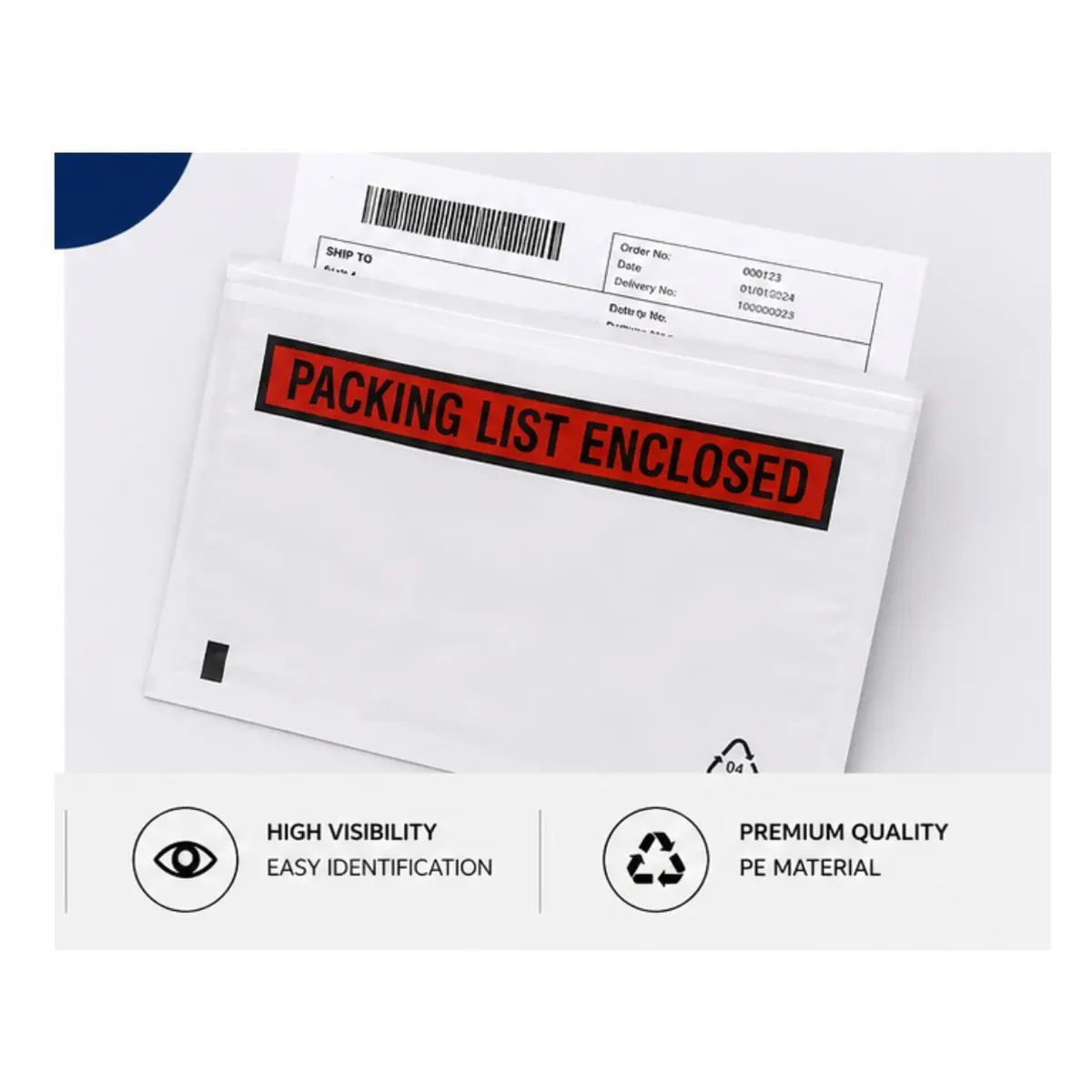
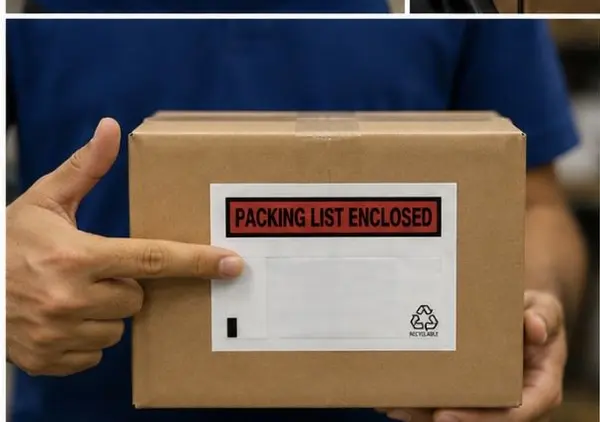
A POD jacket is a clear or printed envelope fixed to the outside of a courier bag, carton or consignment. People also call it a POD pouch or a documents-enclosed pouch. It holds the delivery note or waybill so it can be read and signed at handover without opening the package.
This is where the paperwork and the packaging meet. On a freight or courier route, the POD jacket lets the driver do 3 things.
- Show the delivery note to the recipient at the door.
- Have it checked against the goods and signed on delivery.
- Take a copy as the carrier’s proof and leave a copy with the recipient.
If I were choosing a POD jacket for my own dispatch, I would want 3 things. It should keep out rain, stick firmly enough to survive a rough trip, and carry a clear printed legend such as “Delivery Note Enclosed” or “Documents Enclosed”. The legend matters more than people think, because a driver on a busy dock has seconds, not minutes, to find the paperwork. You can put your own wording on the panel with custom print. For high-value or disputed routes, a tamper-evident pouch adds a layer of security around the signed record.
These are the same pouches we make to keep invoices and customs papers visible on export cartons. We cover that side in B2B and wholesale shipping.
We have made packaging in Jaipur since 1997, with ISO 9001, CE and RoHS in place, and we export to 20+ countries. We supply documents-enclosed and POD-jacket pouches in standard sizes (DL, A6, A5, A4 and the imperial 4.5 × 5.5 and 6 × 9), clear or custom printed. You can see them on the product range page.
Which document is used when?
Each stage of a delivery has its own paper. This is how I would lay it out for a new dispatch clerk.
- At picking and packing, a packing list goes inside or on each carton.
- When goods leave the dock, the delivery note travels in an outside POD jacket.
- At the recipient’s door, the recipient checks the goods and signs the delivery note, and it becomes the POD.
- In the back office, the signed POD supports billing and the invoice asks for payment.
Get these 4 documents right, and the pouch that carries them, and most deliveries close themselves.
Get them wrong and you find out weeks later, in a claim. I would rather you spend 5 minutes on the paperwork now.
Need POD jackets sized to your delivery notes and waybills? Tell us your document size and your routes, and we will send samples with the right print and adhesive to try.
Frequently asked questions
What is the difference between a delivery note and proof of delivery?
A delivery note travels with the goods and lists what is being delivered. Proof of delivery is the evidence that the goods arrived and were accepted. Very often they are the same sheet, and the note becomes the POD the moment the recipient signs it.
Is a delivery note the same as a packing list?
No. A packing list describes what is inside one carton or pallet, so staff can check the contents. A delivery note covers the whole consignment and is the sheet the recipient signs. Some businesses use one combined form for both, which is fine as long as it does both jobs.
Does a delivery note need to be signed?
Not always, but in B2B and freight it usually is. A signature, a printed name and a date give both sides evidence that the goods came in, and in what condition. Without that, a later claim is much harder to settle.
What is a POD jacket or POD pouch?
It is a documents-enclosed envelope stuck to the outside of a courier bag, carton or consignment. It holds the delivery note or waybill, so the driver and the recipient can read it and sign it without opening the package.
Is a delivery note proof of delivery?
Only after it is signed. Unsigned, it is just a record of what left your dock. Once the recipient signs, dates it and writes down any damage, it becomes proof that delivery happened.
What information should a proof of delivery contain?
Sender and recipient details, the order or consignment reference, and the goods or number of packages. Add the date and time, the receiver's printed name and signature, and any notes on shortage or damage. Electronic PODs often add a photo and a GPS stamp.
Do I still need a paper delivery note if deliveries are tracked electronically?
Often you do. An electronic POD records the handover, but a printed note in an outside pouch lets the recipient check goods at the door and works when a device or signal fails. Many B2B buyers also ask for a signed paper copy for their own files.
Sourcing these in volume?
We make packing list envelopes in Jaipur for importers and distributors. Factory-direct, private label welcome.