
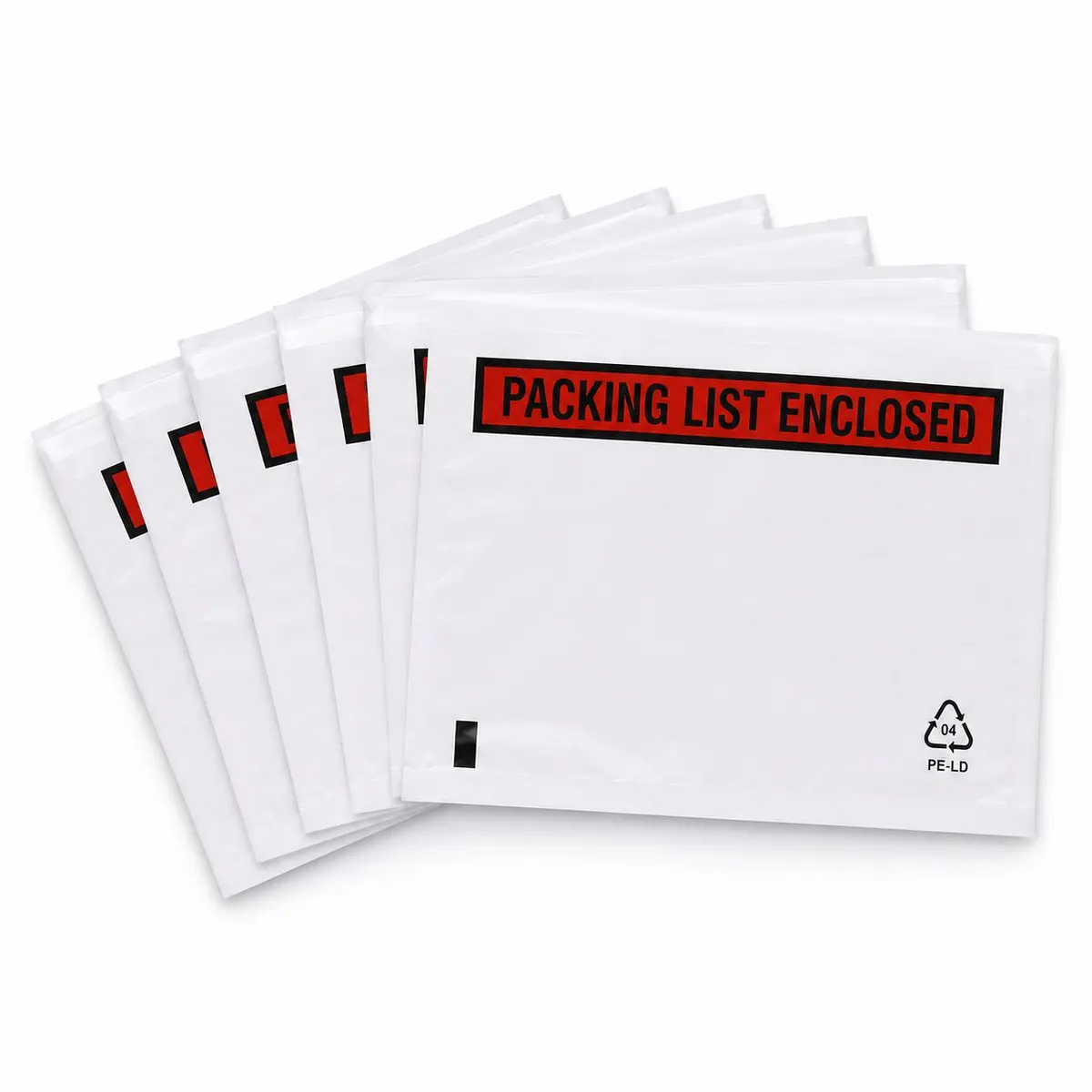
Panel-Face vs Full-Face (Clear) Packing List Envelopes
Most buyers comparing packing list envelope face types end up choosing between two styles. One is the panel-face, a printed strip over a clear window. The other is the full-face, where the print covers the whole front.
That choice decides how readable your documents are, how easily they scan, and how much branding the pouch carries. We make all 3 styles, so I have no favourite to push.
I will give the short answer first, then the detail.
What is the difference between panel-face and full-face envelopes?
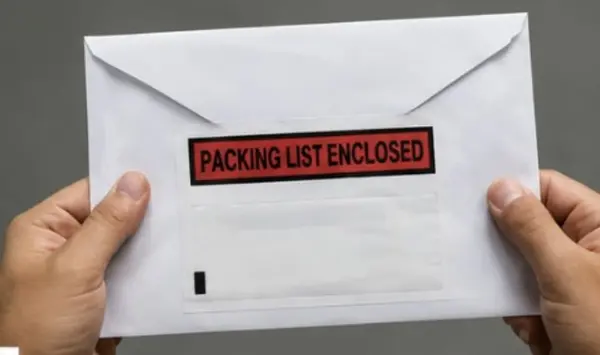
The difference is how much of the front is printed. A panel-face packing list envelope prints a legend, usually “Packing List Enclosed”, in a band across part of the front. The rest is a clear window, so the document shows through. A full-face envelope takes the print and background colour across the entire front and hides whatever is inside.
Underneath, they are the same product. Both are a sealed poly pouch with a self-adhesive back, keeping paperwork attached to the parcel and out of the weather. The face only changes what you can see from outside.
That one thing drives reading, scanning and branding.
The terms are easy to muddle, so here they are plainly.
- Panel-face means a printed strip plus a clear window, so the document is partly visible.
- Full-face printed means the whole front is printed, so the document is hidden.
- Full-face clear, or clear-face, means the whole front is transparent, so the document is fully visible.
So “full-face” on its own can mean fully printed or fully clear, depending on who you buy from. When you order, always say printed or clear.
It saves a wrong shipment.
How do panel-face and full-face compare at a glance?
This table is about visibility and branding. It is not about protection, because all three seal the document equally well once filled.
| Feature | Panel-face | Full-face (printed) | Full-face clear |
|---|---|---|---|
| Front of pouch | Printed strip and clear window | Fully printed | Fully transparent |
| Document visible? | Partly, through the window | No, hidden | Yes, fully |
| Barcode scanning | Yes, through the window | Print or apply on the outside | Yes, through the film |
| Address shows through | Often yes | No | Yes |
| Branding space | The printed panel | The whole front | None, unless you add a legend |
| Discretion | Medium | High | Low |
| Typical use | General dispatch, ecommerce | Sensitive paperwork | Scanning lines, label-style use |
Which face type is easiest to read and scan?
A clear-face pouch, or a panel-face envelope with a large window. The barcode, address and order details show straight through the film, so scanners at the warehouse or courier read them in one pass without anyone opening the pouch.
This is why panel-face is so common for general shipping. The printed strip tells staff at a glance that documents are enclosed, and the window keeps the contents in view, often including the shipping address. In many cases, that visible address means you can skip a separate label.
The printed full-face is the trade-off. The front is fully covered, so the document is hidden, which is exactly the point when the contents are sensitive. But then any barcode or address has to go on the outside of the pouch or the carton. For more on scanning through film, see barcode scanning through the pouch window.
When should you choose a full-face printed envelope?
Choose it when discretion matters more than visibility. I can think of three good reasons.
- The paperwork carries commercial detail, such as pricing, payment terms, customer names or contract numbers, that you would rather not show in transit.
- You want the biggest possible printed area for a legend, a logo or instructions in several languages.
- You want every parcel to look the same, whatever document sits inside.
If your operation lives on scanning, a clear or panel-face pouch keeps things moving. That covers ecommerce dispatch, 3PL conveyor lines and courier hand-offs. Our guide to clear vs printed packing list envelopes goes deeper into that visibility choice.
How does face type affect branding?
Branding grows with print area.
A panel-face envelope gives you a defined strip. That is enough for a logo, a “Packing List Enclosed” or “Invoice Enclosed” legend and a short handling note, while the window still scans. A full-face printed envelope gives you the whole front, which is the most space of the three, but you lose visibility. A fully clear pouch carries no print at all unless you add a small legend.
For most B2B shippers, I would pick panel-face.
It looks professional, it tells people what is inside, and barcodes and addresses keep working. If you want your own artwork, see our custom print page.
Which one costs less?
For standard stock styles, the cost is broadly similar, because every face type uses the same poly film and adhesive backing. The real cost drivers are print area, number of ink colours and custom artwork.
A full-face design uses the most ink. A panel-face uses less, just the strip, and a 1-colour legend is the simplest job of all. A clear, unprinted pouch uses the least. At high volumes, though, these ink differences are small next to size, film thickness and order quantity.
Here is the thing I think most buyers get wrong.
They argue over face type to save money, when the size and the order quantity decide far more of the price. We quote per specification, so tell us your size, face type and volume.
How do I decide quickly?
Answer these questions in order and you will have your face type.
- Do barcodes and addresses need to scan through the pouch? Choose panel-face or clear-face.
- Do you want the customer address to show so you can skip a label? Choose panel-face with a large window.
- Is there sensitive pricing or customer detail inside? Choose full-face printed.
- Do you want the biggest branding area? Choose full-face printed.
- Is it a pure scanning line? Choose full-face clear.
New to this product? Start with what packing list envelopes are, then match a size on our products page.
We have made packaging in Jaipur since 1997 and export to 20+ countries. We make clear, panel-face and full-face printed pouches in standard and custom sizes, with your own artwork where you need it.
Not sure which face type fits your shipments? Send us your document size, scanning needs and daily volume, and we will recommend a pouch and send samples to try.
Frequently asked questions
What is the difference between a panel-face and a full-face packing list envelope?
It is how much of the front is printed. A panel-face envelope has a printed strip, usually a 'Packing List Enclosed' legend along the top, and the rest of the front stays clear so the document shows through. A full-face printed envelope carries the print across the whole front and hides the document.
Is a full-face envelope the same as a clear-face pouch?
No, and this trips up a lot of buyers. A full-face clear pouch is transparent across the whole front. A full-face printed envelope is the opposite, fully covered to hide the contents. 'Full-face' describes the area, so always say whether you mean printed or clear.
Which face type is best for barcode scanning?
A fully clear pouch, or a panel-face envelope with a large window. The barcode and address show through the film and scan in one pass. With a printed full-face envelope the document is hidden, so the barcode has to go on the outside.
Are panel-face and full-face envelopes waterproof?
Both are. They are made from the same sealed poly film with a self-adhesive back, so once filled and pressed down, the document is safe from rain, dirt and smudging. The printed face changes what you can see, not how well it protects.
Which is cheaper, panel-face or full-face?
For standard styles the cost is broadly similar, because the film and adhesive are the same. What moves the price is print area, number of colours and custom artwork. Send us your spec and we will quote it.
When should I use a full-face printed envelope instead of a clear one?
When the paperwork is sensitive and you would rather hide it in transit, for example pricing, customer details or commercial terms. If you need the document or barcode to be seen and scanned, go clear or panel-face.
Sourcing these in volume?
We make packing list envelopes in Jaipur for importers and distributors. Factory-direct, private label welcome.