
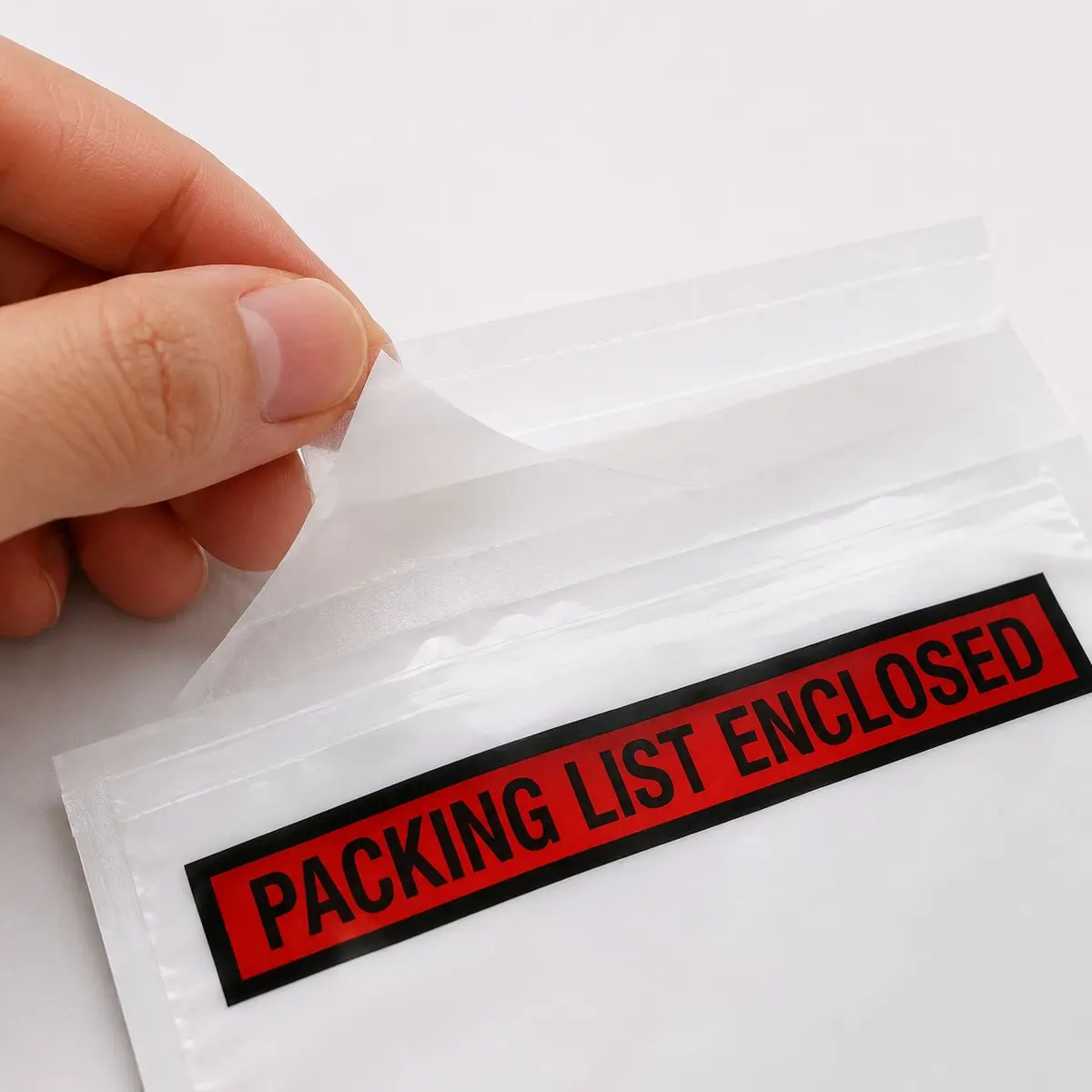
How Does a Packing List Envelope's Adhesive Work?
A self-adhesive packing list envelope sticks to your carton with a pressure-sensitive adhesive, usually called PSA. It is a permanently tacky coating on the back of the pouch, kept clean under a peel-off release liner.
You peel the liner, place the pouch and press it down with your hand. That pressure makes the adhesive flow into the tiny texture of the surface and grip.
No water, no heat, no machine is involved. The pressure does the work.
That is the whole mechanism.
The rest of this post is about making it hold reliably on different surfaces, in different temperatures, and on rough routes. We have made these pouches in Jaipur since 1997 and we ship them to 20+ countries, from cold stores to hot ports. I have kept the explanation practical, because that is what a packing bench needs.
What does “pressure-sensitive” actually mean?
It means the adhesive bonds under light pressure, without anything else. The adhesive on a pressure sensitive document pouch is viscoelastic, i.e. it behaves partly like a solid and partly like a very thick liquid. At rest it holds its shape. Under pressure it spreads across the surface and settles into every small pit and fibre, and that close contact is what makes the bond.
3 properties decide how well a PSA performs.
- Tack is how quickly it grabs on first contact.
- Peel adhesion is how hard it resists being pulled back off.
- Shear, or cohesion, is how well it holds a steady load without sliding or oozing.
A good shipping adhesive balances all three. It needs enough tack to grab a rough carton at once, enough peel strength to survive handling, and enough cohesion to stay in place for the whole trip.
How does the peel-and-stick liner work?
The release liner is a strip of silicone-coated paper or film laid over the adhesive. Silicone is very hard for glue to hold on to, so the adhesive stays on the pouch and lets go of the liner cleanly.
While the liner is on, the peel and stick packing list pouch is protected. It cannot pick up dust, fibres or fingerprints, and all 3 weaken a bond.
Once the liner comes off, you get 1 good chance to place it.
- Peel the liner back fully, because a half-peeled liner leaves dead patches.
- Line the pouch up before it touches down, because a permanent adhesive grabs on contact.
- Press firmly over the whole adhesive area, and finish on the edges.
Hot-melt vs acrylic: which adhesive is on the pouch?
2 adhesive families cover most self-adhesive pouches. The right one depends on where your parcels go, and we can supply either.
Hot-melt adhesives, also called rubber-resin, are coated while molten and cool into a dry, tacky film. They grab very fast and bond instantly to rough, porous board, which makes them the workhorse for everyday corrugated shipping. Their weak side is heat. They soften when it is hot and they age faster.
Acrylic adhesives bond more slowly and build strength over a few hours. In return they handle heat, sunlight and ageing far better, so they suit long transit, outdoor exposure and anything that must hold for months.
| Property | Hot-melt / rubber-resin | Acrylic |
|---|---|---|
| Initial tack | Very high (grabs instantly) | Moderate (builds over time) |
| Heat resistance | Lower (softens when hot) | High |
| UV / ageing | Moderate | Excellent |
| Best for | General corrugated shipping | Long transit, heat, outdoor |
| Cost | Lower | Higher |
My honest view is that most buyers do not need acrylic.
I would start with hot-melt. For domestic and regional shipping, a high-tack hot-melt does the job and costs less, and we would rather sell you the cheaper grade when it works. Acrylic, or a high-performance grade, earns its price on export routes, in hot warehouses and in long storage.
What surfaces does a self-adhesive packing list envelope bond to?
PSA bonds best to surfaces that are clean, dry and firm. Rough, porous board actually helps, because the adhesive keys into the texture. Loose, flexible or dirty films fight it.
| Surface | Typical adhesion | Notes |
|---|---|---|
| Corrugated cardboard | Excellent | The everyday target, texture aids grip |
| Kraft / smooth cartons | Very good | Clean, flat, predictable |
| Rigid plastic, metal, wood | Good to very good | Needs a clean, oil-free face |
| Polybags | Good if taut | Tighten the bag, slack film peels |
| Stretch / shrink wrap | Variable | Bonds to taut film, loose wrap and seams lift |
| Dusty, oily, frosted, wet | Poor | Clean and dry first, or the bond fails |
The rule of the trade here is short.
Clean, dry and taut wins.
When you have to stick to films or to less-than-perfect board, a high-tack grade is the answer. Our note on why a packing list envelope won’t stick goes through the fixes one by one.
How does temperature affect the bond?
Temperature is the biggest single reason a pouch fails to stick. The adhesive has to stay soft enough to flow into the surface, and heat and cold both upset that.
In the cold, the adhesive stiffens and loses tack, like butter straight from the fridge. Below roughly 5°C the bond becomes unreliable, and frost or condensation on the carton makes it worse. Apply at room temperature where you can, or ask for a cold-temperature grade for chilled and frozen goods.
In heat, standard hot-melts soften and can creep or ooze in hot warehouses and containers. I know this one well, because a Jaipur summer is not kind to adhesives.
Acrylic holds much better there.
The temperature at the moment of application matters most. A pouch going into a cold chain still bonds best if the pouch, the carton and the room are warm when you press it on. The bond then holds as everything cools down.
How do I choose the right adhesive for my line?
Match the chemistry to the job. This is how I would sort it, and you can ask us about any of these 4.
- For fast lines on rough corrugated, use a high-tack hot-melt.
- For heat, sunlight or long transit, use acrylic or a high-performance grade.
- For chilled and frozen goods, use a cold-temperature grade.
- If you ever need to move or reopen the pouch, use a removable or resealable grade.
You can see what we make on the products page. For the basics of the format, read what are packing list envelopes and top-loading vs side-loading packing list envelopes.
Not sure which adhesive suits your cartons, films and climate? Tell us your surfaces and shipping conditions, and we will send a sample pack of the grades worth trying.
Frequently asked questions
How does the adhesive on a packing list envelope work?
It uses a pressure-sensitive adhesive, a permanently tacky layer kept under a peel-off liner. You strip the liner, press the pouch onto the carton, and your hand pressure pushes the adhesive into the surface. No water, heat or solvent is needed.
What is a pressure-sensitive document pouch?
It is a pouch whose back is pre-coated with pressure-sensitive adhesive and covered by a release liner. 'Pressure-sensitive' simply means the bond forms from the pressure of your hand. Peel it, place it, press it, and it stays.
Is the adhesive hot-melt or acrylic?
Both are used, and the right one depends on your route. Hot-melt grabs instantly on rough corrugated, which suits most shipping. Acrylic bonds more slowly but handles heat, sunlight and ageing better, so it suits long transit and warm climates.
What surfaces will a peel-and-stick packing list pouch bond to?
Corrugated board, kraft, smooth cartons, most rigid plastics, metal and wood all work well. Polybags and stretch film work if they are clean and pulled taut. Loose shrink wrap and dusty, oily, frosted or wet surfaces are the trouble spots.
Why won't my packing list envelope stick in cold weather?
Cold makes the adhesive stiff, so it cannot flow into the surface. Frost or condensation on the carton adds a layer of moisture on top. Below roughly 5°C the bond gets unreliable, so apply at room temperature or ask for a cold-temperature grade.
Do I need to wet or heat the adhesive before sticking?
No. A self-adhesive pouch is applied dry. Water or heat will not help, and water can actually spoil the bond. Just peel and press.
Can I reposition the pouch after sticking it down?
Usually not. Most shipping pouches use a permanent adhesive, so the first placement is final and pulling it up can tear the film or the carton face. If you need to move or reopen it, ask for a removable or resealable grade.
Sourcing these in volume?
We make packing list envelopes in Jaipur for importers and distributors. Factory-direct, private label welcome.