
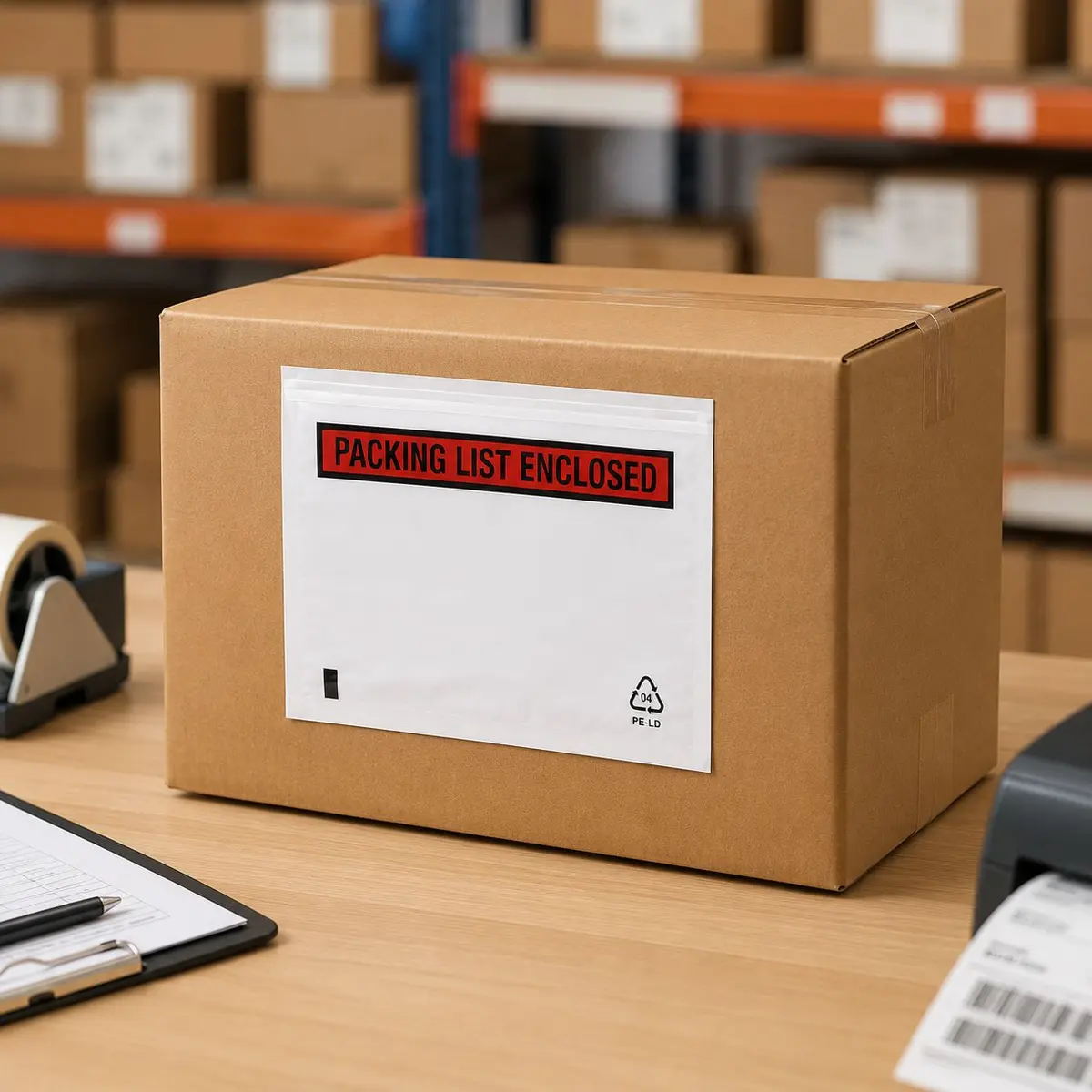
Lead Times and Reorder Planning for Packing List Envelopes
Running out of packing list envelopes sounds like a small problem. It is not, because parcels then ship without their paperwork attached.
That leads to customs delays, returns and unhappy customers. The answer is not ordering more often. It is ordering with a plan: knowing your real lead time, setting a reorder point, holding the right safety stock and, for steady volumes, putting a blanket order in place.
We have made packaging in Jaipur since 1997 and export to 20+ countries, so I think about lead time from both ends, the factory and the buyer’s shelf. Here is how I would plan it.
What makes up the lead time for packing list envelopes?
Total lead time is production time plus freight time. It is the gap between placing an order and having stock on your shelf, and you need to plan for both parts.
Production lead time is how long the factory needs to make your order. Standard clear pouches are the quickest. Custom sizes, custom print or special materials take longer, because they need cylinders, plates or print setup first.
Freight lead time is the transit from the factory to your warehouse. On international orders this is often the largest part, and the least predictable.
If you buy standard stock from a local distributor, lead time can be short. If you buy direct from a manufacturer abroad, freight dominates the timeline. Get both numbers from your supplier in writing, and treat them as ranges, not promises.
How does freight affect lead time and planning?
Freight choice is usually the biggest lever you have.
Each mode trades cost against speed and predictability.
| Freight mode | Relative speed | Relative cost | Best for |
|---|---|---|---|
| Sea freight | Slowest, most variable | Lowest per unit | Bulk, planned reorders |
| Air freight | Fastest | Highest per unit | Urgent top-ups, emergencies |
| Road or regional | Fast within a region | Moderate | Local distributor stock |
The sensible pattern is to move the bulk of your volume by sea, at the best unit cost, and keep a small air-freight option for emergencies. Sea transit also suffers from port congestion, bad weather and seasonal rushes. Anyone who has watched a container sit at a port during monsoon knows that a “fixed” transit time is never fixed.
So build extra buffer around the busy periods you already know about.
How do I calculate a reorder point?
Reorder when stock drops to (average daily usage x total lead time in days) + safety stock. At that level, the new order arrives before you run dry.
- Average daily usage is how many pouches you use per day, based on recent shipping volume.
- Total lead time is production plus freight, in days.
- Safety stock is your buffer, covered in the next section.
This number is not permanent.
Usage drifts and freight times change, so I would review it regularly. A reorder point set once and forgotten will be wrong within a year.
How much safety stock should I hold?
Hold enough to cover a late delivery or a sudden jump in orders. Size it to how uneven your business is, not to a flat rule.
You need more safety stock in these cases:
- Your demand is seasonal or spiky, for example ecommerce peaks, festive sales or promotions.
- Your freight lane is long or unpredictable, such as long sea routes or busy ports.
- A stockout is expensive for you, because it means held shipments, missed cut-offs or customs trouble.
You can hold less when usage is steady, lead times are short and reliable, and storage space is tight.
Here is the mistake I see most often.
Buyers apply one buffer to everything. A custom-printed size that comes from far away needs a much deeper buffer than a fast-moving standard pouch from down the road.
How can forecasting prevent stockouts?
Forecast from your own recent usage, then reorder before you hit the trigger. This turns reordering from a scramble into a routine.
- Base the forecast on the last 8 to 12 weeks of real consumption, and split it by size (DL, A5, A4, 6 × 9 and so on), so each size is reordered to its own demand.
- Use a simple moving average for steady demand, or give recent weeks more weight when volumes are changing.
- Review monthly or quarterly, and adjust the reorder point and buffer as patterns shift.
- Plan peak-season orders early. Work backwards from the date you need stock, subtract full lead time and add extra buffer.
A basic spreadsheet that tracks usage per size beats guessing every time. It also gives your supplier early notice of what is coming. Any factory, ours included, can plan better when a buyer shares that kind of forecast.
When should I use a blanket order with call-offs?
Use one when your yearly volume is predictable and you want fixed prices without storing a year of stock. For recurring needs, it is the best tool I know for taking the risk out of lead time.
A blanket order commits you to a total quantity over a period, often a year, at agreed pricing. You then send call-offs, i.e. release orders for smaller shipments, as you need them.
- Prices stay stable across the whole commitment, with volume pricing on the total.
- The supplier can plan capacity and produce ahead, so each call-off skips most of the production wait.
- You receive stock in scheduled batches instead of paying to warehouse a full year’s supply.
- You deal with one agreement instead of a fresh negotiation every time.
The downside is commitment.
If your volume falls sharply, you are still tied to the total, so do not sign one on a guess. For one-off or unpredictable needs, a clear reorder point is simpler.
Blanket orders make the most sense for custom-printed or custom-sized pouches, where the setup happens once and every release ships against it. Our guide on how to buy packing list envelopes in bulk shows how blanket terms fit into wider sourcing, and the product range will help you pick the sizes and finishes to standardise on.
Planning a regular supply or a peak-season build-up? Send us your sizes, yearly volume and target dates, and we will help you work out a reorder schedule or a blanket order that keeps you in stock.
Frequently asked questions
What is the lead time for packing list envelopes?
It has two parts, production and freight. Production is how long the factory takes to make your order, and custom sizes or printing take longer than standard stock. Freight is the transit to your warehouse, and on international orders it is often the bigger part. Confirm both with your supplier before you plan a reorder.
How do I calculate a reorder point for packaging?
Use (average daily usage x total lead time in days) + safety stock. Multiply how many pouches you use per day by the days a fresh order takes to arrive, then add a buffer. When stock falls to that number, place the next order.
What is safety stock and how much should I hold?
Safety stock is the extra stock that covers a late delivery or a sudden jump in orders. How much you need depends on how uneven your usage is and how reliable your supplier and freight lane are. Long, unpredictable routes and seasonal peaks call for a bigger buffer.
What is a blanket order with call-offs?
It is an agreement to buy a set total quantity over a period, often a year, at fixed pricing. You then release smaller shipments, called call-offs, as you need them. You get stable prices, and the supplier can plan production ahead of each release.
How does freight choice affect lead time?
More than anything else, on international orders. Sea freight is the cheapest for bulk but slow and sensitive to weather and port congestion, while air freight is fast and expensive. Many buyers ship bulk by sea and keep air freight only for emergencies.
How far ahead should I reorder before a peak season?
Work backwards from the date you need stock on the shelf. Subtract the full production and freight time, then add extra buffer, because factories and freight lanes are busiest just before peaks. Ordering early is always cheaper than paying for rushed air freight.
Should I buy from a local distributor or a manufacturer?
It depends on your volume. A local distributor gives short lead times on standard stock but charges more per unit and offers little customisation. A manufacturer gives better volume pricing and custom sizes or print, with a longer lead time that a blanket order largely takes care of.
Sourcing these in volume?
We make packing list envelopes in Jaipur for importers and distributors. Factory-direct, private label welcome.