
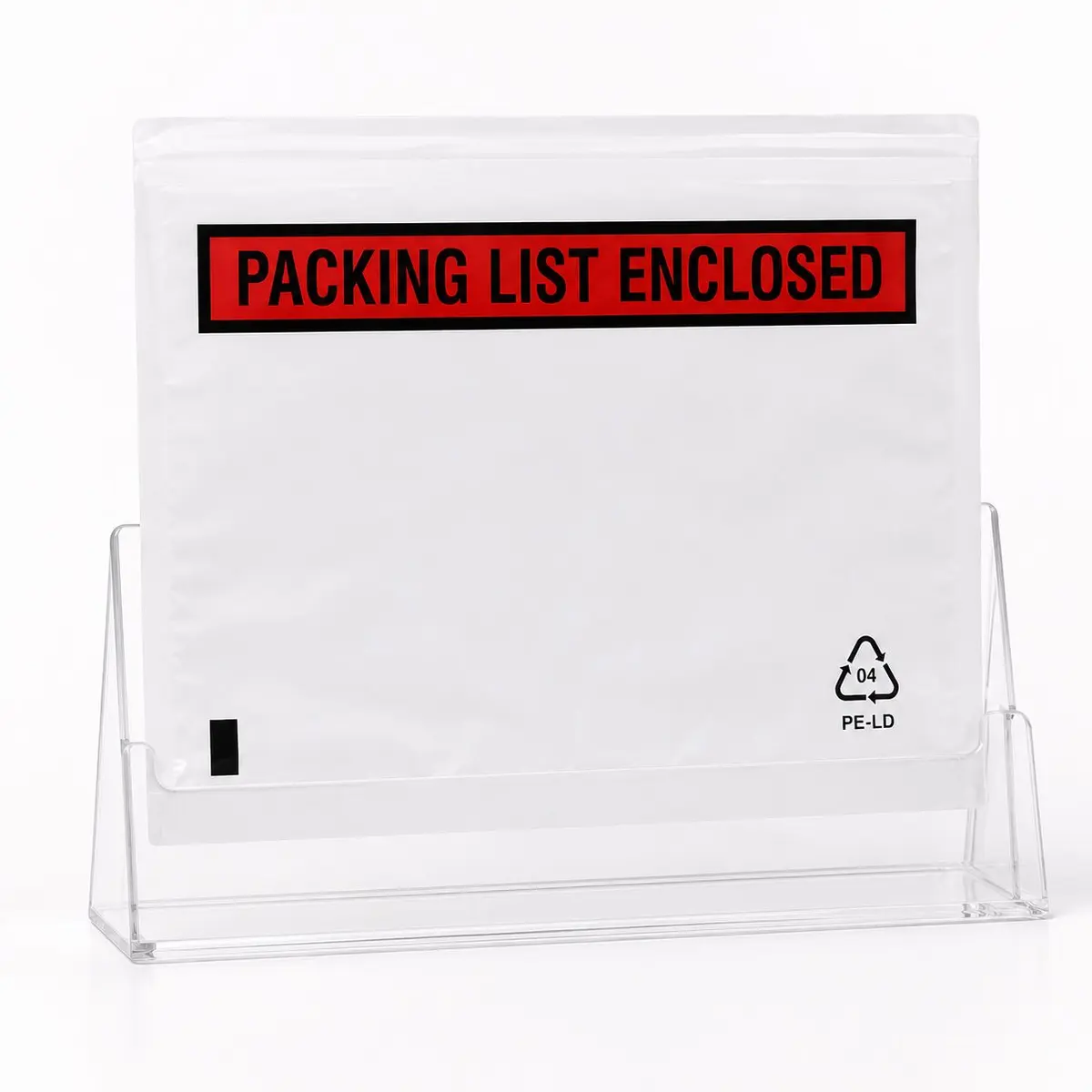
Recycled-Content Films for Document Pouches
A recycled-content document pouch is a packing list envelope made partly from recycled plastic instead of only virgin polymer. Most often that recycled share is post-consumer recycled resin, or PCR.
It does the same job as a normal poly pouch.
Your packing slip or invoice rides on the outside of the carton, dry and readable. The difference is that less new plastic went into making it.
This is also a topic full of loose claims. So I will explain what PCR film is, how it performs, which claims you must check before you print them, and where recycled content really helps.
What is recycled-content (PCR) film?
It is film made by blending recycled plastic resin with virgin polymer, with the recycled share given as a percentage. “PCR” means the plastic came from something a consumer used and threw away, which was then collected, cleaned and made into new pellets.
- PCR (post-consumer recycled) comes from items people used and put out for recycling, such as bottles or films. It counts for the most in a sustainability claim, because it takes waste out of the public stream.
- PIR (post-industrial recycled) comes from factory offcuts and production scrap that never reached a consumer. It is still recycled, but it is a weaker story.
- The recycled percentage is the share of the film made from recycled resin, for example 30% PCR or 50% PCR. The rest is virgin polymer, which gives strength and clarity.
A document pouch is a good place to use recycled content. It only protects paperwork on the outside of a parcel, so it does not face the strict food-contact limits that restrict how much PCR a food pack can carry.
It is the kabadiwala’s trade in a modern form. Yesterday’s plastic comes back as something useful.
How does PCR film perform in a document pouch?
For carrying paperwork, it performs about as well as virgin film.
The main difference you will notice is the look.
- Protection. Water, dust and tear resistance are comparable, so the packing list still arrives dry and readable.
- Appearance. Recycled film can look slightly grey, hazy or specked instead of water-clear. On a fully clear pouch you will see it. On a printed panel-face pouch it is mostly hidden.
- Thickness. To match virgin strength, a high-PCR film is sometimes made a little thicker, which eats into part of the material saving.
- Adhesive and print. These work the same way, because the recycled content is in the film wall, not the glue.
My advice is simple.
If clarity is critical, use a lower recycled percentage with a clear window. If the face is printed anyway, a higher percentage costs you very little in looks.
How does recycled film compare with virgin film?
Recycled film cuts the use of new plastic and usually has a lower carbon footprint. Virgin film wins on clarity and consistency. Both protect documents well.
| Factor | Recycled-content (PCR) film | Virgin film |
|---|---|---|
| Document protection | Comparable | Comparable |
| Appearance and clarity | Can be grey or specked | Water-clear, consistent |
| Virgin plastic used | Reduced | Full |
| Carbon footprint | Typically lower | Higher |
| Consistency | More variable batch to batch | Highly consistent |
| Claim to verify | Recycled % and certificate | None needed |
I will take a side here.
For most B2B shipping lanes, recycled content is the more defensible choice. Virgin film still makes sense where a flawless clear window really matters. For the wider picture on materials, see what packing list envelopes are made of.
What claims do I need to verify before printing them?
Only print a recycled-content claim you can back with a chain-of-custody certificate, and word it exactly as the certificate does. A vague “made with recycled material”, with no percentage and no document, cannot be checked. It is also becoming a compliance risk in many markets.
- Ask which standard applies. Recognised chain-of-custody schemes include GRS (Global Recycled Standard) and RCS (Recycled Claim Standard), which track recycled material through the supply chain.
- Check that the certificate covers the pouch. A certificate on the resin does not automatically cover the finished pouch you are buying.
- Match the percentage. If the certificate says 30%, your claim says 30%. Do not round up, and do not hint at 100%.
- Confirm whether it is PCR or PIR, since the claim strength differs.
- Keep the paperwork. Your supplier’s certificate is your main proof when a customer’s ESG or compliance team asks.
Precise wording such as “contains 30% post-consumer recycled film, GRS-certified” can be defended, if the certificate says so. Loose green wording cannot.
This is where I see most buyers go wrong. They focus on the percentage and forget the proof.
Is recycled content actually more sustainable?
It reduces demand for new plastic and usually lowers the carbon footprint.
But I would not call it automatically green on its own.
Recycled content answers what goes into the film. Recyclability answers what happens after use. They are separate properties, and a pouch can contain recycled material yet still be hard to recycle if it is a mixed laminate.
The strongest position combines both: recycled content in a single-material film that stays recyclable after use. It cuts virgin plastic, keeps a real recycling route open, and holds up in an audit. If end of life is your main concern, our guide on whether packing list envelopes are recyclable covers the disposal routes.
We have made packaging in Jaipur since 1997 and export to 20+ countries. We are happy to talk you through film options on our products page. If you also want the recycled claim printed on the pouch, see custom print, and bring the certificate wording with you.
Want recycled-content document pouches with a claim you can defend? Tell us your target recycled percentage and your shipping lanes, and we will suggest a film and send samples so you can judge the look for yourself.
Frequently asked questions
What is PCR film in a document pouch?
PCR means post-consumer recycled. It is plastic that someone used and threw away, which was then collected, cleaned and turned back into film. A PCR document pouch blends a share of this recycled resin with virgin polymer, and the share is stated as a percentage, such as 30% or 50% PCR.
Does recycled-content film protect documents as well as virgin film?
For a packing list or invoice on the outside of a carton, yes. Water, dust and tear resistance are comparable. The visible difference is appearance, because recycled film can look slightly grey or specked, and a high-PCR film is sometimes made a little thicker to match the strength of virgin.
What is the difference between PCR and PIR recycled content?
PCR comes from material consumers used and discarded. PIR, post-industrial recycled, comes from factory offcuts and scrap that never reached a consumer. PCR usually counts for more in a sustainability claim, so always check which one your supplier means.
How do I verify a recycled-content claim on a pouch?
Ask for a chain-of-custody certificate such as GRS (Global Recycled Standard) or RCS (Recycled Claim Standard). Check that it covers the finished pouch, not only the resin, and make your printed claim say exactly what the certificate says, percentage included. A vague 'made with recycled material' cannot be verified.
Can a recycled-content pouch be recycled again?
It can if it is made from a single material. Recycled content is about what goes into the film, and recyclability is about what happens after use, which are two separate things. A mono-material PCR pouch covers both, while a mixed laminate may contain recycled content and still be hard to recycle.
What percentage of recycled content can a film pouch have?
It depends on the film and the strength you need. Many flexible films sit somewhere in the 30 to 50% range, and some go higher. Higher percentages can affect looks and may need a slightly thicker wall, so tell your supplier the protection level you need first.
Do food-contact rules limit recycled content in document pouches?
No, because a document pouch does not touch food. It only protects paperwork on the outside of a parcel, so the strict cleanliness limits on recycled content in food packaging do not apply. That makes document pouches a sensible home for recycled film.
Sourcing these in volume?
We make packing list envelopes in Jaipur for importers and distributors. Factory-direct, private label welcome.