
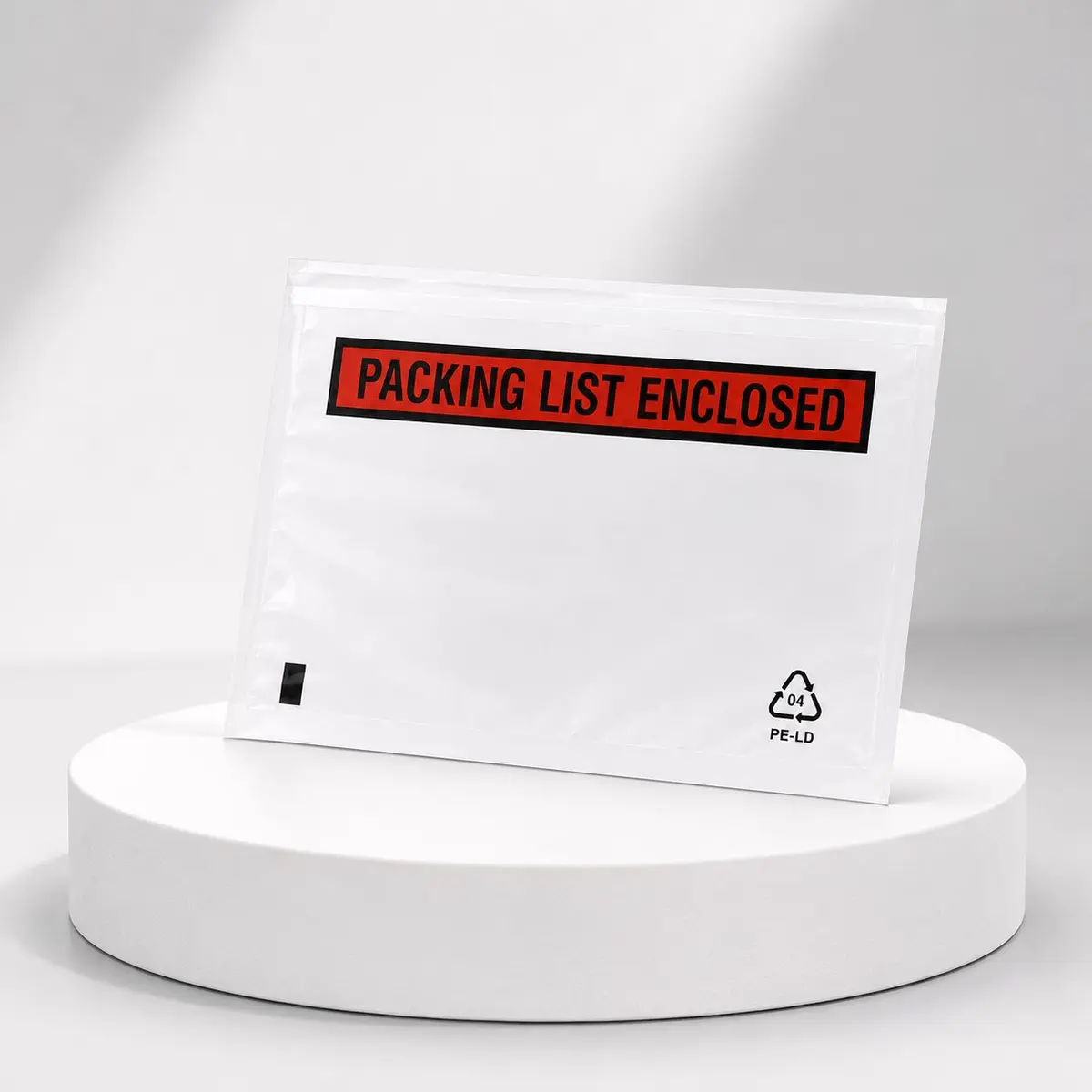
What Are Packing List Envelopes Made Of?
Most packing list envelopes are made of polyethylene film with a pressure-sensitive adhesive on the back. Usually that is low-density polyethylene (LDPE) or a co-extruded poly film.
Paper and glassine versions also exist.
Which one is right depends on how rough the journey is, how much recycling matters to you, and where the pouch travels. Below I break it down for importers, distributors and fulfilment teams. We make poly document pouches in Jaipur, so I will also tell you where I think plastic is the right answer and where it is not.
What are packing list envelopes made of?
Mostly polyethylene film, with a clear front and a self-adhesive back. A smaller share is made from paper or glassine for plastic-free shipping.
A typical polyethylene packing list envelope has three parts.
- A clear film face, so documents can be read without opening the pouch.
- A backing layer, clear, white or printed, that closes the pocket.
- A pressure-sensitive adhesive, as a strip or a full coating, that fixes the pouch to a carton or mailer.
Paper versions swap the film for coated kraft paper or glassine, usually with a small film window so the documents stay visible. You can see our formats on the products page, and a fuller definition in our guide to what packing list envelopes are.
What is the plastic film made of, and what gauge is used?
The plastic is almost always polyethylene. It is usually LDPE, or a co-extruded blend of low-density and linear low-density polyethylene (LLDPE), in a flexible film of around 2 mil. That is roughly 50 microns, since 1 mil is 25.4 microns.
Co-extrusion makes several layers in one film. This lets one side be glossy and clear and the other side white or printable.
A few points matter when you pick the film.
- LDPE and LLDPE blends give flexibility, tear resistance and a good surface for the adhesive to hold.
- Gauge is measured in mil (thousandths of an inch) or in microns. Heavier film resists puncture on rough routes. Lighter film cuts material and weight.
- Polyethylene resists water and oil, so it protects paperwork from rain, condensation and grease in transit.
Here is my stance on gauge.
Most buyers ask for thicker film than they need. I would choose the thinnest gauge that survives your route, because a pouch is like a good roti, thin is fine as long as it does not tear.
The right gauge and blend depend on your goods and route, so we quote specs per order. Ask us for a suggestion on thickness.
What are the clear window and the adhesive made of?
The window is a transparent polyethylene or co-extruded film. The adhesive is a pressure-sensitive formula that bonds on contact.
Together they let staff read documents at once and apply the pouch in one motion.
The clear film has to be clear enough for barcodes, addresses and customs codes to scan through it. On paper versions, the window is a thin film set into the paper face.
The adhesive does the hard work. It bonds under firm hand pressure with no water, solvent or heat. It sticks to corrugated board, kraft, poly mailers and stretch film. It has to hold through humidity, temperature swings and long-haul handling. Until use, a release liner protects it, and the packer peels that liner off at the bench.
For why these pouches exist and what the printed wording means, see the meaning of “packing list enclosed”.
Plastic vs paper document pouch: how do they compare?
Polyethylene wins on durability and moisture resistance. Paper and glassine win on curbside recycling and a plastic-free profile.
| Factor | Polyethylene (LDPE or co-ex) | Paper or glassine |
|---|---|---|
| Moisture resistance | High, resists water and oil | Low to moderate, can soften when wet |
| Durability | High, resists tears and puncture | Moderate, better for light handling |
| Document visibility | Excellent clear film face | Good, through an inset film window |
| Printing and branding | Excellent on co-extruded film | Excellent on kraft surface |
| Recyclability | Film recycling or store drop-off | Widely curbside-recyclable |
| Best for | Export, heavy or wet conditions | Eco-focused, dry, domestic shipping |
So the plastic vs paper document pouch choice is a trade-off between toughness and recycling. A common pattern is poly for long ocean routes and paper for lighter domestic parcels.
I will be honest about poly’s weak point, even though we make poly pouches ourselves.
In most regions it cannot go in the household recycling bin. If your customers care about that, paper is worth a trial.
Which recyclable and sustainable options exist?
The recyclable choices are paper and glassine pouches, and poly films sent into film-recycling streams. Most of the gain comes from choosing the material well.
- Paper or glassine envelopes are accepted in most curbside paper recycling where the film window is small or removable.
- Down-gauged poly film uses the thinnest reliable gauge, so there is less plastic per pouch.
- LDPE pouches can go to store drop-off or commercial film recycling, since they are not curbside items in most regions.
- Right-sizing the pouch to the document set means no film is wasted on empty border.
We are an ISO 9001 certified manufacturer and have made packaging since 1997, exporting to 20+ countries. We can help you match the material to your handling conditions and your environmental policy.
How do I choose the right packing list envelope material?
Match the material to the conditions first. Poly suits wet, heavy or export use, while paper or glassine suits dry, domestic shipping where recycling matters. Then fine-tune gauge, size and printing.
- Exposure. Will it face rain, cold stores or rough handling? If yes, lean towards poly.
- Recycling. Do you need curbside recyclability? If yes, lean towards paper or glassine.
- Document size. Choose a pouch that fits your paperwork without heavy folding.
- Branding. Decide between plain stock and printed text or a logo, which our custom print page covers.
- Volume. Higher volumes justify custom film blends and print plates.
Not sure whether poly or paper suits your shipments? Tell us your route, document size and volumes, and we will send samples to try.
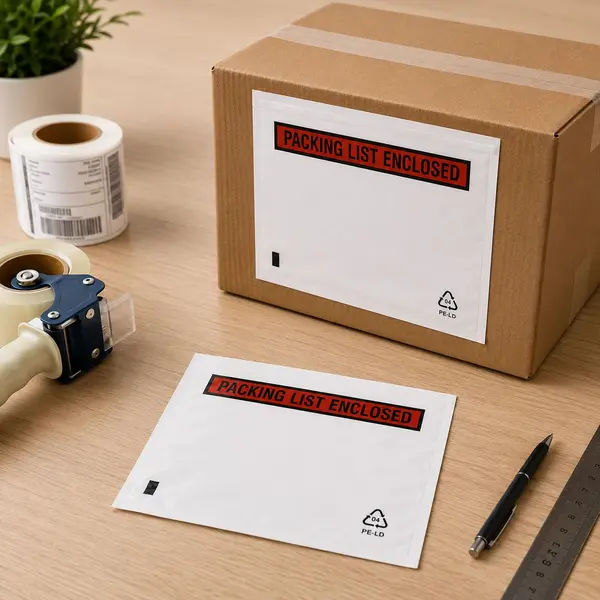
Frequently asked questions
What are packing list envelopes made of?
Most are made of low-density polyethylene (LDPE) or a co-extruded poly film, with a pressure-sensitive adhesive on the back. Paper and glassine versions also exist for plastic-free shipping.
Are packing list envelopes plastic or paper?
Both exist, but plastic is far more common. The usual type is a flexible polyethylene film. Kraft paper and glassine versions are offered for businesses that want a paper-based pouch that goes in curbside recycling.
What is the clear window on a packing list envelope made of?
It is a transparent polyethylene or co-extruded film. It lets carriers and receivers read the documents without opening the pouch.
What gauge or thickness are packing list envelopes?
Poly packing list envelopes are generally made from film of roughly 2 mil, often a clear face with a printed or white back. A heavier gauge adds tear and puncture resistance for rough handling, and a lighter one saves material.
What adhesive is used on packing list envelopes?
A pressure-sensitive adhesive (PSA). It bonds on contact under hand pressure, with no water or heat, and is made to stick to corrugated boxes, poly mailers and stretch-wrapped pallets.
Are packing list envelopes recyclable?
Paper and glassine versions are widely accepted in curbside paper recycling. Poly (LDPE) envelopes go through store drop-off or commercial film recycling instead of the normal curbside bin, depending on your local scheme.
Is polyethylene safe for shipping documents internationally?
Yes, it is well suited to it. Polyethylene resists moisture, is tough and is chemically stable, so it protects invoices and customs papers from rain, rubbing and handling on long export routes.
Sourcing these in volume?
We make packing list envelopes in Jaipur for importers and distributors. Factory-direct, private label welcome.