
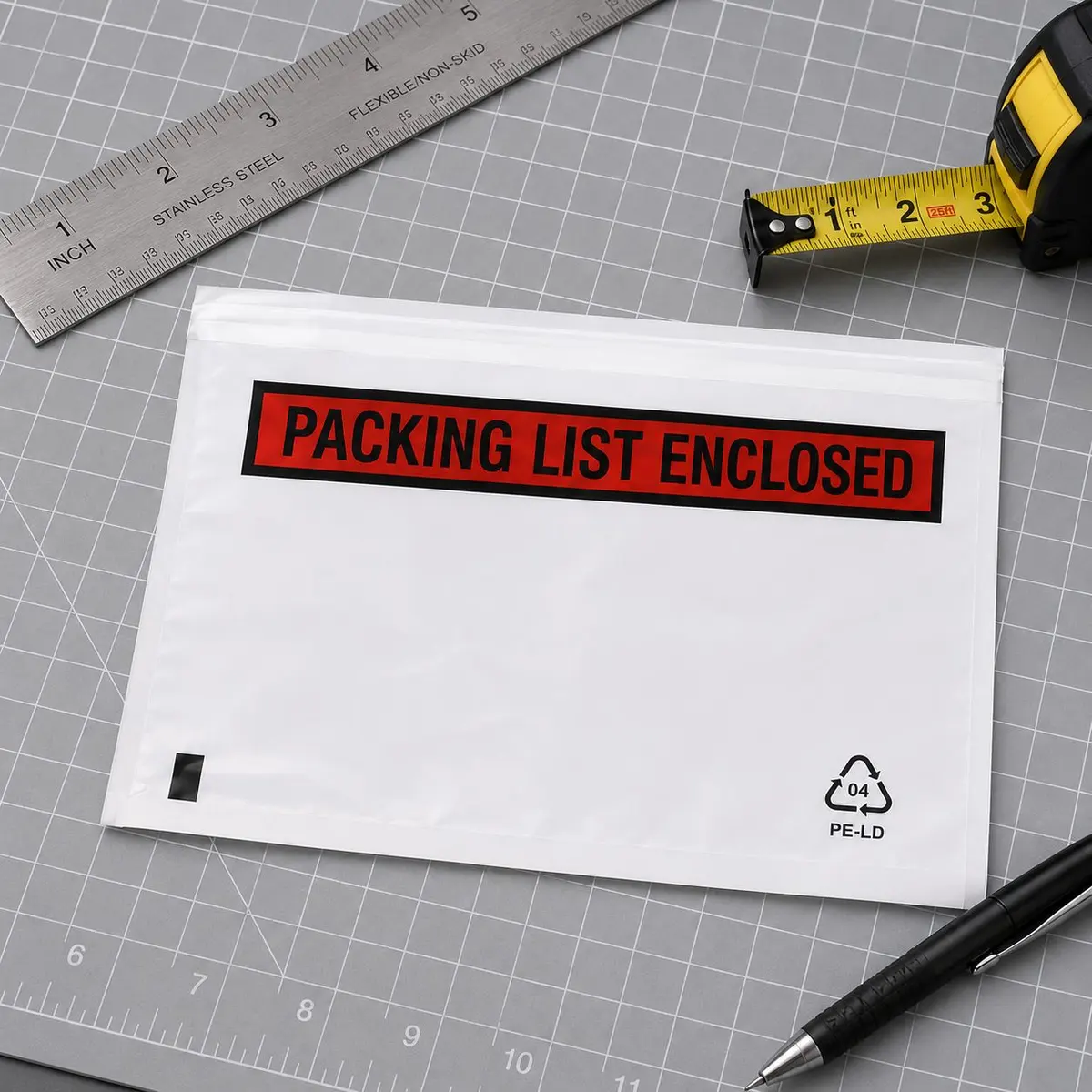
Right-Sizing Document Pouches to Cut Material Use
The quickest way to cut packaging material on a parcel is to stop oversizing the document pouch.
Match the pouch to the document inside it, and every parcel carries less film. That is film you bought, stored and shipped, and film your customer would otherwise throw away.
Below I explain why oversizing wastes material, what right-sizing saves, and a simple way to size pouches across your shipments. It sits alongside our longer guide on reducing packaging waste and spend.
Why does oversizing a document pouch waste material?
Because an oversize pouch wraps the document in a wide empty border of film that does no work. The bigger the gap between pouch and paper, the more film you carry for nothing.
Picture a small slip in a pouch made for a flat A4 sheet. Most of that pouch is empty margin, and that margin costs you four times.
- It is film you paid for, multiplied by every parcel.
- It adds storage and freight, with bulkier stacks to keep and more bulk per carton.
- It becomes the receiver’s waste, and works against your customers’ waste targets.
- It protects nothing. A loose document slides and creases in a big pouch, so the extra size actually hurts legibility.
Oversizing usually comes from buying one large pouch “to be safe”. It feels simple at the purchase desk.
But it bakes waste into every shipment.
It is a bit like serving one roti on a thali meant for a feast. The food is the same, but you wash a much bigger plate.
How much material, cost and emissions does right-sizing save?
The saving is small per parcel and large across volume. Geometry does most of the work here. Each A-size step halves the sheet area. An A4 sheet is 210 × 297 mm and an A5 sheet is 148 × 210 mm, so an A5 pouch uses roughly half the film of an A4 pouch.
That is a big cut for no loss.
Three things move when you right-size.
- Material. Less film per pouch, almost all of it taken from the empty border.
- Cost. Less film per unit means a lower unit price. A flatter parcel can also help on lanes charged by dimensional weight.
- Emissions. Less material to make and a slightly lighter parcel mean lower emissions per shipment. It adds up with volume and supports your customers’ own reporting.
| What changes | Oversize pouch | Right-sized pouch |
|---|---|---|
| Film per parcel | Full size, wide empty border | Sized to document, small margin |
| Material cost | Higher unit price | Lower unit price |
| Receiver’s waste | Large discarded border | Minimal offcut |
| Document fit | Can slide and crease | Held snug, readable |
| Transport profile | Bulkier | Flatter, denser |
None of this is dramatic on one parcel.
The point is the multiplier across tens of thousands of shipments a year.
And it costs you nothing in protection, because a right-sized pouch holds the document better. For the full price picture, see what drives packing list envelope cost.
I should admit the one downside. More sizes mean more stock lines, and a packer can grab the wrong one. This is why I would stop at two or three sizes, not six.
How do I match the pouch to the document set?
Pick the smallest pouch that holds your folded document flat with a small readable margin. No heavy folding, and no wide empty border. Work from your real paperwork, not from habit.
Here is the approach I would follow.
- Map your document types. A single delivery note, a folded A4 invoice and a multi-page customs set each have a natural fit.
- Measure as folded. Fold the document the way your team actually folds it, then measure it.
- Fit flat, and fold once at most. Wadded paper will not lie flat and is hard for couriers and customs to read. A document floating in empty space means the pouch is too big.
- Keep the legend and barcode visible. Leave just enough margin for the printed “Documents Enclosed” legend and any label to read cleanly, i.e. a few millimetres, not a frame.
- Settle on two or three sizes. That usually covers a full mix.
| Document inside | Right-sized pouch | Avoid |
|---|---|---|
| Single delivery note or slip | 4.5 × 5.5 or DL | Defaulting to A4 |
| Standard sheet folded once | 6 × 9 | Oversize A4 with wide border |
| Single A4 invoice (folded to A5) | A5 | Full A4 flat pouch |
| Multi-page A4 customs set (flat) | A4 or C4 | A pouch so small it forces folding |
The rule of the trade is simple. The pouch should be in proportion to the document, and the document in proportion to the parcel.
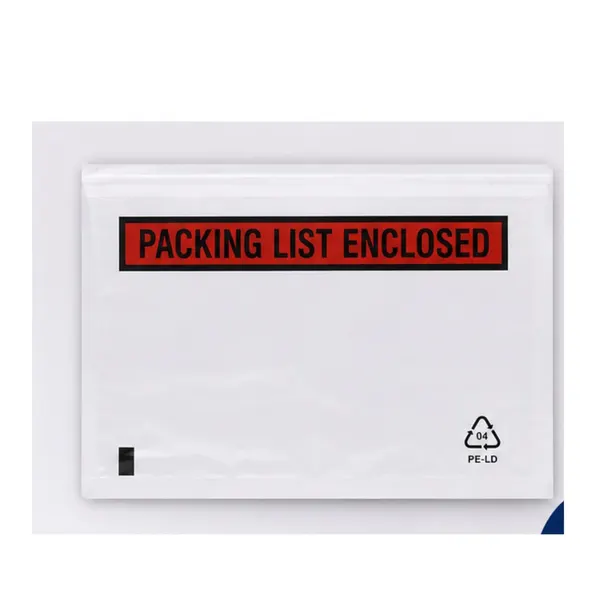
Our packing list envelope sizes guide breaks down each size and what it fits. We make the full range from A7 to A4 in Jaipur, where we have made packaging since 1997, and we export to 20+ countries. We sell every size, so we have no reason to sell you a bigger pouch than you need. You can see the formats on our products page.
Want to trim your pouch range? Send us your document types and typical parcels, and we will suggest the leanest sizes and send samples to try.
Frequently asked questions
How do I right-size a document pouch?
Measure your most common document folded the way your team really folds it. Then pick the smallest pouch that holds it flat, with a small margin so the legend and barcode stay readable. Most operations cover their whole mix with two or three sizes.
How much material does right-sizing a pouch save?
It depends on how oversized you are today, but it can be a lot. Each A-size step halves the sheet area, so moving a slip from an A4 pouch to an A5 pouch removes roughly half the film. Almost all of that was empty border doing no work.
Does a smaller document pouch reduce emissions?
Yes, a little, and at the source. Less film means less material to make, and a slightly lighter, flatter parcel. The effect per parcel is small, but it grows with volume and helps your customers with their own waste targets.
Why is oversizing a document pouch wasteful?
Because the wide empty border adds material cost, storage and freight, and then goes in the receiver's bin. It also lets the document slide and crease in transit, so the extra size gives no extra protection.
Should I fold a document to fit a smaller pouch?
Once is fine, and it is often the most material-efficient choice. A folded A4 invoice fits an A5 or DL pouch. Avoid folding several times, because wadded paperwork does not lie flat and is hard for couriers and customs to read.
How many pouch sizes should an operation stock?
Two or three is enough for most shippers. Map your real document types, such as a single slip, a folded invoice and a multi-page customs set, and give each the smallest pouch that fits. More sizes add buying and storage work without much gain.
Does right-sizing the pouch protect documents as well?
It protects them better. Protection comes from the pouch sealing fully around the paperwork, not from extra size. A snug pouch keeps the document still and readable, while an oversize one lets it slide.
Sourcing these in volume?
We make packing list envelopes in Jaipur for importers and distributors. Factory-direct, private label welcome.