
Certificate of Origin: What It Is and When You Need One
If you export for long enough, a buyer, a bank or a customs officer will ask you for a certificate of origin. Without it, the shipment may not clear.
Here is what the document is, when you actually need one, and how it travels with the rest of your export paperwork. This is general guidance, not legal advice. Always confirm the rules for your own goods and destination.
We have made packaging in Jaipur since 1997, and we now export to 20+ countries. Document-enclosed wallets have been one of our export products to the UK and Australia for a long time. So the paperwork side of shipping is familiar ground for my team and me.
What is a certificate of origin?
A certificate of origin (COO) is an export document that states the country where the goods were made, produced or last substantially transformed. Customs authorities, banks and importers rely on it.
They use it to apply tariffs, enforce trade rules, build trade statistics, and meet the terms of a contract or a letter of credit.
It answers one simple-looking question: where do these goods come from? That answer decides how much duty is charged, whether quotas or anti-dumping measures apply, and sometimes whether the goods can enter at all.
When is a certificate of origin required?
You need a COO when the destination’s customs, the buyer’s contract or a letter of credit asks for one. It is not needed on every shipment.
Whether you need one depends on 3 things.
- The destination. Some countries want a COO for all commercial imports, others only for certain goods.
- The trade regime, i.e. whether a free trade agreement applies between the two countries.
- The type or value of the goods. Low-value shipments and samples are sometimes exempt.
The rules change by lane and by product. I would always check with the freight forwarder, the importer or the issuing chamber before the goods leave. One email before dispatch costs far less than a held container.
Preferential vs non-preferential: what is the difference?
A non-preferential COO only confirms where the goods were made. A preferential COO claims lower duty under a trade agreement. Mixing them up can cost you a duty benefit or hold up a shipment.
| Feature | Non-preferential COO | Preferential COO |
|---|---|---|
| Purpose | Certifies country of manufacture | Claims reduced or zero duty under an FTA |
| Tariff benefit | None | Yes, if origin rules are met |
| When used | General commercial exports | Trade between FTA partner countries |
| Typical issuer | Chamber of commerce | Approved exporter or designated authority |
| Tied to an agreement? | No | Yes, to a specific FTA |
Non-preferential certificate of origin
This is the most common type. It confirms where the goods were made, so the importing country can apply its general rules on statistics, quotas, anti-dumping measures and standard duty.
It gives no tariff reduction.
Even so, it is often a mandatory entry document.
Preferential certificate of origin
This one is used between countries that have signed a free trade agreement (FTA). If your goods meet the agreement’s rules of origin, the importer can claim reduced or zero duty.
That is the catch. The goods must genuinely qualify under the agreement, and the certificate must be the exact form that agreement names. A wrong form is as good as no form.
Who issues a certificate of origin?
A chamber of commerce usually issues or certifies non-preferential certificates. Many now work through secure online portals and return a digitally signed certificate.
To apply, you generally supply:
- Exporter and consignee details.
- A description of the product.
- The declared country of origin.
- A commercial invoice that matches the origin of the goods.
Preferential certificates follow the rules of the relevant agreement. Some are self-certified by an approved exporter, and some are stamped by a designated authority. Use the form the agreement asks for, not the one you used last time for a different country.
How does the COO travel with your export paperwork?
It almost never travels alone. A typical international shipment carries 4 papers as one set: the commercial invoice, the packing list, the transport documents and the certificate of origin. Customs expects to find them together, in one place.
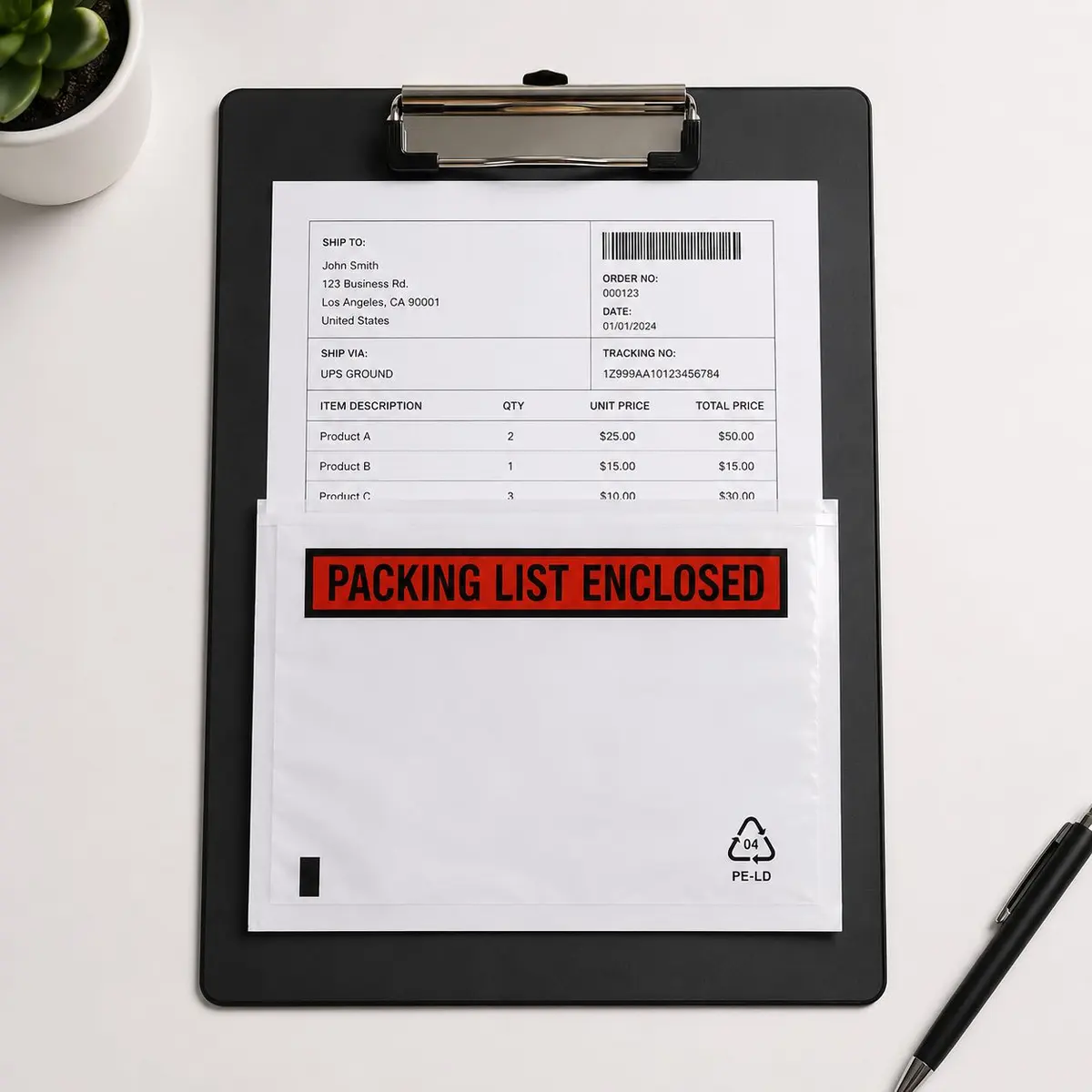
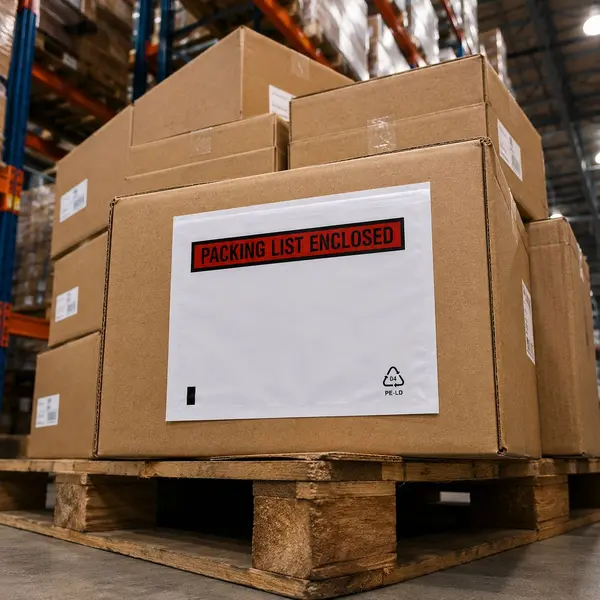
This is why so many exporters, us included, fix a documents-enclosed pouch (also called a packing list envelope) to the outside of the carton. It keeps the invoice, packing list and COO together and flat. A printed “Documents Enclosed” legend tells handlers and customs where the papers are, so nobody has to open the box. A weather-resistant film also protects the originals from rain, scuffing and grease.
My view is simple. If a shipment crosses a border, I would treat the documents pouch as part of the packaging spec.
Originals that arrive creased, soaked or missing are a classic cause of customs holds and demurrage charges.
Our guide on what documents to enclose for international shipments covers the full set. For pouches sized to customs document sets, see our product range. If you want your company name or a legend in the local language, we can do that through custom print.
A checklist before the carton leaves the dock
Run through these 5 questions.
- Do you need a COO at all for this destination and product? Ask first.
- Is it preferential or non-preferential, and does the FTA’s rule of origin really apply?
- Is it the correct form, issued by the correct body?
- Does the origin on the COO match the commercial invoice and the packing list?
- Is it in the pouch, or sent ahead to the bank or consignee, where it will be found?
The fourth question is the one people skip.
I would check it on every shipment, because a mismatch between documents raises more customs questions than a missing stamp.
Exporting across borders? Send us your document size and the lanes you ship, and we will send printed “Documents Enclosed” pouch samples that hold your invoice, packing list and certificate of origin together.
Frequently asked questions
What is a certificate of origin?
It is an export document that states the country where the goods were made, produced or last substantially transformed. Customs, banks and importers use it to apply tariffs, trade rules and statistics. This is general guidance, not legal advice.
When is a certificate of origin required?
Only when someone in the chain asks for it. That may be the customs of the importing country, a letter of credit, or the buyer's contract. Whether you need one depends on the destination, any trade agreement in play, and sometimes the type or value of the goods.
What is the difference between a preferential and non-preferential certificate of origin?
A non-preferential certificate only confirms where the goods were made and gives no duty benefit. A preferential certificate is issued under a free trade agreement. If the goods meet that agreement's rules of origin, the importer can claim reduced or zero duty.
Who issues a certificate of origin?
For non-preferential certificates, usually a chamber of commerce, and often online now. Preferential certificates follow the rules of the agreement. Some are self-certified by an approved exporter, others are stamped by a named authority.
Is a certificate of origin the same as a commercial invoice?
No, they are two separate documents. The commercial invoice shows prices, parties and terms, and customs uses it to assess duty. The certificate of origin confirms the country of manufacture. They usually travel together in the same documents pouch.
Does a certificate of origin guarantee lower duty?
It does not. Only a preferential certificate under a relevant free trade agreement can lower duty, and only when the goods truly meet its origin rules. A non-preferential certificate gives no tariff benefit at all.
Where should the certificate of origin go on the shipment?
The original usually travels with the export paperwork. That means a documents-enclosed pouch on the carton, or a courier to the consignee or the bank. Either way, keep it flat, dry and next to the invoice and packing list.
Sourcing these in volume?
We make packing list envelopes in Jaipur for importers and distributors. Factory-direct, private label welcome.