
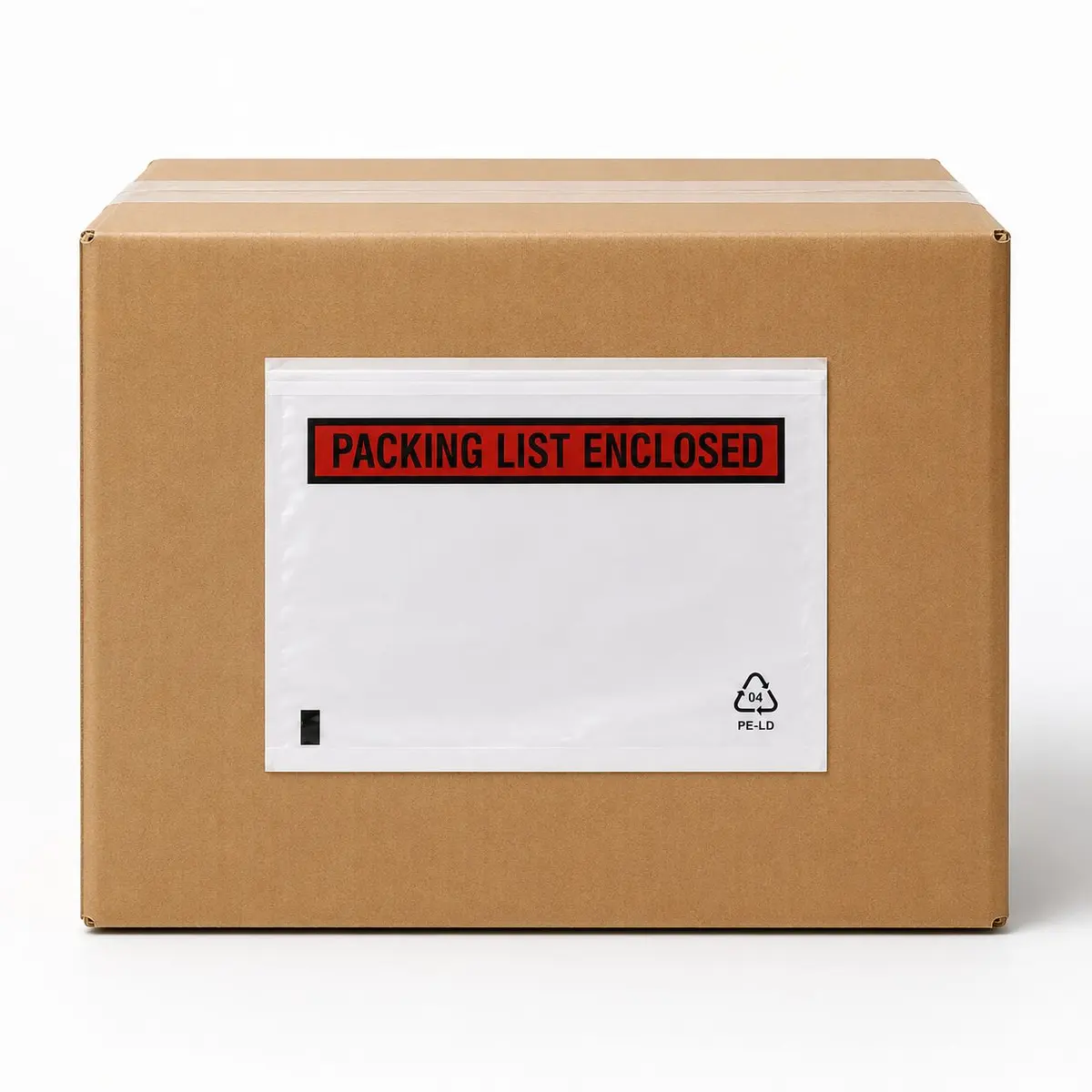
Barcode Scanning Through the Pouch Window
When a barcode will not scan through a packing list envelope, the barcode is usually fine. The clear film in front of it is the problem.
A worker at the dock should get a clean first-time read straight through the window. When that does not happen, the film is reflecting, distorting or scattering the light before it reaches the code.
We manufacture these pouches, so I will be direct about it. Most scanning problems trace back to the film finish and the placement, and we can help you correct both.
Why won’t a barcode scan through the pouch window?
The window is doing something to the scanner’s light. Three things cause nearly every missed scan.
- Glare. A glossy or loose film bounces the scanner’s own light straight back as a bright hotspot. That wipes out the contrast between dark bars and light spaces.
- Wrinkles and creases. Ridges in slack film act like tiny lenses and smear or break the bars, so the scanner cannot tell where one bar ends and the next begins.
- Fog. Trapped moisture inside the pouch scatters the beam, the same way a misted-up windscreen kills your view on a monsoon morning.
Fix these three and a clear face pouch barcode reads on the first pass.
The barcode itself is rarely guilty.
Does matte or gloss film scan better?
Matte film scans better, almost always.
This surprises buyers, because gloss looks crisper to the eye. I understand the instinct. But that mirror-like surface is what throws the hotspot back into the scanner. A matte face spreads the light across its surface instead, so both laser scanners and imagers keep the contrast they need.
| Factor | Gloss film | Matte film |
|---|---|---|
| Glare and hotspots | High, mirrors light back at the sensor | Low, spreads the light |
| First-time scan rate | Lower, sensitive to angle | Higher, forgiving |
| Works with laser scanners | Sometimes | Yes |
| Works with 2D imagers | Often poor, the camera gets blinded | Yes, recommended |
| Clarity to the eye | Slightly higher | Very good, no shine |
| Best for | Display and presentation | Scan-heavy logistics |
If your warehouse scans every inbound carton, I would choose matte. Gloss has its place on a shop shelf, not at a busy dock. Our panel-face vs full-face pouch guide covers how much of the envelope should be clear. This section is only about the finish of that clear area.
How do I keep the film flat over the document?
Make the document fill the window and keep the film pulled flat, with no slack to ripple. Loose film is the most common cause of wrinkle misreads, and it is the easiest one to fix at packing.
- Match the document to the pouch. A DL or A4 sheet that fills its pouch holds the film flat from the inside. An undersized slip lets it sag and crease.
- Smooth the document before sealing, so no fold or dog-ear pushes a ridge up under the window.
- Press out trapped air as you seal. An air pocket both wrinkles the film and reflects light.
- Apply the pouch to a flat carton face, not over a seam, a tape ridge or a curved edge.
A taut window behaves like a sheet of glass over the code.
A slack one behaves like crumpled cling film.
Where should the barcode sit inside the pouch?
Place the document so the barcode faces outward through the window, centred, with a clear margin on every side. The code still lives on the paper, so its own print quality and quiet zone (the blank margin around the bars) still matter.
A few placement habits prevent most self-inflicted misreads.
- Keep the barcode away from the sealed edges and any heat-seal line, because the film can pucker there.
- Leave room so no printed border, logo or address block crowds the quiet zone.
- Turn the code the way your scanners expect. A 1D laser needs the line lined up, while a 2D imager does not mind rotation.
- Do not stack a second document on top of the one with the barcode. It adds bulk and ripple.
How do I get reliable first-time scans in the warehouse?
Use a matte, taut, fog-free window, then fix technique and hardware. The film does most of the work, and operator habits close the gap. This is the order in which I would tackle it.
- Tilt the scanner 10 to 15 degrees instead of aiming dead-on. The reflection then travels away from the sensor, which is the quickest cure for leftover glare.
- Prefer a 2D imager for pouch windows. It reads at almost any angle and can recover a partly hidden code, where a laser scanner gets blinded.
- Control fog at packing. Let chilled or warm goods reach room temperature before sealing, never seal damp paperwork inside, and ask for anti-fog film on cold-chain or humid lanes.
- Use soft, even overhead light at scan stations. One harsh spotlight is what turns a gloss face into a mirror.
If documents arrive fogged or streaked on the inside, the cause is usually moisture plus finish. Our guide on unreadable documents from condensation and glare goes through that case.
Here is the rule of the trade I would give any warehouse manager. If you live on scan rates, the pouch specification is part of your throughput, not a stationery purchase. A cheaper gloss pouch that makes every picker rescan is not really cheaper.
We make packing list envelopes in Jaipur, have done so since 1997, and export to 20+ countries under ISO 9001, CE and RoHS. We are happy to advise on matte versus gloss, and on anti-fog options, for your particular scanners and shipping routes. If you want your logo or handling marks printed on the pouch, see custom print.
Fighting misreads at the dock? Tell us your scanners, document size and routes, and we will send matte and gloss samples so you can test both on your own line.
Frequently asked questions
Why won't my barcode scan through the packing list envelope window?
Glare, wrinkles or fog, in that order of frequency. A glossy or loose film throws the scanner's light straight back, creases break up the bars, and trapped moisture scatters the beam. A taut, matte, fog-free window reads first time.
Does matte or gloss film scan better?
Matte, in almost every case. Its surface spreads light out instead of bouncing a bright spot back at the scanner, so both laser scanners and 2D imagers keep their contrast. Gloss looks clearer to your eye, but that shine is exactly what blinds a scanner.
Can a 2D imager read through plastic better than a laser scanner?
Yes. A 2D imager reads at almost any angle and can recover a partly obscured code through error correction. A laser scanner needs the line lined up and is easily blinded by reflection. For pouch windows, matte film with a 2D imager is the most reliable pair.
What is the best angle to scan a barcode through a pouch window?
Tilt the scanner about 10 to 15 degrees off straight-on. The reflection then goes away from the sensor instead of back into it, and there is still enough contrast to decode.
How do I stop fog forming inside the pouch?
Let goods come to room temperature before sealing, and never seal warm or damp documents inside. For cold-chain or humid routes, ask for film with anti-fog properties. Trapped moisture fogs the window and scatters the scan.
Is the barcode printed on the film or on the document behind it?
It is on the document behind the window. The film is only a clear cover, so the print quality, contrast and quiet zone on the paper still matter. The window just has to stay clear, flat and taut.
Sourcing these in volume?
We make packing list envelopes in Jaipur for importers and distributors. Factory-direct, private label welcome.