
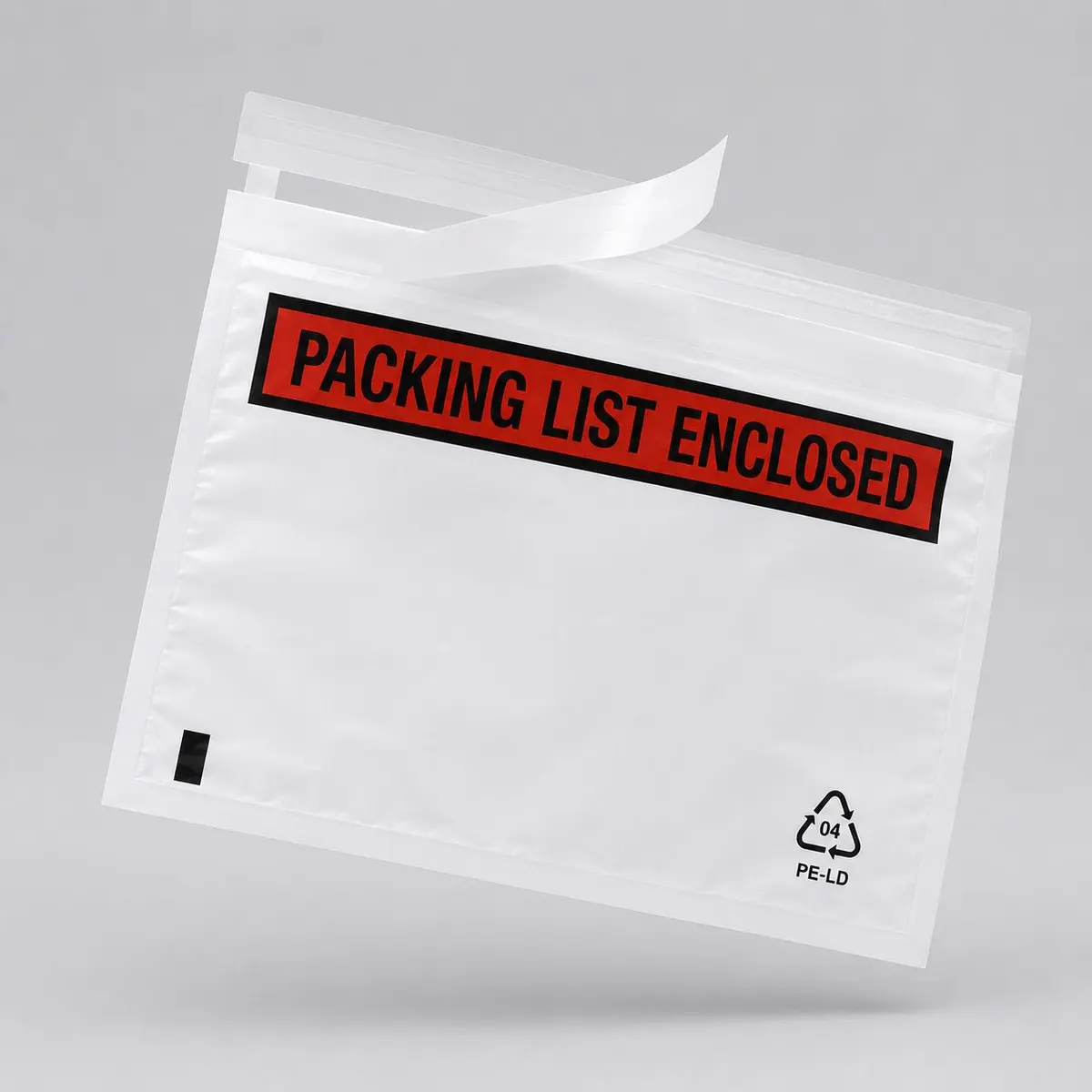
Packing List Envelope Tears Easily? Film Gauge Explained
If your packing list envelope tears before the parcel arrives, the usual cause is film gauge, i.e. the thickness of the pouch.
Get the gauge right and the pouch survives staples, box edges, stretch wrap and pallet stacking. Get it wrong and your paperwork ends up on the warehouse floor. We have made plastic packaging in Jaipur since 1997, and thickness is the one number I would ask any buyer to understand before they compare quotes.
This article explains how thickness is measured in micron, mil and gauge, why thin film tears, and when to step up for freight.
Why does my packing list envelope keep tearing?
Most of the time, the film is too thin for how the shipment is handled. Under-gauged film cannot absorb the normal knocks of a supply chain.
Thin film fails at predictable points:
- Staples and document corners punch through it from the inside.
- Box edges and corrugated flutes cause abrasion and split it.
- Stretch-wrap tension on a pallet pulls it until it tears.
- Stacking crushes an over-stuffed pouch until it bursts.
- Cold and rough handling make thin film brittle.
If you see edge splits, clean punctures or stretch-wrap tears, blame the film. The adhesive and the size are rarely at fault in these cases. The fix is almost always a heavier gauge or a tougher blend. For a wider view of the materials, see what packing list envelopes are made of.
What is film gauge: micron, mil and gauge explained
Film gauge is simply the thickness of the plastic. It can be written in micron, mil or gauge, and all three measure the same thing.
Once you know how they convert, you can compare quotes from any supplier in the world, including us.
| Unit | What it is | Conversion |
|---|---|---|
| Micron (µm) | One-thousandth of a millimetre | The global manufacturing standard |
| Mil | One-thousandth of an inch | 1 mil ≈ 25.4 micron |
| Gauge | One-hundred-thousandth of an inch | 1 mil = 100 gauge, 1 micron ≈ 4 gauge |
So a 2 mil film is roughly 50 micron or 200 gauge. It is the same physical thickness in three units. We work in microns, as most manufacturers and labs do, while many North American buyers think in mil.
Here is where buyers go wrong. They put a 50 micron quote from one supplier next to a “2 mil” quote from another, assume the two pouches are different, and then choose on price alone. Convert everything to one unit first.
Then compare.
How thick should a packing list envelope be?
Light parcels run well at around 2 mil (50 micron). Heavier and palletised freight is safer at 2.5 to 3 mil (60 to 80 micron).
A practical starting point by use:
- Light e-commerce and small parcels: about 2 mil, or 50 micron, is the cost-effective choice.
- General B2B and mixed warehouse handling: around 2 to 2.5 mil, or 50 to 60 micron.
- Pallets, freight and export routes: 2.5 to 3 mil, or 60 to 80 micron, for tear and puncture resistance.
- Heavy, sharp or industrial goods: heavier still, with a tougher co-extruded blend.
These are typical ranges, not fixed specs. We would quote the right gauge per order, against your goods and your routes.
I want to add one thing that many buyers miss. Film quality matters as much as raw thickness. A well-made co-extruded LDPE/LLDPE blend can outperform a thicker but lower-grade film, because the blend controls how a tear spreads. A good roti is like that. It is thin, but it does not tear, because the dough is right.
How do I balance durability against cost?
Match the gauge to where your pouches actually fail, not to the cheapest line on the quote. Too thick wastes plastic and money. Too thin loses documents.
| Factor | Thinner film (down-gauged) | Thicker film (stepped up) |
|---|---|---|
| Tear / puncture resistance | Lower | Higher |
| Material cost per pouch | Lower | Slightly higher |
| Weight / plastic per unit | Less | More |
| Best for | Light, dry, gentle handling | Freight, pallets, export, rough handling |
| Risk if mismatched | Tears, lost paperwork | Wasted spend |
The hidden cost of a torn pouch is rarely the pouch itself, and we think buyers should price it that way. A lost packing list or invoice can mean a customs hold, a re-sent document set, a late payment or a chargeback. Each of those costs far more than the few extra paise a heavier gauge adds.
I am also against using more plastic than the job needs. So my advice is to down-gauge only where handling is genuinely gentle, and step up only where the route is tough. You can see our pouch formats on the products page.
When should I step up the gauge for freight and pallets?
Step up whenever shipments are palletised, stacked, stretch-wrapped or sent long-haul, because each of these adds a stress that a light parcel never sees and that thin film was never designed to take.
We keep the checklist short.
Step up when your shipments involve any of these:
- Pallets and stacking, where load weight crushes thin pouches.
- Stretch wrap or strapping, where film tension drags on the pouch and tears it.
- Long road, sea or air journeys, where every transfer adds more abrasion.
- Cold chain or outdoor storage, where low temperatures make thin film brittle.
- Heavy or sharp goods such as furniture, machinery and tiles.
For palletised freight, a gauge around 2.5 to 3 mil (60 to 80 micron) with a high-tack adhesive gives the pouch its best chance of arriving intact and still stuck down. Our article on packing list envelopes for furniture and pallets covers these heavy-duty cases.
We are an ISO 9001 manufacturer exporting to 20+ countries, and we can adjust gauge, film blend and adhesive to the conditions your parcels really face.
Tell us how your pouches are failing and how your shipments travel, and we will suggest a film gauge and send samples to try.
Frequently asked questions
Why does my packing list envelope keep tearing?
Usually the film is too thin for the way the shipment is handled. Staples, box edges, stretch-wrap tension and pallet stacking all punch or split a low-gauge pouch. Stepping up the gauge, or moving to a tougher film blend, normally fixes it.
What thickness should a packing list envelope be?
For light parcels and e-commerce, around 2 mil (about 50 micron) works well. For heavier freight, pallets and export routes, 2.5 to 3 mil (about 60 to 80 micron) is safer. These are typical ranges, and the exact spec is quoted per order.
What is the difference between mil, micron and gauge?
They are three units for the same thickness. A mil is one-thousandth of an inch, about 25.4 micron. A micron is one-thousandth of a millimetre. Gauge is one-hundred-thousandth of an inch, so 1 mil equals 100 gauge.
Does a thicker film stop the pouch tearing?
Usually, yes. A heavier gauge resists punctures, edge splits and scuffing much better than thin film. But the blend matters too, and a well-made co-extruded film can beat a thicker, lower-grade one.
Is a thicker packing list envelope worth the extra cost?
If pouches are failing and documents are getting lost, yes. A re-shipped order, a customs hold or a chargeback costs far more than the few extra paise a heavier gauge adds. Match the gauge to where the pouch fails, not to the lowest price.
Can I make a thin pouch last longer without changing gauge?
Partly. Stick it on a flat panel away from box edges and staples, and do not over-stuff it. If the film is genuinely too thin for the load, though, only a thicker film or a tougher blend will fix it for good.
How do I choose the right film gauge for my shipments?
Look at how and where your pouches fail. Edge splits, punctures and stretch-wrap tears all point to under-gauged film. Match the gauge to your toughest route, then test samples before you commit to a full order.
Sourcing these in volume?
We make packing list envelopes in Jaipur for importers and distributors. Factory-direct, private label welcome.