
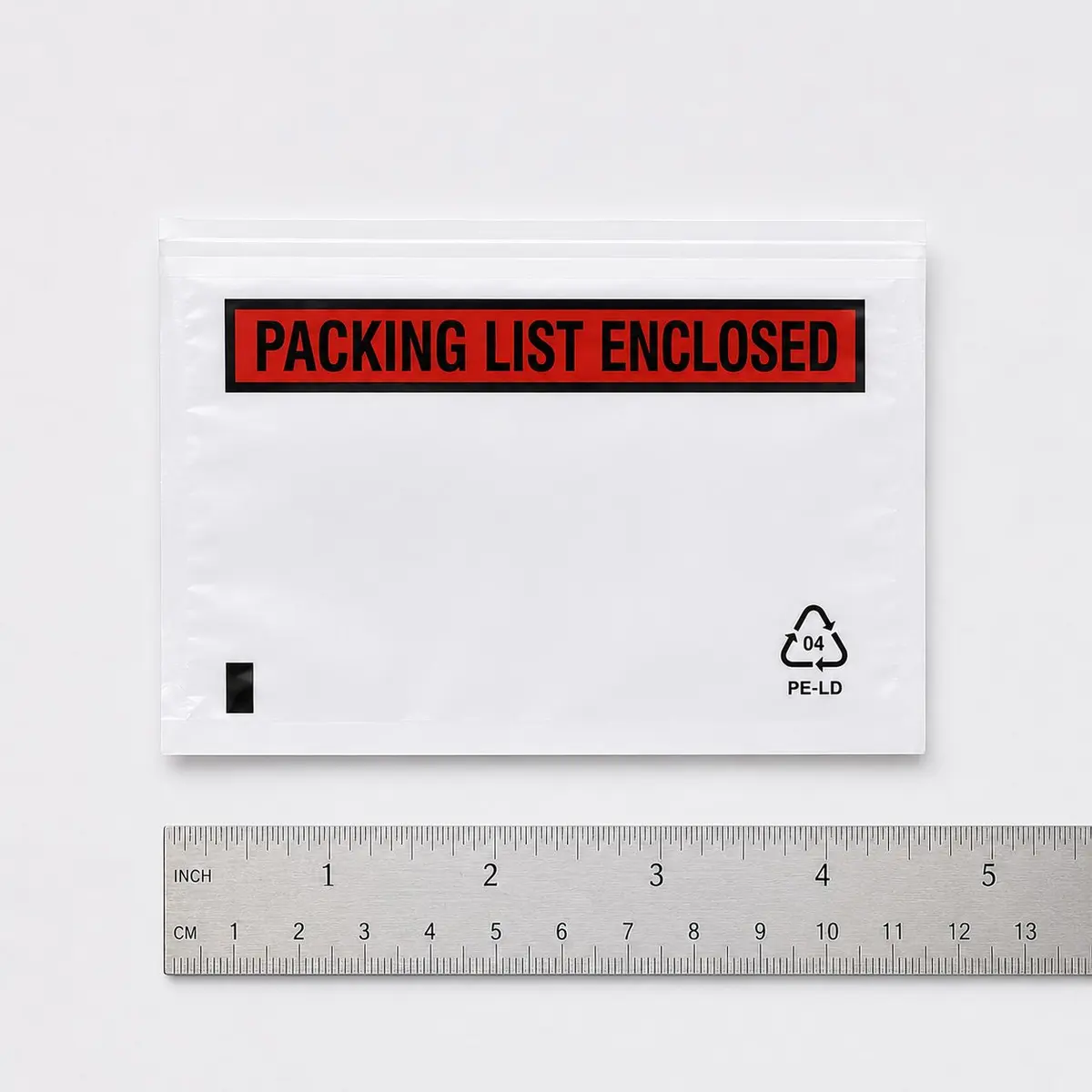
ESG Reporting and Packaging Choices: Where the Pouch Fits
ESG reporting now reaches all the way down to the document pouch stuck on the side of your carton.
A packing list envelope is a small item. But it is bought in huge numbers, it repeats on nearly every shipment, and it feeds straight into your packaging-weight, recycled-content and Scope 3 figures. This article explains where those choices land in a report, what data to ask your supplier for, and how to write claims that survive a hard look.
One honest note before we start. This is a practical overview for sourcing and operations teams, written by a packaging maker. It is not legal or accounting advice, so I would confirm the details for your markets and frameworks with a qualified adviser.
Where do document pouches fit in ESG and Scope 3 reporting?
The pouch is almost always a Scope 3 Category 1 line. That is Purchased Goods and Services, with smaller links to transport and end-of-life. Scope 3 covers the emissions in your supply chain, outside your own sites. For most businesses it is by far the biggest part of the total.
Here is how the pouch maps across:
- Category 1, Purchased Goods and Services, takes the cradle-to-gate emissions of the packaging you buy. This is the main home for a document pouch.
- The transport categories pick up the freight that brings the pouches to you and moves the goods they ride on.
- End-of-life treatment covers what happens to the pouch after the carton is opened, whether that is landfill or recycling.
Most ESG frameworks also track packaging directly. That means total packaging weight, recycled-content percentage and the recyclable or reusable share. A document pouch shows up in all three.
Why does such a small item matter?
It matters because it repeats. One pouch weighs almost nothing. But a busy warehouse buys the same item thousands of times a month.
This cuts both ways. A single sourcing decision, such as switching to recycled-content film or right-sizing the pouch to the document, multiplies across your whole shipping programme. It is like a leaking tap. One drop means nothing, but it fills a bucket overnight.
Auditors also like items they can count. So clean data here is cheap to get, and I think it earns you more trust than its size suggests.
What packaging choices move the numbers?
Recycled content, material choice and right-sizing move both your carbon and packaging numbers. Thinner film helps too, where the job allows it. The table below is how we would explain them to a buyer at our factory.
| Choice | Metric it moves | Reporting effect |
|---|---|---|
| Recycled-content (PCR) film | Recycled-content %, Category 1 carbon | Lower embodied carbon than virgin, higher recycled share |
| Mono-material or paper | Recyclable %, end-of-life | Better recyclability and a clearer disposal route |
| Right-sizing the pouch | Packaging weight, transport carbon | Less material per carton, lighter freight |
| Thinner film (where performance allows) | Packaging weight | Less material without changing the format |
Recycled content usually carries lower embodied carbon than virgin polymer, so it improves a Category 1 figure as well as the recycled-content metric. Right-sizing takes weight out of every shipment.
I will add one caution from the factory side. Going too thin to win a weight number is a false saving, because a pouch that tears or falls off costs you a lost document and a re-shipment. We cover two of these levers in more detail in recycled-content films and reducing plastic in the packaging mix.
What supplier data should buyers request?
Ask for a data pack for each SKU, with certificates and not adjectives. Rough estimates based on spend are the weakest input you can use. Real data from your supplier makes a Scope 3 number stronger. It also lowers your greenwashing risk.
For each pouch format you buy, request:
- Material composition, meaning the exact polymer or paper grade, and whether it is mono-material or a laminate.
- Unit weight in grams per pouch, so you can turn volumes into total packaging weight.
- Recycled-content percentage, backed by a chain-of-custody certificate such as GRS (Global Recycled Standard) or RCS (Recycled Claim Standard), and stating whether it is post-consumer (PCR) or post-industrial (PIR).
- The recyclability or end-of-life route, i.e. whether the pouch fits an established recycling stream.
- A product carbon footprint (PCF) per unit, where the supplier can support one.
- Confirmation that all of the above holds across lots, production sites and time.
Keep this on file. If a customer audits you, the supplier pack is your proof. If we supply you, I would expect you to ask us for the same. Our guide on how to evaluate a pouch supplier shows what a credible answer looks like.
How do I avoid greenwashing in packaging claims?
Only say what you can prove, match your wording exactly to the certificate, and never report selectively. Regulators are tightening the rules. The UK brought in an anti-greenwashing rule in 2024, and the EU directive on empowering consumers for the green transition restricts vague environmental claims. So loose wording can now get you into legal trouble. It can also hurt your name.
These are the traps I see most often:
- Vague labels like “eco-friendly”, “green” or “sustainable” with no percentage, certificate or scope.
- Over-claiming, for example implying 100% recycled when the certificate says 30%, or saying “recyclable” when no real route exists.
- Selective reporting, where only the flattering categories get disclosed.
- Mixing up input and end-of-life. Recycled content and recyclability are different things, so report each one accurately.
A rule of the trade here: the claim on the pouch should never be bigger than the claim on the certificate. “Contains 30% post-consumer recycled film, GRS-certified” beats any adjective. This is also why recycled-content claims need checking before you print them.
What should you do next?
Start with the data, then pull the levers. Get per-SKU composition, weight and recycled-content figures with certificates, and only then decide whether recycled content, paper or right-sizing moves your numbers most.
We have made packaging in Jaipur since 1997, under ISO 9001, CE and RoHS, and we export to 20+ countries. Ask us for the composition, weight and recyclability details of any pouch we quote you. The formats are on our products page.
Tell us your pouch formats, your volumes and the metrics you report against, and we will send you the specification details and samples to try.
Frequently asked questions
Which Scope 3 category does packaging fall under?
Mostly Scope 3 Category 1, Purchased Goods and Services. That category covers the cradle-to-gate emissions of everything you buy. Moving the packaging can touch the transport categories, and its disposal can fall under end-of-life treatment, but for a document pouch the material itself is the Category 1 line.
Why does a small item like a document pouch matter for ESG reporting?
Because it repeats on almost every carton. One pouch weighs very little, but a fulfilment operation buys the same item in very large numbers, so it becomes a real line in packaging-weight and recycled-content metrics. A switch to recycled content or a smaller format multiplies across the whole programme.
What supplier data should buyers request for ESG packaging reporting?
Ask for material composition, unit weight, recycled-content percentage with a chain-of-custody certificate, the end-of-life route, and any carbon footprint figure the supplier can support. Get it per SKU. Then check it holds across lots and production sites, so your team has evidence it can defend.
How do packaging choices reduce Scope 3 emissions?
Three ways, mainly. Recycled-content film usually carries lower embodied carbon than virgin polymer. Right-sizing removes material from every shipment, and lighter formats trim transport emissions too.
What counts as greenwashing in packaging claims?
Vague wording with nothing behind it is the classic case, for example 'eco-friendly' with no percentage, certificate or scope. Implying 100% recycled when the certificate says 30%, or reporting only the good numbers, also crosses the line. Regulators in the EU and UK are tightening rules against exactly this.
What is a product carbon footprint (PCF) and should I ask for one?
A PCF is the estimated greenhouse-gas emissions of one item, usually in CO2-equivalent per unit. Yes, ask for one, because supplier-specific figures make a Category 1 number more accurate than spend-based averages. Treat early figures as indicative unless they are independently verified.
Is recycled content or recyclability more important for ESG metrics?
Neither, because they measure different things and most frameworks want both. Recycled content is about what went into the pouch. Recyclability is about what happens after use. The strongest position is a mono-material pouch with verified recycled content that stays recyclable.
Sourcing these in volume?
We make packing list envelopes in Jaipur for importers and distributors. Factory-direct, private label welcome.