
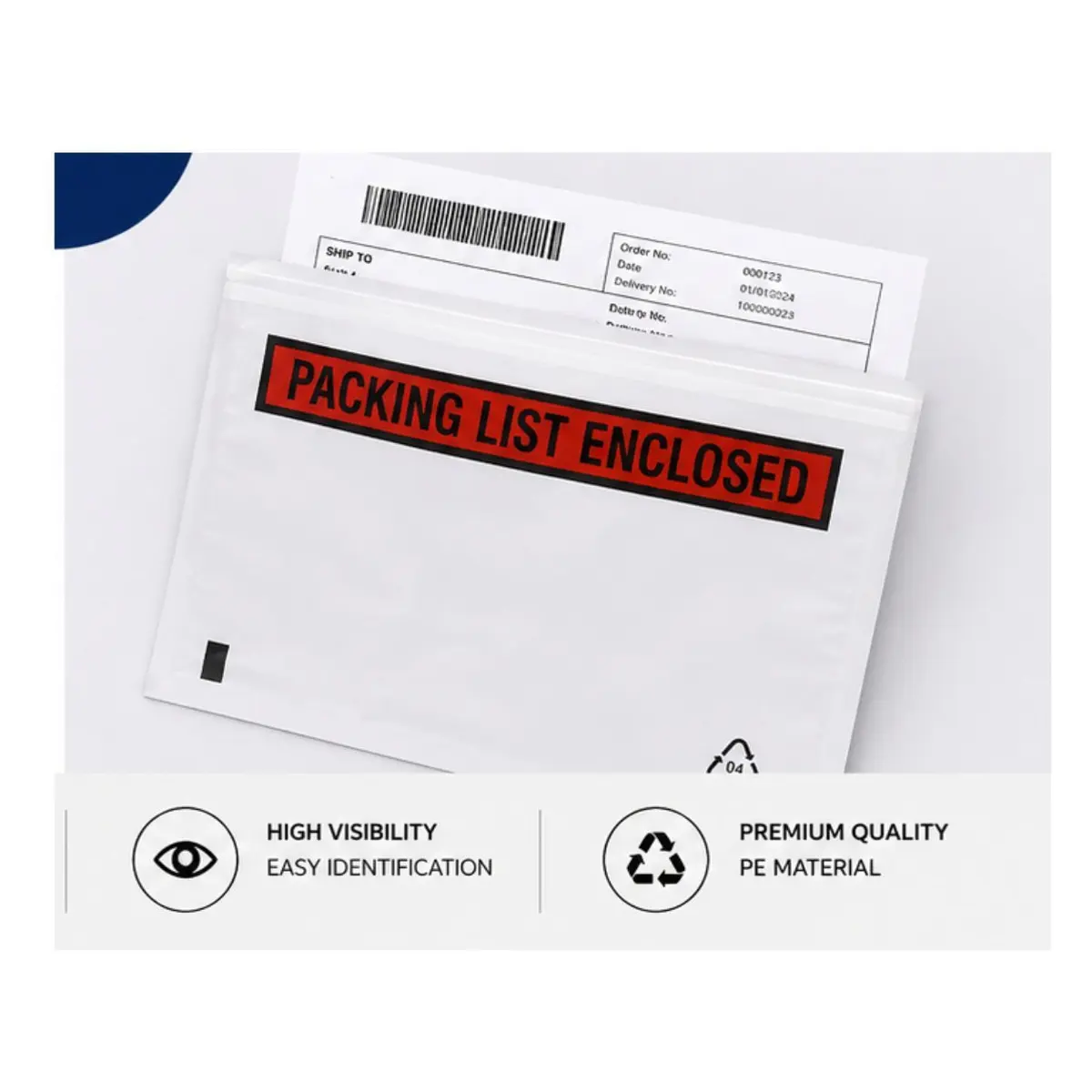
Reduce Packaging Waste and Spend with Right-Sized Pouches
Most operations cut packaging waste in the wrong place first. They look at the box, the filler and the tape. The document pouch gets ignored, because it is small.
I think that is a mistake. Every empty border on an oversize pouch is film you paid for, stored and shipped, and your customer then throws it away. Matching the pouch to the document removes that waste at the source, and it costs you nothing to try.
We make these pouches, so this advice means we sell you less film.
We are fine with that.
Here is how to right-size your packing list envelopes, why oversize is a hidden cost, and where recyclable single-material options fit in.
Why does an oversize document pouch cost more than it looks?
An oversize pouch charges you twice. You pay once for the extra film, and your customer pays again to get rid of it.
On one parcel you will not notice it. Across an order it adds up quickly. When every shipment gets the same large pouch, a single packing slip sits in the middle of a wide empty margin. It is like wearing a kurta two sizes too big. It still covers you, but you paid for cloth you did not need.
That margin does 4 kinds of damage:
- It adds material cost on every parcel you ship.
- It adds storage and freight, because the stock is bulkier to keep and move.
- It becomes your customer’s waste, which works against their sustainability targets and yours.
- It lets the document slide around, so the paper creases and becomes harder to read.
This is why I would start any packaging cost review with the pouch. It is low-risk and quick to change.
How do I match the pouch to the document?
Choose the smallest pouch that holds your folded document flat, with a small readable margin. Most operations only need 2 or 3 sizes for their real mix of documents. I would not go beyond 4.
Work from your actual paperwork, not from habit:
- List your document types, for example a one-page delivery note, a folded A4 invoice and a multi-page customs set.
- Fold once at most. If a document needs several folds to fit, couriers and customs may not be able to read it. If it floats in empty space, the pouch is too big.
- Keep the legend and barcode visible, with just enough margin for “Documents Enclosed” and any label to read cleanly.
| Document inside | Right-sized pouch | Avoid |
|---|---|---|
| Single delivery note or slip | 4.5 × 5.5 or DL | Defaulting to A4 |
| Standard sheet folded once | 6 × 9 | Oversize A4 with a wide border |
| Single A4 invoice (folded to A5) | A5 | Full A4 flat pouch |
| Multi-page A4 customs set (flat) | A4 or C4 | A pouch so small it forces folding |
The rule of the trade is simple. Size the pouch to the document, and the document to the parcel. Our guide to packing list envelope sizes explains each size band.
How much can right-sizing actually save?
Less film per pouch lowers the unit cost directly. A tighter parcel can also lower freight on dimensional-weight lanes.
The arithmetic is easy to see with paper sizes. An A4 sheet has exactly twice the area of an A5 sheet. So if a one-page invoice folded to A5 goes into an A4 pouch, about half of that film is doing nothing.
3 cost lines move when you right-size:
- Material, because a smaller pouch uses less film, and most of what you remove was empty border.
- Freight, because a flat pouch on a right-sized outer box helps where carriers bill on dimensional weight.
- Handling and storage, because there are fewer bulky cartons of stock to keep.
None of this is dramatic on a single shipment. The point is the multiplier. Across tens of thousands of parcels a year the saving is real, and protection does not suffer, because a snug pouch holds the paper better.
I will add one honest caution. Do not go so small that people start folding documents three or four times. You then save a little film and lose the whole point of a readable pouch. For more on what moves pouch prices, see what drives packing list envelope cost.
Do recyclable and single-material pouches reduce waste further?
Yes. Right-sizing cuts the amount of waste, and a single-material pouch makes that waste easier to recycle. Use both.
Once the size is right, look at what the pouch is made of.
- Single material is the key. A paper wallet goes into the cardboard stream with the carton, and a mono-material film stays in one plastic stream. Mixed paper-and-plastic laminates are the hardest to recycle, so I would avoid them.
- Match the material to the lane. Paper wallets suit dry, short domestic routes. Mono-material film suits wet, rough or export lanes where waterproofing matters.
- Make only claims you can back up. Name the actual recycling stream instead of writing a vague “eco-friendly”.
We have made packaging in Jaipur since 1997 and export to 20+ countries. I will happily tell you which material I would use for your lane, even if the answer is paper. Our guide to recyclable and biodegradable document pouches covers how to choose a material you can defend in each market.
Where should I start?
I would start by collecting 1 of each document you ship. Lay them out, fold each one once, and see which of your current pouches it really needs.
Most teams find they can drop from 1 large size to 2 or 3 smaller ones. Then order those sizes in a single-material stock, and we can help you pick them. You can browse the formats on our products page.
Want help right-sizing your pouches? Send us your document types and typical parcels, and we will suggest a lean, recyclable range and send samples to try.
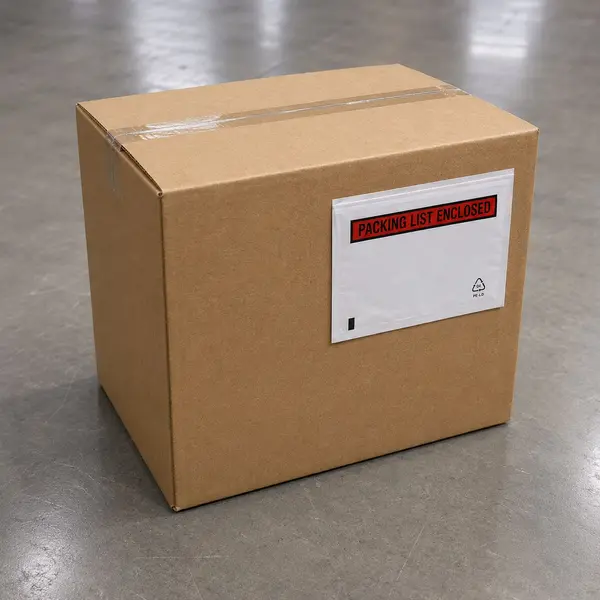
Frequently asked questions
How do I choose the right size document pouch?
Pick the smallest pouch that holds your folded document flat, with a small margin so the legend and barcode stay readable. A sheet folded once suits a 6 × 9, and an A4 sheet folded to A5 suits an A5 pouch. You want no heavy folding and no wide empty border.
Does right-sizing packaging really reduce costs?
Yes, it does. A smaller pouch uses less film and costs less per piece, and on dimensional-weight lanes a flatter parcel can help freight too. The saving on one parcel is small, but across thousands of parcels a year it adds up.
What is the most common packaging waste mistake?
Using one oversize pouch for everything. It feels simpler to buy, but most parcels then carry far more film than the document needs. Two or three sizes matched to your real documents remove that hidden waste.
Does a smaller pouch protect documents as well as a large one?
Yes, as long as the document fits flat with a small margin. Protection comes from the pouch sealing around the paper, not from extra size. An oversize pouch can even let the document slide and crease in transit.
How can I make my packing list envelopes more sustainable?
Right-size first, because less film per parcel is the simplest cut. Then choose a single-material pouch, either a paper wallet or a mono-material film, that has a real recycling route. Avoid mixed laminates of paper and plastic.
Should I use a paper or film pouch to reduce waste?
It depends on the lane. Paper wallets recycle with the carton and suit dry, short domestic routes. Mono-material film stays waterproof on wet or export lanes. Either one can be low-waste if it is single-material and sized correctly.
Can right-sizing lower my shipping cost too?
Sometimes. On lanes priced by dimensional weight, a flat, snug pouch avoids adding bulge to the parcel. The pouch is a small part of the parcel size, so the real gain comes when the outer box is right-sized as well.
Sourcing these in volume?
We make packing list envelopes in Jaipur for importers and distributors. Factory-direct, private label welcome.