
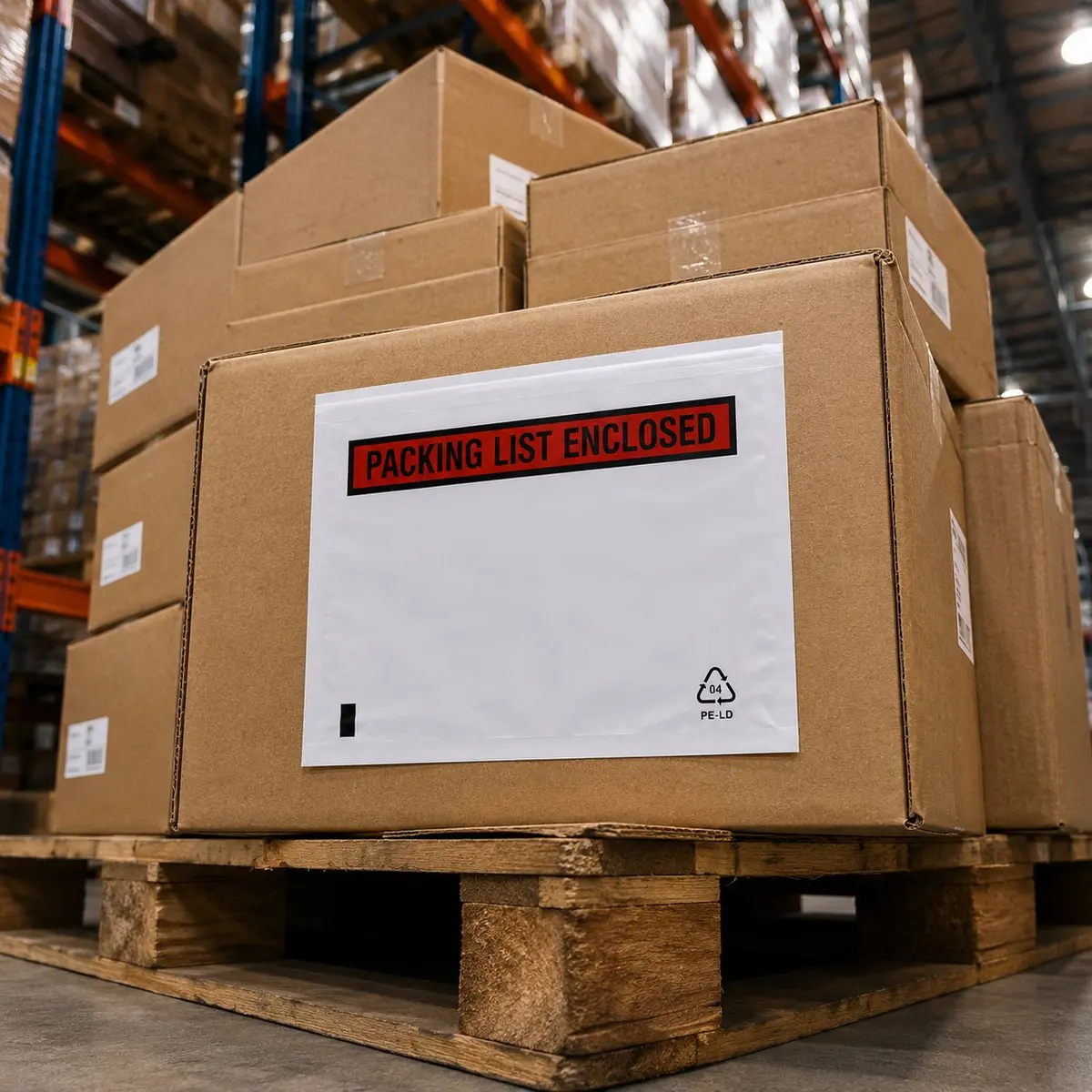
Sea Freight Documents: Protecting Container Paperwork
On a sea shipment, the papers on the outside of a carton matter as much as the cargo inside the container. A bill of lading that does not match the commercial invoice and packing list can hold a shipment at the port for days. So can paperwork ruined by condensation.
Both problems are avoidable, and I think the fix costs far less than 1 day of demurrage.
Ocean freight document pouches are clear, adhesive, water-resistant wallets that keep the papers attached and readable from the day a carton is stuffed to the day it is unpacked at destination. We have made these pouches in Jaipur since 1997 and export them to 20+ countries, many of them by sea. Below I cover what travels with the cargo, how LCL and FCL paperwork differs, and how to beat the humidity inside a container.
What documents travel with sea-freight cargo?
The working set on the cartons is the commercial invoice and the packing list, often with a certificate of origin. The bill of lading usually moves separately to the consignee. Together these let customs and the receiving warehouse check the shipment.
- The bill of lading (B/L) is the carrier’s receipt, the contract of carriage and the document of title. It names the shipper, consignee, goods and quantity.
- The commercial invoice gives the value, currency, Incoterms and parties, for customs valuation and duty.
- The packing list gives cartons, weights, dimensions and contents, so customs and the carrier can check the load.
- The certificate of origin says where the goods were made, for duty and preferential-origin claims.
There is one rule I would put above all the others.
The bill of lading must agree with the commercial invoice, the packing list and the booking. If they disagree, customs can hold, penalise or refuse the cargo. That is why a clear, readable pouch on the carton is worth the small cost.
How does LCL documentation differ from FCL?
FCL moves on one master bill of lading for the whole box, whether it is a 20 ft or a 40 ft container. LCL cargo shares a container and gets a house bill of lading per shipment under that master. LCL paperwork is more detailed because several consignees’ cartons travel together and are separated at destination.
| Aspect | FCL (full container load) | LCL (less than container load) |
|---|---|---|
| Container use | One shipper fills the box | Cargo shared with other shippers (groupage) |
| Bill of lading | Master B/L for the whole container | House B/L per shipment under one master B/L |
| Issued by | Carrier to the shipper | Forwarder/consolidator issues the house B/L |
| Document granularity | Single document set | More copies, one master can cover many house B/Ls |
| Handling at destination | Whole box to one consignee | Deconsolidation, cartons separated by consignee |
With LCL, every carton needs its own clearly visible pouch. When a shared container is opened at destination, staff sort the cartons by consignee using the papers on the outside.
A carton with a missing or soaked pouch cannot be matched quickly to its house bill of lading.
It waits. I would not want my cargo to be that carton.
How do I protect paperwork from humidity inside a container?
Seal the documents in a water-resistant pouch on the carton. Then back that up with desiccants, vapour-barrier liners and raised stacking inside the container. The pouch is the last line of defence when the carton itself gets damp.
Containers suffer from what the trade calls container rain. Warm, humid air inside the box cools at night and over the voyage, condenses on the ceiling and walls, and drips back onto the cargo. Anyone who has seen a Jaipur warehouse roof sweat in the monsoon will recognise it. Over a crossing of several weeks, it can soak corrugated board and turn loose paperwork into pulp.
Good practice uses several layers together.
- Desiccants, such as silica gel or calcium chloride, hung high or placed above the cargo. Never put them on the floor, because the condensation forms near the roof.
- Vapour-barrier liners, which seal cargo that is already dry away from outside humidity.
- Ventilation, through weather-protected vents that let the box breathe as temperatures swing.
- Raised stacking on pallets or dunnage, so cartons stay clear of any water pooling on the floor.
- A sealed document pouch, which keeps the invoice and packing list readable even when the carton is damp.
For more on how the film and seals handle water, see our guide on whether packing list envelopes are waterproof.
What film and adhesive survive a sea crossing?
You want a heavy, water- and oil-resistant polyethylene film with a high-tack adhesive. It has to bond to corrugated board, shrink wrap and crate surfaces and hold for weeks.
In my view, sea freight is the hardest test a document pouch faces.
Nothing else comes close. Salt air, condensation, humidity and rough handling at several ports all attack the film, the adhesive and the print. If a pouch clouds, peels or lifts at one corner, moisture wicks in and the paperwork is lost.
These are the 4 things I would check.
- Sealed edges, so water cannot reach the document from the sides.
- A high-tack adhesive suited to corrugated and stretch-wrapped surfaces.
- A full clear window, so the whole document set can be read without opening the pouch.
- Printed legends that do not fade or smear when wet.
Ask us for all 4. Then match them to your route. Our overview of packing list envelopes for exporters covers multilingual legends and copy counts for customs, and if you want your own legend printed, see custom print.
Do document pouches work for break-bulk and project cargo?
Yes. They matter even more there. Break-bulk and project cargo travel on deck or in open holds, without even the partial shelter of a container, so the paperwork takes the full force of spray and weather.
For crates, drums, machinery and oversized pieces, use a heavy water-resistant pouch with a strong adhesive. It needs to bond to wrapping, timber and steel and survive salt spray, sun and a long handling chain at the terminals. These units are often handled one by one, so a firmly attached, readable pouch is what keeps each piece matched to its paperwork through loading, lashing and discharge.
You can see our clear, printed and full-face options for container, LCL, FCL and break-bulk shipments on the product range page.
Shipping by sea? Tell us your routes, carton surfaces and document sizes, and we will send pouch samples to test before your next container.
Frequently asked questions
What documents are needed for sea freight shipping?
The core set is the commercial invoice, the packing list and the bill of lading. A certificate of origin, import permits or an insurance certificate are often added. The bill of lading must match the invoice and packing list exactly, or customs may hold the cargo.
What is the difference between LCL and FCL documentation?
An FCL shipment usually moves on one master bill of lading for the whole container. LCL cargo shares a container, so each shipment gets its own house bill of lading from the forwarder, under one master. That makes LCL paperwork more detailed, because several consignees' cartons travel together and are separated at destination.
What is the difference between a master bill of lading and a house bill of lading?
The master bill of lading is issued by the ocean carrier to the forwarder or consolidator for the whole container. The house bill of lading is issued by the forwarder to each shipper for their own cargo. One master can cover many house bills in a consolidated container.
What is container rain and how does it damage paperwork?
Container rain is condensation. Warm, humid air inside the box cools, water forms on the ceiling and walls, and it drips back onto the cargo during the voyage. It can soak cartons and turn loose paper into pulp, which is why documents need a sealed, water-resistant pouch.
Should the bill of lading travel inside the container with the cargo?
Usually not. The original negotiable bill of lading is normally couriered or sent electronically to the consignee. What travels on the cartons is a working copy of the invoice and packing list, plus any certificate of origin. Confirm the document flow with your forwarder.
How do you attach documents to cartons inside a container?
Put the invoice and packing list in a clear adhesive documents-enclosed pouch and stick it to the outside of the carton, clear of barcodes and the shipping label. It stays on through loading, stacking and deconsolidation, and staff can read it without opening the box. A spare copy inside the carton is a sensible backup.
Are document pouches suitable for break-bulk and project cargo?
Yes. They matter even more there. Break-bulk cargo sits on deck or in open holds, exposed to spray and weather. A heavy film pouch with high-tack adhesive bonds to crates, drums and machinery wrapping and survives salt air over weeks in transit.
Sourcing these in volume?
We make packing list envelopes in Jaipur for importers and distributors. Factory-direct, private label welcome.