
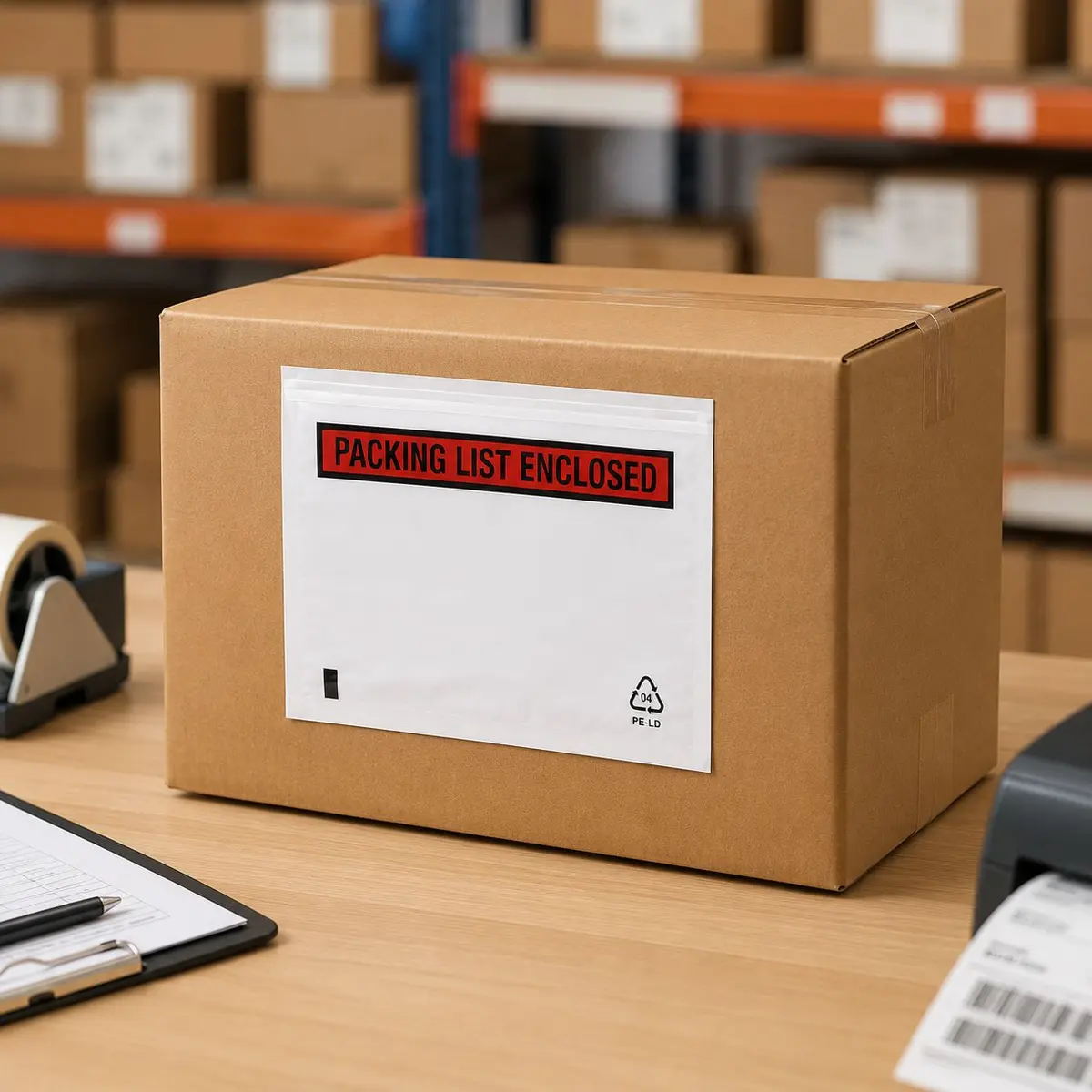
Speeding Up Packing-Station Throughput
A packing bench lives or dies on its slowest repeated motion.
Lose 2 seconds per carton across a shift of 2,000 parcels, and that is 4,000 seconds. You have spent more than an hour of labour you never needed to spend.
So speeding up packing station throughput is rarely about working faster. It is about removing reaches, decisions and fumbles from a cycle that repeats all day.
We run our own production lines in Jaipur, and have done since 1997, so I know how much a few seconds per cycle add up to over a year. Below I cover pouch placement, easy-peel liners, dispensers, pre-printed legends, ergonomics and the point where automation starts to pay.
How do you speed up the packing process?
Take motion and decisions out of every pack cycle, then measure what is left. The fastest benches keep consumables within reach, use pouches that peel cleanly first time, and stick to a standard range so the packer never stops to choose.
This is the order I would work in.
- Put consumables in the power zone. Pouches, tape, slips and labels go between mid-thigh and mid-chest, so nothing needs a bend or a stretch.
- Cut the peel step with easy-peel liners that release on the first try.
- Skip the labelling step with pre-printed legends, so no stamp or extra label is needed.
- Remove the choice. A small, standard range of pouch sizes means the operator grabs without deciding.
- Measure, fix the slowest task, and measure again.
Standardise the manual method first. Our walkthrough on how to apply a packing list envelope sets the baseline this guide is trying to speed up.
Where should pouches sit at the bench?
Pouches belong in the power zone, i.e. the area between mid-thigh and mid-chest where the hand moves without bending or over-reaching. Anything the operator touches on every carton goes there. Anything touched now and then goes below, behind or to the side.
This is simple ABC placement applied to consumables.
- A items are the pouch size and tape used on nearly every order, say your A5 pouch. They sit front and centre.
- B items are a second common size, perhaps A4 or DL, and the label stock. They sit to the sides or just below.
- C items are rare sizes and refills. They live behind or under the bench.
The idea behind it is the waterfall.
Replace up-and-down arm travel with a short downward motion.
A pouch presented edge-up at hand height takes one move. A pouch buried in a flat stack on the far side of the bench costs a reach, a search and a separation, every single time.
It is the same reason a good cook keeps salt next to the stove and not in the store room. Nobody decides to waste time. The layout decides for them.
What is a document pouch dispenser, and does it help?
Yes, it helps.
A document pouch dispenser is a desk- or wall-mounted holder that presents adhesive packing list envelopes one at a time, edge-up, so the operator grabs and peels in a single motion.
It is one of the cheapest gains available, because it removes the search-and-separate fumble on every carton.
Mount it next to the tape and label dispensers so all three consumables share one work zone. The packer then never leaves the bench or changes posture to fetch a pouch. If you use printed pouches, the dispenser also keeps them the right way up, so the legend always lands correctly.
Which pouch features remove steps from the cycle?
The pouch itself can take away two of the slowest manual steps, the peel and the label. The right liner and the right pre-print are small spec choices with a big effect on cycle time.
| Feature | Step it removes | Throughput effect |
|---|---|---|
| Easy-peel release liner | Picking at or tearing the backing | Pouch separates first time |
| High-tack adhesive | Re-pressing a pouch that did not stick | One press, bonds on first contact |
| Pre-printed “Documents Enclosed” | Stamping or extra labelling | Legend is already on the pouch |
| Pre-printed barcode or branding zone | Applying a separate label | One fewer consumable per carton |
| Standard, consistent sizing | Choosing a size, trimming slips | No decision, no fiddling |
| Flat, curl-free film | Flattening a curled pouch | Feeds and sticks straight |
Easy-peel and high-tack pay off twice. A clean, predictable peel makes hand application fast today, and the same property lets the same pouch run on an applicator if you automate later.
Here is the honest catch. High-tack costs more, and on clean, flat cartons a standard adhesive is usually enough. I would only pay for high-tack where pouches are actually failing to stick first time. We make both grades, so we have no reason to push the dearer one.
Pre-printed legends are covered in printed legends explained and on our custom print page. The faces and finishes we make are on our products page.
How does ergonomics affect packing-bench efficiency?
Ergonomics protects throughput by removing the fatigue that slows people down as a shift wears on. A bench set up for the worker keeps output steady from the first hour to the last.
These are the moves that give the most.
- Height-adjustable benches, so each operator, sitting or standing, keeps a neutral posture.
- Anti-fatigue matting on standing stations to reduce strain on joints and muscles.
- Mounted trays, clip-on bins and swing arms that bring consumables to the hand, not the hand to the consumables.
- Job rotation between pick, pack and receiving to spread the repetitive load and cut strain injuries.
- A clear left-to-right flow of infeed, pack, document, seal, label and outfeed, so cartons never travel backwards across the bench.
None of these makes one carton dramatically faster. The same logic holds on any production floor, ours included. Together they stop the slow loss of pace, and the injuries that take a packer off the line.
When should you automate instead of fixing the bench?
Automate when manual application is a real bottleneck and you pack thousands of cartons a day on a steady mix.
Not before.
Below that level, a well-set manual bench or a semi-automatic applicator pays back faster than full line integration. This is how I would frame the decision.
- Tens of cartons a day. Fix the bench with placement, a dispenser, easy-peel and pre-print. A machine would sit idle.
- Growing or mixed volume. Look at a semi-automatic applicator that helps with peel-and-place at modest cost.
- Thousands a day, steady. Consider full print-and-apply, where small savings per carton turn into large labour savings.
The economics turn on the labour you free up, the errors you avoid and the throughput you gain at the end of the pack-out line. The payback maths and the pouch specs an applicator needs are in automating pouch application and applicator lines.
This is my rule of the trade here. Buy the pouch spec your future line will need, even while you pack by hand. The same easy-peel, consistently sized pouch that speeds up your bench today is what feeds a machine tomorrow, so you never have to change spec when you scale.
We are an ISO 9001, CE and RoHS certified manufacturer with 30+ years in packaging, and we export to 20+ countries. We make packing list envelopes with easy-peel liners, high-tack adhesive and optional pre-printed legends in consistent sizes.
Want to take seconds off every carton? Tell us your cartons per day, your sizes and how you pack, and we will suggest a pouch spec and send samples to try at your bench.
Frequently asked questions
How can I speed up my packing station?
Take motion and decisions out of each pack cycle. Keep pouches, tape and slips within easy reach, use easy-peel liners, fit a document pouch dispenser and stick to a small range of sizes so the packer never has to choose. Then time the cycle and fix the slowest step.
What is a document pouch dispenser?
It is a desk- or wall-mounted holder that presents adhesive packing list envelopes one at a time, edge-up. The operator grabs and peels in one motion instead of searching a stack. Put it next to the tape and label dispensers so everything sits in one work zone.
How do I measure packing station throughput?
Count cartons or orders packed per operator-hour. Then time a typical pack cycle step by step: pick, fold, peel, stick, seal and label. The headline number tells you how you are doing, and the step breakdown tells you what to fix. Measure again after every change.
What is the ideal packing bench height?
There is no single number, because it depends on the operator and on whether they sit or stand. That is why height-adjustable benches make sense. The aim is to keep the work between mid-thigh and mid-chest so packers avoid bending and stretching all shift.
Do pre-printed pouches actually save time?
Yes. A pouch pre-printed with ‘Documents Enclosed’, a barcode zone or your branding removes a stamping or labelling step from every carton. Over thousands of parcels, those saved seconds add up to real labour hours, and the legend looks the same every time.
When should I automate packing list envelope application?
When manual application has become a real bottleneck and you pack thousands of cartons a day on a steady mix. Below that, a semi-automatic applicator or a better manual bench pays back faster. Our guide to automating pouch application covers the payback maths.
How do easy-peel liners speed up packing?
An easy-peel liner lets the pouch come off its backing cleanly on the first try, so the operator does not pick at an edge or tear the liner. Steady, predictable peel is what makes hand application fast, and it is also what lets the same pouch run on an applicator later.
Sourcing these in volume?
We make packing list envelopes in Jaipur for importers and distributors. Factory-direct, private label welcome.