
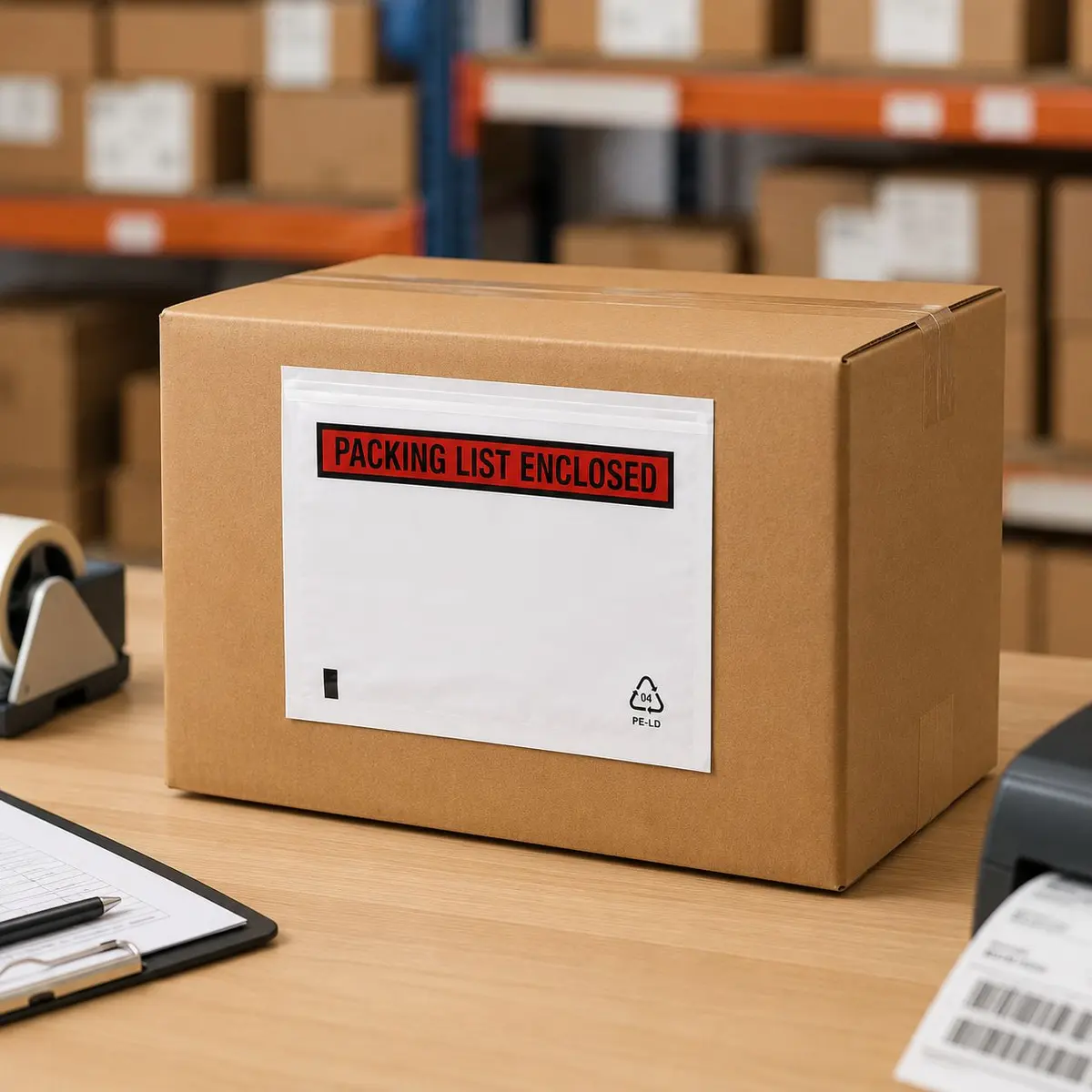
Standardising Document Pouches Across Multiple Warehouses
Running several warehouses means every site ships paperwork on the outside of its cartons. If each one buys its own packing list envelopes, you end up with mismatched sizes, different print, scattered orders and errors nobody can trace.
The fix is to standardise on one specification and one supplier across the network.
We have made packaging in Jaipur since 1997 and export to 20+ countries. In my view, pouches are one of the easiest consumables to standardise, because the choices are few and the savings are real. Here is how I would do it: a short SKU list, central buying, one house pouch, and a calm rollout.
Why standardise document pouches across multiple warehouses?
Standardising means every site holds the same short list of pouches, built to one written spec and bought from one supplier. That single decision removes most of the friction in multi-site supply.
When each warehouse buys locally from office-supply shops or regional distributors, 3 problems pile up.
- Batches vary. Sizes, film thickness and adhesive tack drift between sites and between orders.
- Buying power is lost. You place many small orders instead of one pooled volume.
- Output looks different. Cartons leave different sites with different pouches and legends.
A consistent set of packing list envelopes fixes all 3 at once. Stock gets simpler and forecasting gets easier. Any site can cover another site’s overflow with the same stock. The customer also gets the same carton whichever warehouse shipped it.
What is the right SKU list for a multi-site network?
Aim for 2 or 3 sizes that cover most of your cartons, plus one branded variant if you want it. Avoid a long tail of local specials.
| Pouch role | Typical size | Use case | |
|---|---|---|---|
| Single-page slip | DL / A6 | Standard orders, e-commerce | Neutral “documents enclosed” |
| Multi-page slip | A5 | Multi-line B2B orders, returns forms | Neutral or barcode zone |
| Document set | A4 | Customs packs, multi-language, invoice sets | Neutral or branded |
| Branded house pouch | A6 / A5 | Network-wide branded carton | Logo + message |
My aim would be simple. Any warehouse should be able to fulfil any order from the same handful of SKUs.
Keeping size codes the same (A4, DL, A5, 4.5 × 5.5, 6 × 9) at every site is what makes central buying and shared stock possible. You can see the formats on our products page.
Should buying be central or left to each site?
For a consumable like document pouches, a centre-led model almost always wins. Head office sets the spec and the supplier and pools the spend. Each site keeps the right to call off stock when it needs it.
Here are the 3 options in plain terms.
- Central buying gives the most volume, consistent quality and one supplier relationship. It needs coordinated forecasting.
- Site-by-site buying is fast and local. It loses bulk pricing and brings variation back.
- A centre-led hybrid means one negotiated spec and contract with local call-off. This is usually the best balance.
Pooling the spend across all DCs turns dozens of small orders into one negotiated volume, and that is where better pricing comes from. It also gives you one view of what every site uses and spends.
The honest downside is that central buying is slower to react. If one site suddenly needs a special size for a new customer, it has to go through head office. I would keep a small, approved exception list for that.
How does standardising pouches reduce errors?
When every site uses the same pouch with the same printed legend, staff handle one familiar item. Nobody has to choose between local variants. The clear window also lets pickers check that the slip matches the carton before sealing.
This removes several kinds of error at once.
- Wrong pouch or size, because there is only one correct pouch per document type.
- Mismatched slips, because the same window check runs at every site.
- Scan failures, because print and barcode zones sit in the same place on every pouch.
- Lost paperwork, because the same adhesive holds through sortation and line-haul everywhere.
For more on the workflow side, see how to reduce shipping errors with document pouches.
Can we private-label one pouch across all sites?
Yes. One private-label design on the shared house pouch gives every warehouse the same branded carton, without breaking the standard spec.
A network house pouch usually carries your logo and colours, a “documents enclosed” or returns message, barcode or order-ID zones placed for your scanners, and language variants for cross-border sites on the same base spec.
It is one design, on one pouch, built to one spec. You keep the cost and stock benefits of standardising, and every carton looks like yours. We handle this through custom print, and our guide on how to buy packing list envelopes in bulk covers the ordering side.
How do we roll out a standard pouch across existing sites?
Set the spec and SKU list centrally, test a sample batch at each site, and then phase the old stock out as it runs down. Treat it as a small change project, not a flick of a switch.
This is the order I would follow.
- Audit what each site buys today: sizes, prints, volumes and suppliers.
- Write one spec covering size codes, film and ply, adhesive, print, barcode zones and packing format.
- Test a sample batch against each site’s process or applicator line.
- Move to one supplier and one purchase agreement.
- Switch site by site as the old stock runs down, with one supplier contact for questions.
I think step 2 matters most. A clear written spec is what lets every site reorder the same pouch, and it lets the manufacturer hold the same quality from batch to batch.
Why buy a standard pouch direct from a manufacturer?
Buying direct gives you one consistent spec across every warehouse, a lower landed cost at volume, and all sizes and print versions on one order. You also avoid the drift that comes with buying from local shops.
We are an ISO 9001, CE and RoHS certified manufacturer with 30+ years in packaging, and we supply standard packing list envelopes, neutral or private-labelled, held to one spec. One manufacturer also means one contact for forecasting and consolidated shipments. At scale, that consistency matters more than the unit price on any one pack.
Rolling out one pouch standard across your warehouses? Send us your sites, sizes and yearly volumes, and we will quote central supply to one spec and send samples for each site to test.
Frequently asked questions
Why standardise document pouches across multiple warehouses?
One spec and a short SKU list remove variation between batches and sites. Buying gets simpler, any site can fulfil any order with the same pouch, and volume brings the unit cost down. Stock and forecasting also get much easier.
How many pouch sizes should a multi-site operation stock?
Two or three sizes cover most networks. Typically that is a DL or A6 pouch for single-page slips and an A5 or A4 pouch for multi-page or customs sets. Keep the list short and identical at every site.
Should packaging procurement be centralised or left to each site?
For a consumable like document pouches, I would go centre-led. Head office sets one spec and one supplier and pools the spend, while each site still calls off stock locally. Fully local buying loses the volume and brings the inconsistency back.
How does standardising pouches reduce shipping errors?
Staff handle one familiar pouch instead of guessing between local variants. The clear window lets pickers check that the slip matches the carton before sealing. Consistent print and barcode zones also scan the same way at every site.
Can we private-label a standard pouch across all sites?
Yes. One private-label design, with your logo, a 'documents enclosed' message, return instructions or barcode zones, can go on the shared house pouch. Language variants for cross-border sites can sit on the same base spec.
How do we roll out a new pouch standard across existing sites?
Agree the spec and SKU list centrally, then test a sample batch at each site, including on any applicator line. After that, phase the old stock out as it runs down so nothing is wasted. One named supplier contact makes the change much smoother.
What should the written pouch specification include?
It should list size codes, film type and ply, adhesive tack, print and legend, barcode zones and any applicator needs. Add the packing format too: loose, fan-folded or on rolls. With that document, every site reorders the exact same pouch.
Sourcing these in volume?
We make packing list envelopes in Jaipur for importers and distributors. Factory-direct, private label welcome.