
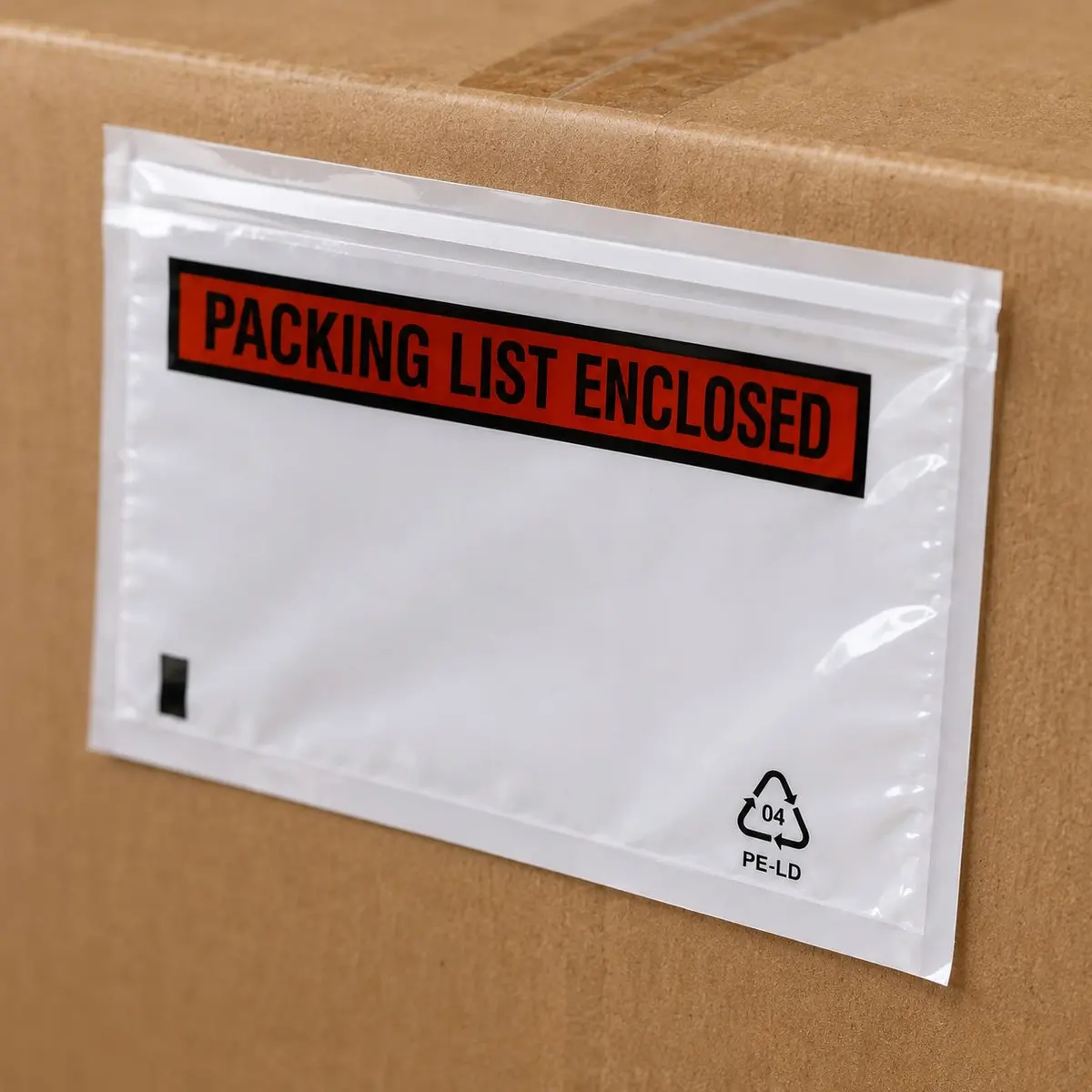
Packing List Envelope Adhesion in Cold Storage and Freezers
A packing list envelope that falls off in cold storage is usually not a bad pouch. It is a good pouch stuck down at the wrong moment.
We have made packaging in Jaipur since 1997 and ship these pouches to 20+ countries, some of them into chillers and freezer rooms. I see the same 2 problems every time.
The adhesive gets stiff and stops grabbing, and a cold carton collects condensation or frost that the adhesive cannot bond through. The fix is mostly about timing: apply the pouch warm and dry, then chill the parcel. For the harder cases, a cold-temperature adhesive covers the rest.
Why does standard adhesive fail in the cold?
It fails because the glue hardens and because moisture gets in the way. Either one is enough to make a pouch peel. Together, they make a standard pouch close to useless on a frozen box.
- The adhesive stiffens. A pressure-sensitive adhesive works by staying soft enough to flow into the surface when you press it. As it cools, it loses that softness, a bit like butter straight out of the fridge. Standard permanent grades become unreliable below roughly 5°C.
- Condensation and frost block the contact. When a cold carton meets warmer, humid air, a thin film of water forms on it. Below freezing, that film turns to frost. The pouch then sticks to water or ice, not to the box, and lets go as soon as that layer shifts.
So a document pouch that won’t stick in the cold is almost always the wrong adhesive for the temperature, put down on a wet or frozen surface. If you want the science behind it, read how a packing list envelope’s adhesive works.
How should I apply a packing list envelope before chilling?
Apply it warm and dry, before the parcel ever enters the cold.
This costs nothing. You are only changing when and where the pouch goes on. Here is the order I would follow on a packing line.
- Apply in your normal packing area, not inside the chiller. Room temperature keeps the adhesive soft enough to wet out.
- Stick it onto a clean, dry, frost-free carton. Wipe off dust, oil and moisture first.
- Press firmly across the whole adhesive pad, because pressure is what switches the bond on.
- Give it some time before chilling. Most adhesives keep building strength after application, and cold slows that down.
- Then move the parcel into the chiller or freezer.
A bond made warm will hold far colder than the temperature at which you could ever apply it.
That is the rule of the cold chain. Food and pharma packers have worked this way for years. For placement and pressure in more detail, see how to apply a packing list envelope.
Which adhesive options work in cold storage and freezers?
When applying warm is not possible, I would move to a cold-temperature or freezer-grade adhesive. This happens more than people expect, for example when pouches must go onto goods that are already cold, or when the parcel will be handled roughly while frozen.
- Standard permanent adhesive is fine for ambient and chilled parcels, as long as it is applied warm. Applied cold, it is a gamble.
- High-tack grabs harder on cold and rough surfaces and gives you extra margin. The trade-offs are in high-tack vs standard adhesive.
- Cold-temperature or freezer-grade adhesive stays flexible at low temperatures. This is the right tool for true cold-chain work.
- Cryogenic grades are for the deepest cold, such as biotech and pharma storage well below an ordinary freezer.
The pouch material matters as much as the glue. We make these pouches in polyethylene, and PE does not absorb condensation, so it stays intact and the paperwork stays readable. A paper-faced pouch can soften. If you ship chilled food, our note on food and beverage cold chains goes further.
I will be honest about one thing, even though we sell both grades. A freezer-grade adhesive costs more than a standard one, and if you can apply warm, you may not need it at all.
I would try the warm-and-dry method first.
Cold-storage adhesion: problem, cause and fix
Most cold-storage complaints come from how and where the pouch was applied. If you send us a pouch that has lifted, we would run through the same checks. This table maps what you see to the likely cause.
| Symptom | Likely cause | Fix |
|---|---|---|
| Pouch peels in the freezer | Standard adhesive stiff below ~5°C | Apply warm, or use a cold-grade adhesive |
| Won’t stick to a cold carton | Adhesive too rigid to wet out | Apply at room temperature before chilling |
| Lifts off a frosty box | Frost or ice blocks the bond | Dry, frost-free surface, apply before freezing |
| Sticks, then falls off later | Condensation crept under the bond | Dry surface, give it time before the cold |
| Pouch face softens | Paper face absorbing moisture | Switch to a plastic (PE) pouch |
| Item is already frozen | Moisture forms again on contact | Wipe fully dry, use a cold-temperature adhesive |
What if the product is already frozen?
Avoid it if you can, and apply the pouch before freezing instead. If you have no choice, wipe the surface completely dry and frost-free first. If it fogs up while you are working, you are sticking onto moisture again.
That is the catch.
This is where a dedicated cold-temperature adhesive earns its price. Paired with a dry surface, it gives you the best chance on a box that is already cold.
Which two habits fix most cold-storage failures?
Apply warm and dry, and match the adhesive to the temperature, not to habit. These two solve most cold temp packing slip pouch problems before you change any product.
Frost, condensation, dust or oil will defeat even a freezer-grade adhesive.
And a parcel going to an ordinary chiller, applied warm, is usually fine on a standard grade. Keep the special grade for real freezer and cold-chain work, where a lost document or a customs hold costs far more than the adhesive does.
We make pouches from A7 up to A4 with both grades of adhesive, and the formats are on our products page.
Shipping into chillers, freezers or cold-chain export? Send us your storage temperatures and carton types, and we will suggest the right adhesive and pouch material and send samples to try.
Frequently asked questions
Why won't my packing list envelope stick in the freezer?
Two things work against it. Standard adhesive goes stiff as it cools and loses its grab below roughly 5°C. On top of that, frost or condensation on a cold carton puts a thin layer of water or ice between the pouch and the box. Apply at room temperature, and switch to a cold-grade adhesive where you have to.
Can I apply a packing list envelope at room temperature before freezing?
Yes, and it is the most effective fix there is. Stick the pouch onto a clean, dry carton in your normal packing area, press it down hard, and give it some time before the parcel goes into the cold. The bond forms while the adhesive is soft, then holds as everything cools.
At what temperature does standard pouch adhesive stop working?
Roughly 5°C, but that is the application limit, not the service limit. A standard permanent adhesive becomes unreliable if you try to stick it down below that. A pouch applied warm will keep holding at far lower temperatures.
Is there a freezer-grade adhesive for document pouches?
There is. Cold-temperature and freezer grades are made to stay soft and tacky where a standard grade turns hard, so they can go on in cool conditions and hold through frozen storage. Cryogenic grades go colder still for pharma and biotech work. Tell us your temperatures and we will suggest the right one.
Why does condensation stop a document pouch from sticking?
Because the adhesive ends up touching water instead of the box. When a cold carton meets warm, humid air, moisture forms on its surface, and below freezing that moisture becomes frost. The pouch grabs that layer, and it peels once the water moves or refreezes.
Will a high-tack adhesive solve cold-storage problems?
Partly. High-tack grabs harder on cold and rough surfaces, so it gives you more margin than a standard grade. It still cannot bond through frost or condensation, so a dry surface comes first and the adhesive choice comes second.
Are paper or plastic document pouches better in cold and damp conditions?
Plastic, clearly. A polyethylene pouch does not soak up condensation, so the film stays intact and the document stays dry and readable. A paper-faced pouch can soften in a chiller, which is a risk you do not need.
Sourcing these in volume?
We make packing list envelopes in Jaipur for importers and distributors. Factory-direct, private label welcome.